
A lot of people have been asking this same question “what do Snails eat?”. Like every other animal snails also need food for growth. In this post we will be talking extensively about what type of food snails eat.
Contact us to get 3 days free trial consultation on snail farming.
The distinction between extensive, semi-intensive and intensive snail farming systems not only applies to housing, but also to feeding. In an extensive system, snails feed only on vegetation planted in their pens specifically for that purpose, as in mini-paddock and free-range pens.
Get our snail farming rearing guide on discount today
In a semi-intensive snail farm, external feed is provided to hatchlings, juveniles and possibly to breeding snails housed in hutch boxes or trench pens. In an intensively managed snail farm, all snails, at whatever growing stage, are always provided with external feed. Snails are kept in hutch boxes or trench pens. In very intensive farms the snails are fed a formulated snail feed mix containing all the proteins, carbohydrates, minerals and vitamins required for optimal growth. Snails are housed in boxes or trench pens.
What snails eat.
Snails are vegetarians and will accept many types of food. All snails will avoid plants that have hairy leaves or produce toxic chemicals. Young snails prefer tender leaves and shoots; they consume about twice as much feed as mature snails. As they get older, mature snails increasingly feed on detritus: fallen leaves, rotten fruit and humus. Older snails should be fed the same items as immature snails. If a change in the diet has to be made, the new food items should be introduced gradually.

What snails need.
Snails need carbohydrates for energy, and protein for growth. In addition, they require calcium (Ca) for their shells, as well as other minerals and vitamins. Snail meat is low in crude fibre and fat; for that reason, these components are of minor importance in snail feed.
Leaves: cocoyam, kola, paw paw, cassava, okra, eggplant, cabbage and lettuce. Pawpaw leaves (as well as its fruit and fruit peels) stand out in many trials as good snail food.

Fruits: pawpaw, mango, banana, eggplant, pear, oil palm, water melon, tomato and cucumber. Fruits are usually rich in minerals and vitamins, but low in protein.

Tubers: cocoyam, cassava, yam, sweet potato and plantain. Tubers are a good source of carbohydrates, though low in protein (Cassava should be the low-cyanide type).

Household waste: peels of fruit and tuber, like banana, plantain, pineapple, yam and especially pawpaw, and leftovers like cooked rice, beans, fufu and eko.
Caution: Snail food must not contain salt!
Market waste: Because snails are vegetarians, the cheapest way to feed them is by collecting rejected but recommended food from marketplaces. At the end of any market day, some perishable vegetables and fruits still useful for snail consumption can be collected from the dumping areas. This would reduce the cost and labour of buying or cultivating vegetables and fruits only to feed snails.
Recommendations on formulated feed.
As land pressures force people to move from extensive farming, in which natural foods are abundant, to semi-intensive farming, it may become necessary to introduce formulated feeds. You can mix a snail feed formula yourself, using the following ingredients and ratios as a guide, you can make changes if you want to work on the nutritional requirements of the snail.
Read also: How to determine Metabolizable energy and Percentage Crude Protein in livestock feed.
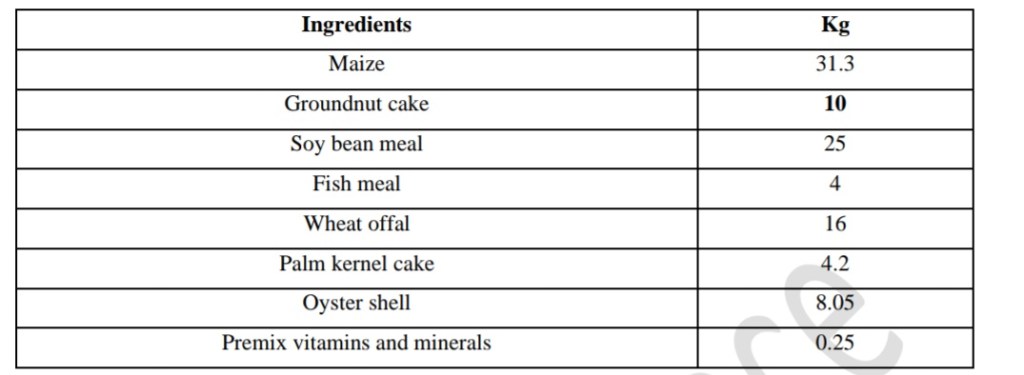
Remember, No Salt!
This sort of feed, formulated to meet the snail’s specific nutritional requirements, has the effect of considerably reducing the growth period.
Don’t forget to like share and comment if you found this helpful.
Are you interested in making 5-7% commission selling Kiki’s Agroplace manuals? If yes, click here.
 Kiki's Agroplace
Leave a comment