If your agritech marketing is not working, the problem is usually simple: you are talking about features instead of user pain.
Farmers and agribusiness owners do not wake up looking for software, platforms, or tools. They wake up thinking about problems that cost them money, time, or yield.
When your content speaks directly to those problems, traction starts to appear.
This is why mapping your user’s pain points is one of the most important steps in digital marketing for agritech founders.
What User Pain Actually Means
A pain point is a problem your user actively wants solved.
Not an inconvenience.
Not a theoretical improvement.
A real pain point has three signs:
- It costs money
- It wastes time
- It creates risk
Examples include:
- Crops lost to disease
- High feed costs
- Poor market prices
- Labour shortages
- Post-harvest losses
These are problems people pay to remove.
If your solution does not connect directly to one of these pains, your marketing will struggle.
Read also: How to use webinars to grow your Agritech startup
Why Most Agritech Startups Miss The Real Problems
Many founders build products before deeply understanding the buyer.
They assume problems based on:
- Industry reports
- Investor expectations
- Technology possibilities
But real agricultural pain usually shows up in daily work.
Farmers talk about:
- Late fertilizer delivery
- Feed prices rising every month
- Fish mortality in ponds
- Crops spoiling before buyers arriv
These problems rarely appear in pitch decks, but they dominate real farm conversations.
Good marketing begins where those conversations happen.
The 5-Pain Mapping Framework
You only need one simple framework.
List five problems your ideal customer would gladly pay to solve today.
Focus on problems connected to money, risk, or productivity.
Pain Type and Examples
- Revenue loss
Crops spoil before reaching market - Cost pressure
Poultry feed prices rising - Labour issues
Difficulty finding reliable workers - Operational inefficiency
Poor planting schedules reduce yield - Market uncertainty
Farmers cannot find buyers easily
When your product solves one or more of these clearly, your messaging becomes easier.
How to Identify Pains Your Target Users Actually Pay to Remove
You do not need complex research.
Start with direct conversations.
Ask questions like:
- What is the most frustrating part of your farm operation?
- What problem costs you the most money each season?
- What have you already tried to fix it?
Look for patterns.
If several people mention the same issue, you have found a real pain.
Also pay attention to what farmers already spend money on. Spending reveals priority.
For example:
- Paying extra for reliable seedlings
- Hiring consultants to reduce fish mortality
- Buying feed in bulk to control costs
These signals show where real demand exists.
Example: Buyer Pain Mapping
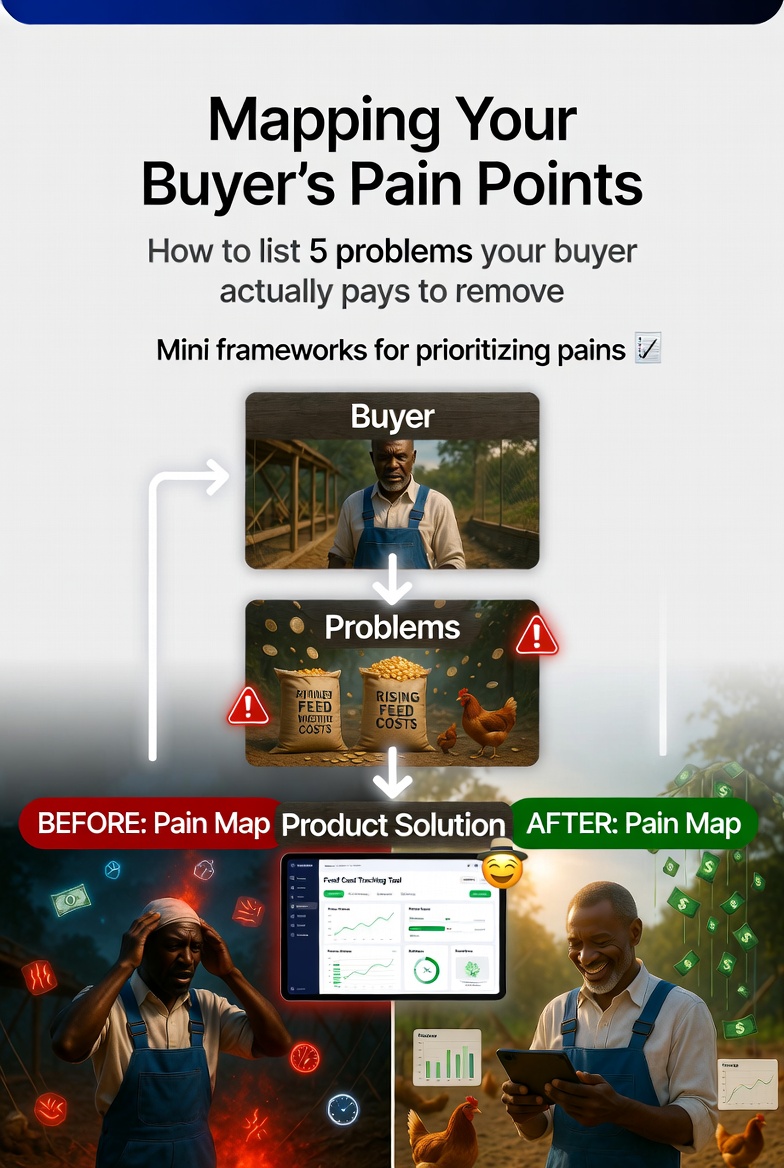
Let’s say your agritech product helps poultry farmers track feed costs.
Your ICP (check previous post) might be:
Medium-scale poultry farmers managing 2,000–10,000 birds in Nigeria.
Their possible pain points could include:
- Feed costs rising every production cycle
- Difficulty tracking feed usage per batch
- Poor records leading to profit uncertainty
- High mortality due to poor monitoring
- Unclear selling price because real costs are unknown
Now your marketing becomes simple.
Instead of saying:
“AI-powered farm management platform”
You say:
“Know exactly how much each bird costs you to raise.”
One message speaks to real pain. The other sounds technical.
Take 20 minutes and complete this exercise.
- Write down your ideal buyer.
- List five problems they pay to remove.
- Circle the one pain your product solves best.
Then check your marketing.
Does it talk about that pain clearly?
If not, replan it.
When you map user pain correctly:
- Your content starts attracting the right audience
- Conversations with potential users become easier
- Messaging becomes clearer and simpler
- Your product roadmap becomes more focused
Most importantly, users start saying:
“That is exactly the problem I have.”
That sentence is the beginning of traction.
Recap
- Agritech marketing works best when it starts with user pain.
- Pain points must connect to money, risk, or productivity.
- Talk to real farmers and agribusiness operators to identify patterns.
- Focus on the one problem your product solves best.
- Clear pain-focused messaging improves traction.
Don’t forget to like, share and comment.
 Kiki's Agroplace
Leave a comment