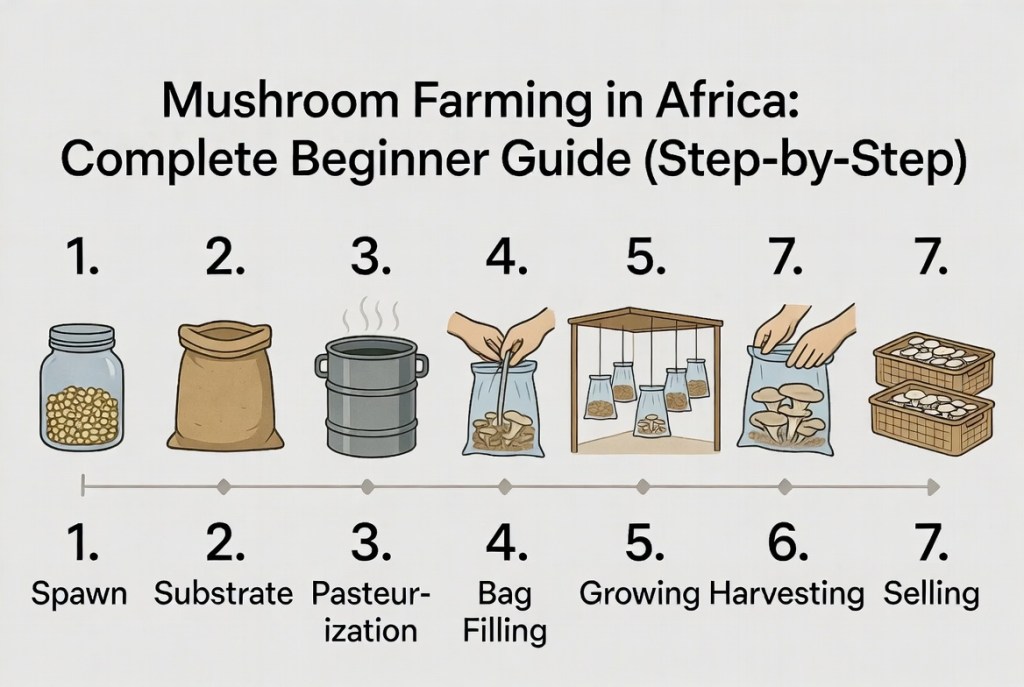
If you have been searching for how to start mushroom farming for beginners in Africa, you are in the right place. This guide explains everything from scratch, what mushroom farming is, what you need, how to grow mushrooms step by step, how to sell them, and how much money you can make.
It does not matter if you are a student, a small-scale farmer in Nigeria, Kenya, Ghana, Zimbabwe, or South Africa, or someone outside Africa who wants to understand how mushroom farming works on the continent. This guide is written for you.
No farming experience needed. No big budget required. Just follow the steps.
Table of Contents
1. What Mushroom Farming Really Means
2. Why Mushroom Farming Is Growing Fast in Africa
3. Types of Mushrooms Beginners Should Start With
4. What You Need Before You Start (Simple Checklist)
5. Step-by-Step Guide to Mushroom Farming for Beginners
6. Most Common Mistakes Beginners Make
7. How Profitable Mushroom Farming Can Be
8. How to Sell Mushrooms in Africa
9. Frequently Asked Questions
10. Conclusion
1. What Mushroom Farming Really Means
Let’s start with the basics.
A mushroom is not a plant. It is a fungus. You can think of it as the fruit of an underground network called mycelium, the same way an apple is the fruit of an apple tree. The difference is that mushrooms grow from tiny threads instead of roots, and they do not need soil or sunlight the way crops like maize or tomatoes do.
This is what makes mushroom farming special.
You do not need a farm. You do not need rain. You do not need to wait for a growing season. Instead, mushrooms grow indoors, in a controlled space, using materials you can find almost anywhere; straw, sawdust, maize cobs, or even banana leaves.
Because of this, indoor mushroom farming is very popular for people who live in cities, rent small apartments, or have limited land. A spare room, a shed, a garage, or even a large cupboard can produce mushrooms that you can sell for real money.
Beginners can start with as few as 10 to 20 bags of growing material. That is how small the entry point is.
2. Why Mushroom Farming Is Growing Fast in Africa
Across Africa — from Lagos to Nairobi, Accra to Cape Town — more young people and small farmers are turning to mushroom farming. Here is why.
Low startup cost. You can begin with as little as ₦20,000 in Nigeria or KES 10,000 in Kenya. You do not need expensive machinery or large plots of land to get started.
Small space required. Mushrooms grow vertically in bags stacked on shelves. A small room that is 3 metres by 3 metres can produce a meaningful harvest every few weeks.
Fast growth time. Oyster mushrooms, the most popular variety for beginners, can be ready to harvest in as little as 3 to 4 weeks from the time you set up your growing bags. Compare that to maize, which takes months.
Strong demand from restaurants and supermarkets. Hotels, restaurants, supermarkets, and health food stores across Africa are looking for local suppliers. Many restaurants currently import mushrooms or get inconsistent supply. A reliable local farmer fills that gap.
Opportunity for students and young farmers. Many young people run mushroom farms in university hostels, family homes, and rented rooms. It is one of the few farming businesses where you can start learning and earning at the same time, without leaving school.
3. Types of Mushrooms Beginners Should Start With
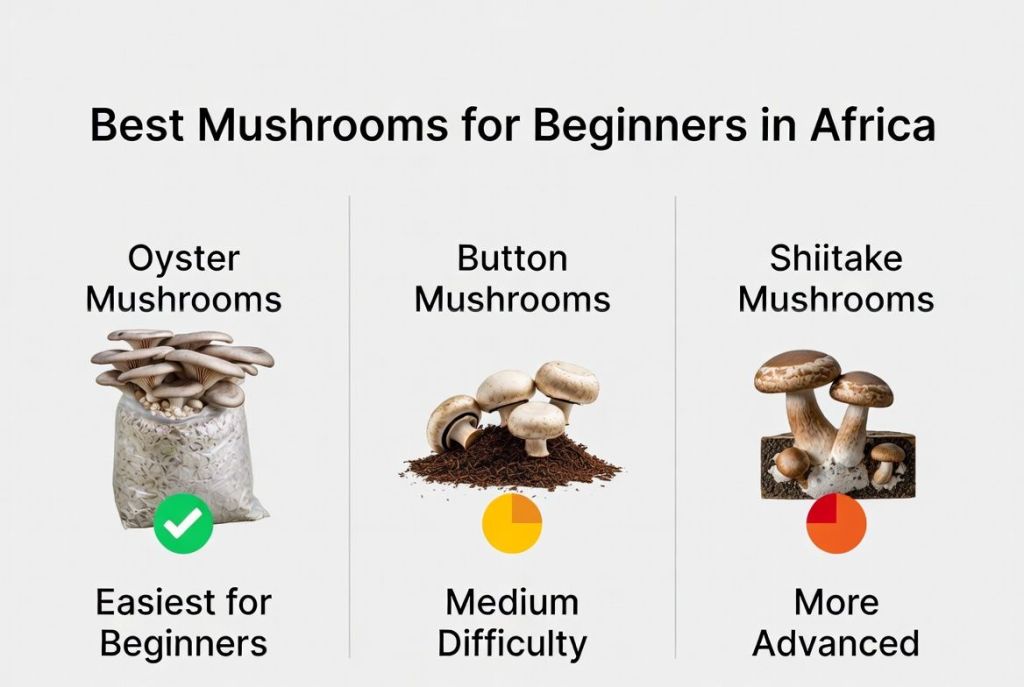
There are hundreds of mushroom varieties in the world, but only a few make sense for beginners in Africa. Here are the three main ones.
Oyster Mushrooms
Oyster mushrooms are shaped like small fans or shelves, and they come in white, grey, pink, or yellow depending on the type. They are the best choice for most beginners in Africa, especially in warm climates like Nigeria, Ghana, and Kenya.
They grow on simple substrates like straw or sawdust. They do not need complicated equipment. They produce multiple flushes (harvests) from the same bag, and they sell well in local markets, restaurants, and health food stores.
Best for: Absolute beginners. Warm climates. Small budgets.
Button Mushrooms
Button mushrooms are the round white mushrooms you see in most supermarkets. They are the most consumed mushroom in the world and have very strong demand. However, they are harder to grow than oyster mushrooms. They need a special compost substrate, specific temperature control, and more technical knowledge. South Africa grows mainly button mushrooms commercially, but most beginner guides recommend starting with oysters first.
Best for: Farmers who are ready for more technical work and have a clear path to supermarket buyers.
Shiitake Mushrooms
Shiitake mushrooms are dark brown, meaty, and have a rich flavour. They are popular in Asian cooking and sell at premium prices in health food stores and high-end restaurants. They grow on hardwood sawdust or logs and take longer than oyster mushrooms, usually 6 to 12 weeks to produce their first harvest.
Best for: Farmers targeting niche, premium markets who are willing to invest more time.
The bottom line for beginners: Start with oyster mushroom farming. It is the most forgiving, the fastest, and the easiest to sell. Once you understand the process, you can expand into shiitake or button mushrooms.
4. What You Need Before You Start (Simple Checklist)
Before you grow your first mushroom, you need to understand these six things. Think of this as your starter shopping list.
Spawn: This is the “seed” of mushroom farming. Spawn is basically grain (like wheat or sorghum) that has been mixed with mushroom mycelium. You press it into your growing material, and it spreads through the substrate to grow mushrooms. You buy spawn from a supplier or online. You cannot skip this step, without spawn, nothing grows.
Substrate: This is the material your mushrooms grow on. Think of it as the “soil” for mushrooms, except mushrooms don’t actually need soil. Common substrates in Africa include rice or wheat straw, sawdust, maize cobs, and sometimes coffee husks. Each mushroom variety has a preferred substrate.
Water: Mushrooms need moisture to grow, but they do not like to sit in standing water. You will spray or mist your growing bags with clean water regularly to maintain humidity.
Growing space: You need a room, shed, or enclosed space where you can control the environment. It does not need to be fancy. It needs to be clean, shaded from direct sunlight, and able to hold moisture.
Humidity: Mushrooms need humid air, think of how a forest feels after rain. The ideal humidity for most mushrooms is between 80% and 95%. You can achieve this by misting your bags with water several times a day. A simple spray bottle works when you are starting out.
Clean environment: This is the most important factor that beginners underestimate. Mushrooms are easily contaminated by competing moulds and bacteria. Your tools, your hands, your bags, and your growing space must all be clean and as sterile as possible. More on this in the mistakes section.
5. Step-by-Step Guide to Mushroom Farming for Beginners
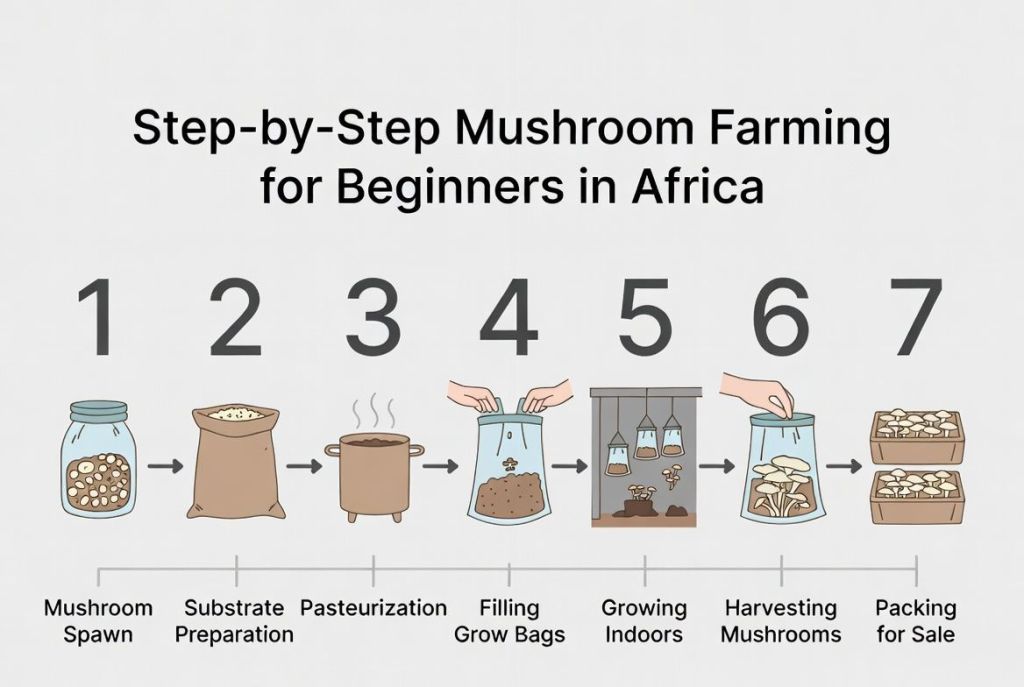
This is the most important section. Follow each step carefully.
Step 1: Choose the Right Mushroom
As a beginner, start with oyster mushrooms. Specifically, look for grey oyster or white oyster strains, which do well in temperatures between 20°C and 30°C, typical of most African countries. Do not try to grow multiple varieties at the same time when you are just starting. Master one first.
Step 2: Prepare Your Substrate
For oyster mushrooms, the best substrate for beginners is straw (rice straw or wheat straw). Here is how to prepare it:
Chop the straw into pieces roughly 5 to 10 centimetres long. Shorter pieces pack better into bags. Soak the chopped straw in clean water for 12 to 24 hours to soften and hydrate it. Then drain the straw until it is moist but not dripping wet. If you squeeze a handful and more than a few drops of water fall out, it is too wet.
Other substrates you can use include sawdust (good for shiitake), maize cobs (widely available in East Africa), and banana leaves (used in some parts of West Africa).
Step 3: Pasteurize the Substrate
Pasteurization means heating your substrate to kill off unwanted bacteria and moulds, without completely sterilizing it, which is harder to do at home. Think of it like boiling water to make it safe to drink.
Simple hot water method: Soak your straw in very hot water (around 65°C to 75°C) for 60 to 90 minutes. You can heat water in a large drum over a fire and submerge the straw. After that, drain it and let it cool before adding your spawn.
Steam method: Pack the substrate in bags and steam it for 1 to 2 hours using a drum or large pot. This is slightly more effective but requires more equipment.
Allow the substrate to cool down completely before moving to the next step. If it is still hot when you add spawn, it will kill the mycelium.
Want to go deeper on this step? Check our guide: How to Pasteurize Mushroom Substrate
Step 4: Add the Spawn (Inoculation)
This step is called inoculation which just means mixing your spawn (mushroom seed) into your cooled substrate. Here is how to do it:
Wash your hands thoroughly or wear clean gloves. Take a clear polythene bag (the kind used for packaging in markets works fine). Add a layer of substrate, then a layer of spawn. Repeat — substrate, spawn, substrate, spawn — until the bag is full. The spawn should make up about 10% to 15% of the total mixture. Tie the bag tightly at the top and poke small holes (about 1 centimetre wide) around the sides of the bag. These holes allow the mushrooms to push through when they are ready to grow.
Step 5: Create the Right Growing Conditions (Incubation and Fruiting)
This stage has two phases.
Incubation phase (1 to 2 weeks): Place your bags in a warm, dark area. During this time, the mycelium spreads through the substrate. You will see white fluffy growth spreading through the bag, that is a good sign. Do not open the bag. The target temperature is 22°C to 28°C.
Fruiting phase (from week 2 or 3 onwards): Once the bag looks fully white with mycelium, move it to your growing area. Start misting the bags with clean water 2 to 3 times a day. Keep the room humid and introduce some indirect light, mushrooms need light to know which direction to grow, but not direct sunlight. The temperature should stay between 20°C and 28°C.
Small mushroom pins will appear within 5 to 10 days of the fruiting phase beginning. These grow quickly.
Step 6: Harvest Your Mushrooms
Harvest your mushrooms when the caps are fully open but before the edges start to curl upward or turn yellow. For oyster mushrooms, this usually happens 5 to 7 days after the pins appear.
To harvest, grip the base of the mushroom cluster and twist gently while pulling. Try not to leave stumps in the bag, as these can rot and cause contamination.
After your first harvest (called a flush), clean the holes in the bag, continue misting, and wait for the second flush. A well-managed bag can produce 3 to 5 flushes before the substrate is exhausted.
Step 7: Store Your Mushrooms
Fresh mushrooms are perishable. Oyster mushrooms begin to deteriorate within 24 to 48 hours at room temperature in a warm climate. Here is how to handle them after harvest:
Place them in paper bags or perforated plastic bags, not sealed plastic, which traps moisture and causes slime. Store in a refrigerator at 2°C to 4°C if possible. This extends shelf life to 5 to 7 days. If you do not have refrigeration, sell on the day of harvest. Many successful African mushroom farmers deliver directly to restaurants and markets the same morning they harvest.
For longer shelf life, consider drying your mushrooms. Dried mushrooms can last 6 to 12 months and sell well to buyers who want convenience. This is called value addition and it can increase your profit significantly.
Step 8: Sell Your Mushrooms
Have your buyers lined up before you harvest. Know who you are selling to, at what price, and how you will deliver. Mushrooms that sit unsold lose value fast. Section 8 below covers this in detail.
6. Most Common Mistakes Beginners Make
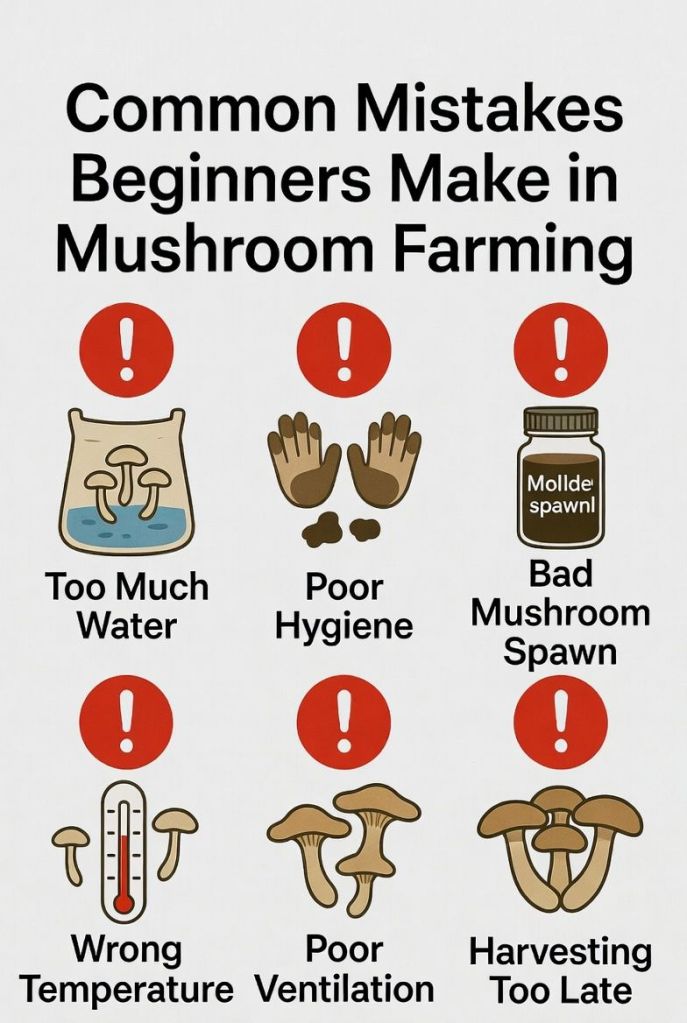
Most beginners fail because of these avoidable mistakes. Learn from them before you start.
Mistake 1: Skipping pasteurization. Many beginners skip heating their substrate because it seems like extra work. But unpasteurized substrate is full of competing moulds and bacteria. Your mushroom mycelium will lose the battle, and your bags will turn green or black. Always pasteurize.
Mistake 2: Adding spawn to hot substrate. If your substrate is still warm when you add spawn, you will kill the mycelium. Always wait until the substrate has cooled to room temperature, below 30°C.
Mistake 3: Using too much water. Wet substrate causes bacterial contamination. Moist and wet are not the same thing. After soaking and draining your substrate, it should feel like a wrung-out sponge damp but not dripping.
Mistake 4: Poor hygiene. Unwashed hands, dirty tools, dusty rooms, and reused unsterilized bags all introduce contamination. Many beginners do not take this seriously until they have lost several batches.
Mistake 5: Buying low-quality spawn. Cheap or old spawn produces weak growth or nothing at all. Buy from a trusted supplier who sells recently prepared spawn. If possible, check with other farmers in your area for recommendations.
Mistake 6: Ignoring humidity. If the room is too dry, mushrooms will not pin (form). A dry environment is one of the most common reasons beginners see no results after the incubation phase. Mist regularly and keep your growing room enclosed.
Mistake 7: No ventilation. Mushrooms produce carbon dioxide (CO2) as they grow. Too much CO2 in a closed room causes long, thin, poor-quality mushrooms. You need fresh air exchange, an open window at night or a small fan, without creating a direct draft on the bags.
Mistake 8: Starting with too many varieties at once. Some beginners buy oyster, shiitake, and button spawn at the same time and try to grow all three simultaneously. Each variety has different needs. Pick one, master it, then expand.
Mistake 9: No buyers lined up before production. Growing mushrooms without a plan for selling is a trap. You can have a perfect harvest and still lose money if no one buys from you. Sort out your market before you even buy your first bag of spawn.
Mistake 10: Quitting after one failed batch. Contamination in the first or second batch is normal. Almost every experienced mushroom farmer has failed multiple times. The difference is they adjusted; better hygiene, cooler substrate, more humidity and tried again. Do not quit after one bad result.
Mistake 11: Using unclean water. Tap water in many African cities contains chlorine and other chemicals. Let tap water sit in an open container for 24 hours before using it to mist your bags, or use filtered water. Contaminated water introduces problems directly into your growing environment.
Mistake 12: No record keeping. Write down what you do or keep record with a digital tool, how much substrate you used, how much spawn, when you inoculated, when you harvested, how many kilograms you got. Without records, you cannot improve.
7. How Profitable Mushroom Farming Can Be
Let us talk about money honestly.
Small scale (10 to 50 bags): Each well-managed bag of substrate can produce 1 to 1.5 kg of oyster mushrooms across 3 to 5 flushes. Oyster mushrooms currently sell for ₦3,000 to ₦5,000 per kilogram in Lagos, KES 500 to 800 per kilogram in Nairobi, and similar rates in Accra and other African cities.
At 30 bags with an average yield of 1 kg per bag, you get roughly 30 kg per cycle. At ₦4,000 per kg, that is ₦120,000 in revenue. Minus the cost of spawn, straw, bags, and water, your profit on a small batch is modest but real. You can run 5 to 6 production cycles in a year.
Medium scale (100 to 500 bags): At this level, the numbers become much more compelling. Many medium-scale mushroom farmers in Africa earn between ₦300,000 and ₦800,000 per month, depending on the market they supply. Hotels, caterers, and supermarket contracts become accessible at this scale.
Why many beginners quit early: The first one or two batches often have contamination problems, which means lost money and disappointment. Many people take this as evidence that mushroom farming “does not work” when it actually means their process needs adjustment. Farmers who push through the first few cycles and fix their hygiene issues typically see their results improve significantly.
How beginners can succeed: Start with a small number of bags (20 to 30) to learn the process before investing heavily. Find at least one buyer before you start. Keep records. Scale up only once you have a consistent, clean production process.
For a detailed income projection and cost breakdown, read our Mushroom Farming Business Guide
8. How to Sell Mushrooms in Africa
Growing mushrooms is only half the job. Selling them is the other half. Here is where to find buyers.
Restaurants and hotels: This is the most reliable buyer for fresh mushrooms. Approach chefs directly, especially in mid-range to high-end restaurants that use fresh ingredients. Bring a sample. Let them taste the difference between fresh local mushrooms and whatever they are currently using. Chefs who love quality will buy consistently from a reliable supplier. In cities like Lagos, Nairobi, Accra, and Johannesburg, this market is real and accessible.
Supermarkets: Supermarkets look for consistency and quantity. If you can supply the same volume at the same quality every week, they will consider you as a supplier. Start with smaller independent supermarkets and health food stores before approaching the big chains. In South Africa, stores like health food retailers and organic grocers actively look for local growers.
Selling online: In Nigeria, platforms like Jumia and social media (Instagram, Facebook, WhatsApp) are strong channels for selling directly to consumers. Build a simple page, post clear photos of your mushrooms, and make ordering easy. Many mushroom farmers run very successful WhatsApp broadcast lists to existing customers.
Health food buyers and wellness consumers: Mushrooms are increasingly popular with health-conscious buyers who care about protein, immunity, and low-calorie food options. Target gym communities, wellness groups, and corporate staff canteens. In South Africa, Nigeria, and Kenya, this segment is growing fast. Dried mushrooms, mushroom powder, and mushroom tea are also value-added products you can create to serve this market.
Want a full strategy for this? Read our post: How to Market Mushrooms and Build a Steady Customer Base
9. Frequently Asked Questions
Is mushroom farming profitable?
Yes, it can be, if you manage your process well and have buyers in place. Small-scale farmers in Africa typically start seeing returns within their first or second production cycle after fixing early contamination issues. The profit margin grows significantly as you scale up and improve efficiency.
Can I start mushroom farming at home?
Yes. A spare room, a shed, or even a large clean cupboard works as a growing space for beginners. Indoor mushroom farming is specifically designed for small, controlled environments.
Which mushroom is best for beginners?
Oyster mushrooms, without question. They grow fast, tolerate a wide temperature range, work on cheap substrates, and are easy to sell. They are the standard starting point for new mushroom farmers across Africa.
How long does mushroom farming take?
From the day you set up your bags, oyster mushrooms take 3 to 4 weeks to produce your first harvest. That includes about 1 to 2 weeks of incubation and another 1 to 2 weeks in the fruiting phase. Subsequent flushes from the same bags happen every 1 to 2 weeks after that.
How much does it cost to start mushroom farming?
A very small setup (20 to 30 bags) can cost as little as ₦15,000 to ₦30,000 in Nigeria, or KES 5,000 to 10,000 in Kenya. This covers spawn, substrate materials, bags, and basic spray equipment. You do not need to buy expensive machinery at the start.
Do I need a lot of space?
No. A space as small as 9 square metres (about 3m x 3m) is enough to start with 50 to 100 bags. Bags stack on shelves, so you use vertical space efficiently.
What is mushroom spawn?
Spawn is the “seed” used to start mushroom growth. It is usually grain (like wheat, sorghum, or millet) colonised by mushroom mycelium. You mix it into your substrate to start the growing process. Buy fresh spawn from a reputable local supplier.
Can I grow mushrooms without electricity?
Yes. Most small-scale mushroom farms in Africa operate without electricity. You do not need electric humidifiers or climate control systems at the beginner stage. Consistent misting with a hand sprayer and a well-shaded room handles humidity well enough to get results.
What can go wrong?
The most common problems are contamination (green or black mould appearing on your bags), poor or no pinning (mushrooms not forming), and dehydration (the substrate drying out). All of these are fixable with better hygiene, adjusted humidity, or more careful substrate preparation.
Where do I get mushroom spawn in Africa?
In Nigeria, search for mushroom spawn suppliers on social media (Instagram and Facebook have active communities). In Kenya, the Kenya Agricultural and Livestock Research Organisation (KALRO) and private suppliers sell certified spawn. In Ghana and South Africa, there are specialist agribusiness suppliers in most major cities. Ask in local farmer WhatsApp groups for referrals.
New to mushroom terminology? Read our Mushroom Farming Glossary for simple definitions of every term you’ll encounter.
10. Conclusion
Mushroom farming for beginners in Africa is not as complicated as it looks from the outside. You do not need land. You do not need rain. You do not need to wait for a growing season. You need a clean space, a consistent process, good spawn, and buyers lined up before you harvest.
The best way to start is small and focused. Master 20 to 30 bags of oyster mushrooms first. Fix your hygiene. Learn what your substrate should feel like. Figure out who your first three buyers are. Then scale up once the process is working.
Farmers in Zimbabwe, Kenya, Nigeria, and Ghana are already making real income from mushroom farming; some from inside rented rooms, some from university campuses, some from converted storage spaces. The opportunity is real.
What separates successful mushroom farmers from people who tried once and stopped is simple: they kept adjusting until they got it right.
Start small. Start clean. Start now.
 Kiki's Agroplace
Leave a comment