
Starting a mushroom farming business without a plan is like cooking without a recipe. You might get lucky once. But you will not get consistent results.
A mushroom farming business plan helps you think through your costs, your market, and your production process before you spend a single naira or shilling. It does not need to be long or complicated. It just needs to be real.
This guide walks you through every section of a small-scale mushroom farming business plan, with simple language, practical examples, and real cost figures for beginners in Nigeria and across Africa.
If you are still learning the basics of growing, read our complete guide first: [Mushroom Farming in Africa: Complete Beginner Guide (Step-by-Step)].
What Is a Mushroom Farming Business Plan?
A mushroom farming business plan is a written document that describes your mushroom farming idea, how you will run it, how much it will cost, and how you plan to make money from it. It covers your production process, your target customers, your startup costs, and your expected income, all in one place.
Think of it as a map for your business. Without it, you are guessing. With it, you know what to do next at every stage; from buying your first bag of spawn to selling to your first restaurant.
A good plan does not need to be 50 pages long. For a beginner starting small, two to five pages with clear numbers is enough.
Why You Need a Business Plan Before Starting Mushroom Farming
Many beginners skip the plan and jump straight into buying equipment. This is one of the main reasons small mushroom farms fail in the first few months.
A business plan forces you to answer three questions before you spend money:
1. Who will buy your mushrooms?
If you cannot name three potential buyers before growing your first batch, you have a sales problem waiting to happen.
2. Can you afford to start?
Startup costs are manageable for most beginners, but going in without a budget means overspending on the wrong things.
3. Will it actually be profitable?
Many people assume mushroom farming is profitable without running the numbers. A plan shows you exactly when you will break even and how much you can realistically earn.
You do not need to write a perfect plan. You need an honest one.
How to Write a Mushroom Farming Business Plan (Step-by-Step)
Follow this template to write a business plan for your mushroom farming business. Please note that the prices in this template are used as a guide make sure to confirm prices in environment.
Executive Summary
The executive summary is a short paragraph (or half a page) that describes your whole business at a glance.
Write it last, even though it appears first. It should answer:
- What are you growing? (e.g., oyster mushrooms)
- Where? (e.g., a converted spare room in Lagos)
- Who are your customers? (e.g., restaurants and households in your area)
- What do you need to start? (e.g., ₦50,000 in startup capital)
- What is your goal? (e.g., earning ₦80,000 per month within six months)
Keep it short. Two to three paragraphs is enough.
Business Description
This section gives more detail about your mushroom farm.
Include:
- The mushroom type you will grow — Oyster mushrooms are the best starting point for most beginners in Africa. They grow fast, need low investment, and have strong demand.
- Your growing method — Indoor farming using plastic bags packed with pasteurized straw or sawdust.
- Your scale — How many bags you plan to start with (e.g., 50 bags, 100 bags).
- Your location — You can use a spare room, a shed, or a dedicated grow house.
- Your competitive advantage — This could be: lower price than imported mushrooms, fresher product, or reliable weekly supply.
Market Analysis
Market analysis just means: who wants to buy mushrooms in your area, and how many of them are there?
For most African cities, your buyers fall into three groups:
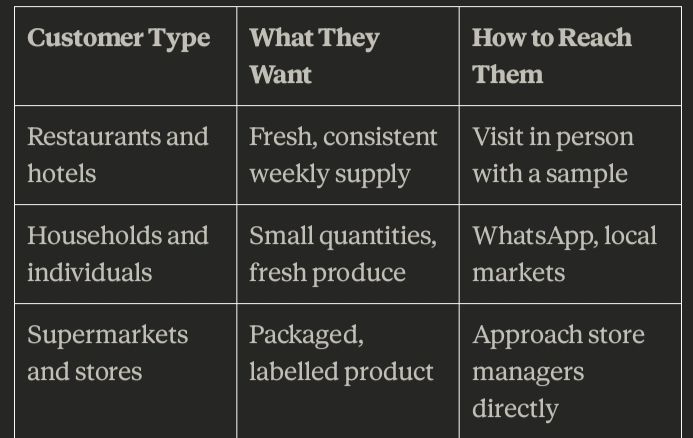
Research your local market before growing. Visit two or three restaurants in your area and ask if they buy mushrooms. Check whether nearby supermarkets stock fresh mushrooms and where they source from. This research takes one day and saves you months of guessing. To make your marketing even easier read our guide on How to market mushrooms strategically.
Production Plan
Your production plan explains how you will grow your mushrooms, from substrate preparation to harvest.
A simple oyster mushroom production cycle looks like this:
1. Buy spawn and substrate (straw, sawdust, or rice husks)
2. Pasteurize the substrate — kills competing organisms before inoculation
3. Inoculate bags — mix spawn into cooled substrate and pack into grow bags
4. Incubation — bags sit in a dark, warm room for 10–20 days while mycelium colonizes the substrate
5. Fruiting — bags are opened and placed in a humid space; mushrooms appear within 3–7 days
6. Harvest — first harvest in 3–4 weeks from inoculation; second and third flushes follow
7. Sell — deliver to buyers or sell at market
For a 100-bag beginner setup, expect to spend roughly one to two hours per day on misting, checking humidity, and harvesting when ready.
To understand the full step-by-step process, read our guide on how to pasteurize mushroom substrate it is the step most beginners get wrong.
Equipment Needed
Starting a small mushroom farm does not require expensive equipment. Here is what a beginner needs:
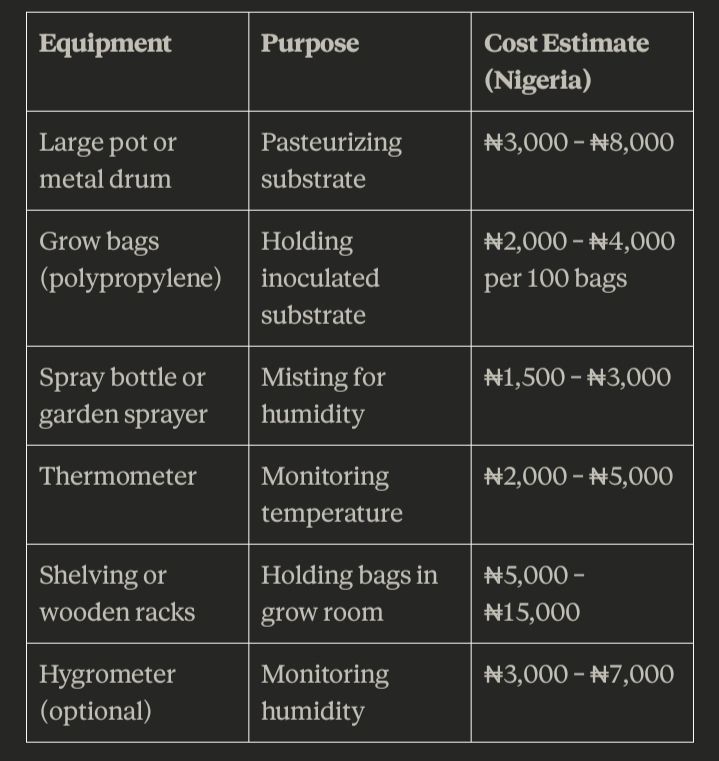
Total equipment cost for a beginner also, depends on what you already have at home.
Cost of Starting a Mushroom Farm
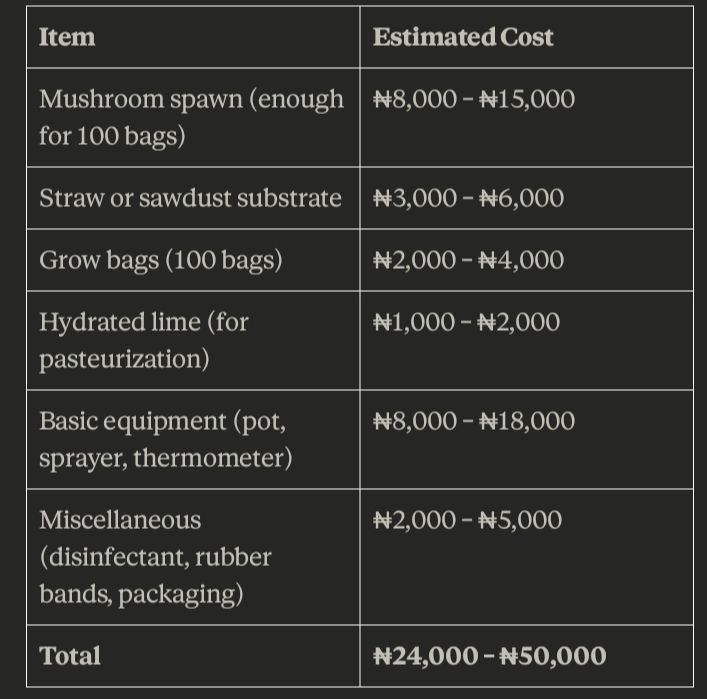
The cost of starting a small mushroom farm in Nigeria ranges from ₦20,000 to ₦80,000 for a beginner setup of 50 to 100 bags. This covers spawn, substrate (straw or sawdust), grow bags, basic equipment, and any initial space preparation. Costs vary depending on whether you source materials locally or buy them packaged.
Here is a sample cost breakdown for a 100-bag beginner setup in Nigeria (for the updated please check with your local supplier):
Marketing Plan
Your marketing plan does not need to be complicated. For a beginner selling locally, it comes down to four things:
1. Visit restaurants before you harvest. Do not wait until you have mushrooms to look for buyers. Visit local restaurants, lodges, and caterers two weeks before harvest and offer a sample.
2. Set up a WhatsApp Business page. Post photos of your growing process and harvest. People buy more when they can see where their food comes from.
3. Price competitively but not cheaply. Check what fresh mushrooms sell for in your area. Price your product just below imported mushrooms to win customers, but do not underprice to the point where you lose money.
4. Be reliable. The single biggest marketing advantage a small farmer can have is consistency. If you promise to deliver 5kg every Tuesday, deliver 5kg every Tuesday.
Profit Potential
A 100-bag oyster mushroom setup in Nigeria can produce roughly:
- First flush: 150–200g per bag average = 15–20kg total
- Second flush: 100–150g per bag = 10–15kg total
- Third flush: 75–100g per bag = 7–10kg total
- Total per batch: approximately 32–45kg of fresh mushrooms
At ₦3,000–₦5,000 per kg (direct to restaurants or households):
- Low estimate: 32kg × ₦3,000 = ₦96,000 per batch
- High estimate: 45kg × ₦5,000 = ₦225,000 per batch
After subtracting input costs of ₦24,000–₦50,000, a 100-bag batch can yield a net profit of ₦50,000–₦170,000 depending on your selling price and yield.
Most beginners achieve two to three batch cycles per two months once their process is running smoothly.
Financial Plan Explained Simply
A financial plan answers: will your farm make money, and when?
For a beginner, you need three numbers:
1. Total startup cost — what you spend before your first harvest (covered in the cost section above).
2. Monthly running cost — what you spend to keep producing each month. For a small setup, this is mainly spawn, substrate, and packaging; typically ₦15,000–₦25,000 per batch cycle.
3. Break-even point — how many kilograms you need to sell to cover your costs. If your costs are ₦30,000 and you sell at ₦3,500/kg, you break even after selling about 9kg. Everything after that is profit.
Run these numbers before you start. It takes 30 minutes and removes all the guesswork.
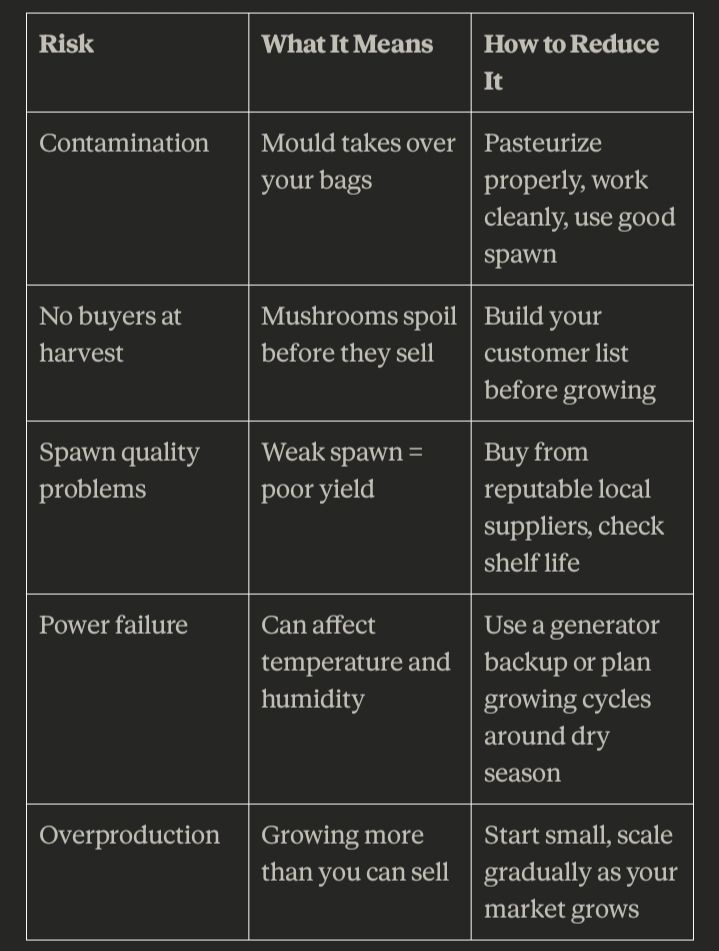
Risks in Mushroom Farming and How to Avoid Them
Simple Mushroom Farming Business Plan Example for Beginners
Here is what a one-page business plan looks like for a real beginner:
Business Name: Green Flush Farms
Location: Ibadan, Nigeria
Mushroom Type: Oyster mushrooms (pink and grey varieties)
Starting Scale: 100 bags per cycle
Growing Space: Converted spare room (roughly 15 square metres)
Target Customers:
– 3 local restaurants (weekly orders)
– WhatsApp customer list (households, 15–20 buyers)
Startup Cost: ₦45,000
Expected Revenue Per Batch: ₦90,000 – ₦140,000
Expected Profit Per Batch (after input costs): ₦60,000 – ₦110,000
Goal: Run two batch cycles per month within three months of starting. Reinvest profits to scale to 250 bags by month six.
Risks identified: Contamination (mitigation: strict hygiene, buy fresh spawn). Slow sales (mitigation: pre-sell before each harvest via WhatsApp).
Is Mushroom Farming Profitable?
Yes, mushroom farming is profitable for beginners who start small, control their costs, and build their customer base before scaling. A 100-bag oyster mushroom setup in Nigeria can generate ₦50,000 to ₦170,000 net profit per batch. The key is consistent production, direct sales without middlemen, and reliable delivery to buyers. Beginners who scale too fast or sell through brokers often earn much less.
The farmers who make the most money from mushrooms share three habits: they sell direct, they produce consistently, and they grow their customer list before every harvest.
Frequently Asked Questions
What is a mushroom farming business plan?
A mushroom farming business plan is a written document that outlines your mushroom farming goals, production method, startup costs, target customers, and expected income. It helps you plan before you spend money and gives you a clear roadmap for running and growing your business. Beginners can write a useful plan in one to two pages.
How do I start mushroom farming with little money?
Start with oyster mushrooms — they have the lowest input cost and fastest return. Buy spawn locally to reduce cost and transit time. Source your substrate (straw or rice husks) from nearby farms for free or very cheaply. Begin with 20 to 50 bags to keep initial costs under ₦20,000, then reinvest your first profits to scale up.
Which mushroom is best for beginners?
Oyster mushrooms. They grow on cheap, widely available materials like straw and sawdust. They produce a harvest in 3–4 weeks. They sell well to restaurants, households, and health food buyers across Africa. Pink oyster varieties grow especially well in hot climates like Nigeria and Ghana. See our full guide on [Mushroom Farming in Africa: Complete Beginner Guide] for a full comparison of mushroom types.
Can I start mushroom farming at home?
Yes. Mushroom farming can be started at home using a spare room, a shed, or any covered space that stays cool, clean, and humid. You do not need farmland or expensive infrastructure. A room as small as 10 to 15 square metres is enough for a beginner setup of 50 to 100 bags. Many successful mushroom farmers in Nigeria, Kenya, and Ghana started from a bedroom or storeroom.
Conclusion
A mushroom farming business plan does not have to be complicated. It needs to be honest, specific, and based on real numbers from your actual situation.
Know your startup cost. Know who your buyers are. Know how much you can produce in your first batch. Write it down. Then start.
Mushroom farming is one of the few agribusinesses where a beginner can go from plan to first harvest in under six weeks. The plan just makes sure you get there with money left over.

 Kiki's Agroplace
Leave a comment