Feed is the single biggest cost in catfish farming and it is also the factor that most determines how fast your fish grow and how much profit you make.
Get feeding right and your fish reach market size faster, your feed cost per kilogram drops, and your harvest earns more. Get it wrong and you spend a lot of money on feed while your fish grow slowly, die early, or pollute your pond water.
This guide covers catfish feed formulation for beginners: what catfish need to eat, how to make your own feed at home, how often and how much to feed, and how to reduce costs without sacrificing growth.
If you are just getting started with the whole farming process, this Complete guide to catfish farming explains everything from pond setup to stocking fingerlings before you get to the feeding stage.
What Is Catfish Feed Formulation?
Catfish feed formulation is the process of selecting and combining ingredients; protein sources, energy sources, fats, vitamins, and minerals, in the right proportions to meet a catfish’s nutritional needs at each growth stage. A well-formulated feed supports fast growth, good health, and efficient use of resources, which directly reduces your cost per kilogram of fish produced.
What Do Catfish Eat?
Catfish are omnivores; they eat both plant and animal matter. In farming, they are fed a formulated diet containing protein (for growth and muscle), energy sources like corn and wheat (for daily activity), fats (for energy and essential fatty acids), and vitamins and minerals (for health and immunity). The exact ratio of each depends on the fish’s size and growth stage.
Here is a simple breakdown of the three main nutrient groups catfish need:
Protein is the most important nutrient and the most expensive. It builds muscle, supports growth, and repairs tissue. Young catfish (fingerlings and juveniles) need more protein than adults. Common protein sources include soybean meal, fish meal, groundnut cake, and blood meal.
Energy comes from carbohydrates and fats. Corn, wheat offal, and sorghum provide carbohydrates. Fish oil and vegetable oils provide fats. Energy nutrients keep the fish active and allow protein to be used for growth rather than just survival.
Vitamins and minerals support immune function, bone development, and metabolic processes. These are usually added through a commercial vitamin-mineral premix; a small but important addition to any homemade feed formula.
Why Feed Is the Most Important Cost in Catfish Farming
Feed accounts for 60–70% of the total production cost in most catfish farms. That is more than pond construction, fingerlings, and labour combined.
This means that how you manage feed has a bigger impact on your profit than almost any other decision you make on the farm.
Two common scenarios:
– A farmer who overfeeds wastes money on feed that sinks to the pond bottom and rots. This pollutes the water, stresses the fish, and reduces their growth rate.
– A farmer who uses poor-quality, unbalanced feed saves money upfront but ends up with slow-growing fish that take longer to reach market size, which means more feed cost overall, more time, and lower profit per batch.
The right approach is a balanced, correctly formulated feed given at the right time in the right quantity. That is what this guide helps you do.
To see exactly how feed costs factor into your overall business numbers, read our Catfish farming business plan guide it includes a cost breakdown showing how feed efficiency directly affects your margin per kilogram.
Nutritional Requirements of Catfish (By Growth Stage)
Catfish nutritional needs change as they grow. Feeding a fingerling the same formula as a mature fish or vice versa reduces efficiency and wastes money.
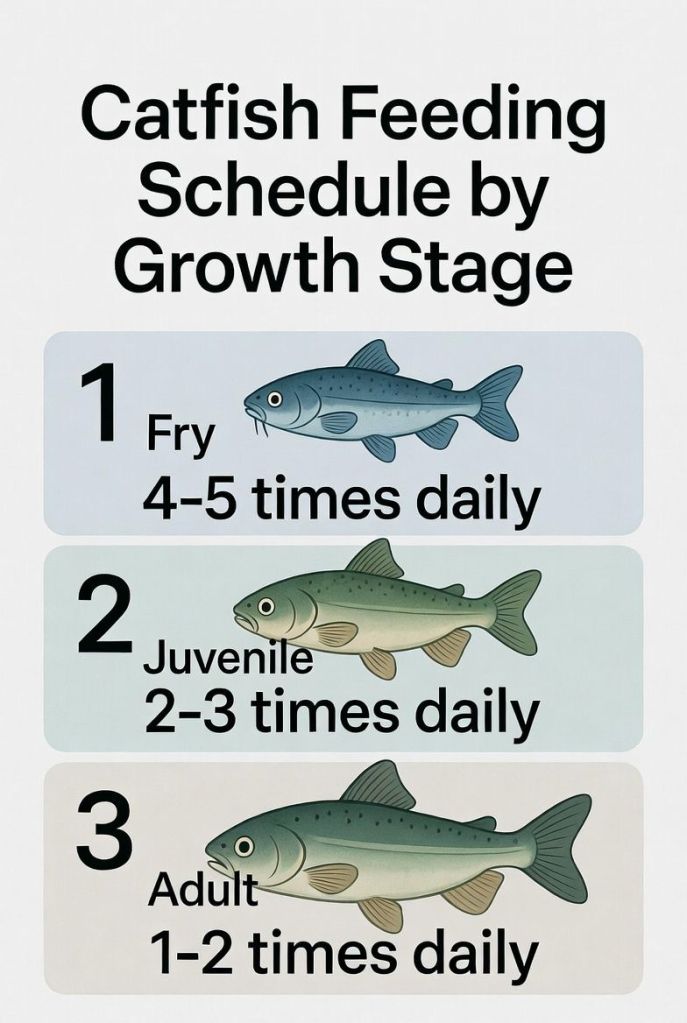
- Fry (0–5g) — 45–50% protein, feed 4–6 times daily
- Fingerling (5–50g) — 40–45% protein, feed 3–4 times daily
- Juvenile (50–200g) — 35–40% protein, feed 2–3 times daily
- Adult / grow-out (200g–1.5kg) — 28–35% protein, feed 1–2 times daily
The key principle: the smaller the fish, the more protein it needs and the more often it must eat. As fish grow larger, they need slightly less protein per gram of body weight, and they feed efficiently in fewer daily sessions.
How to Make Catfish Feed (Step-by-Step)
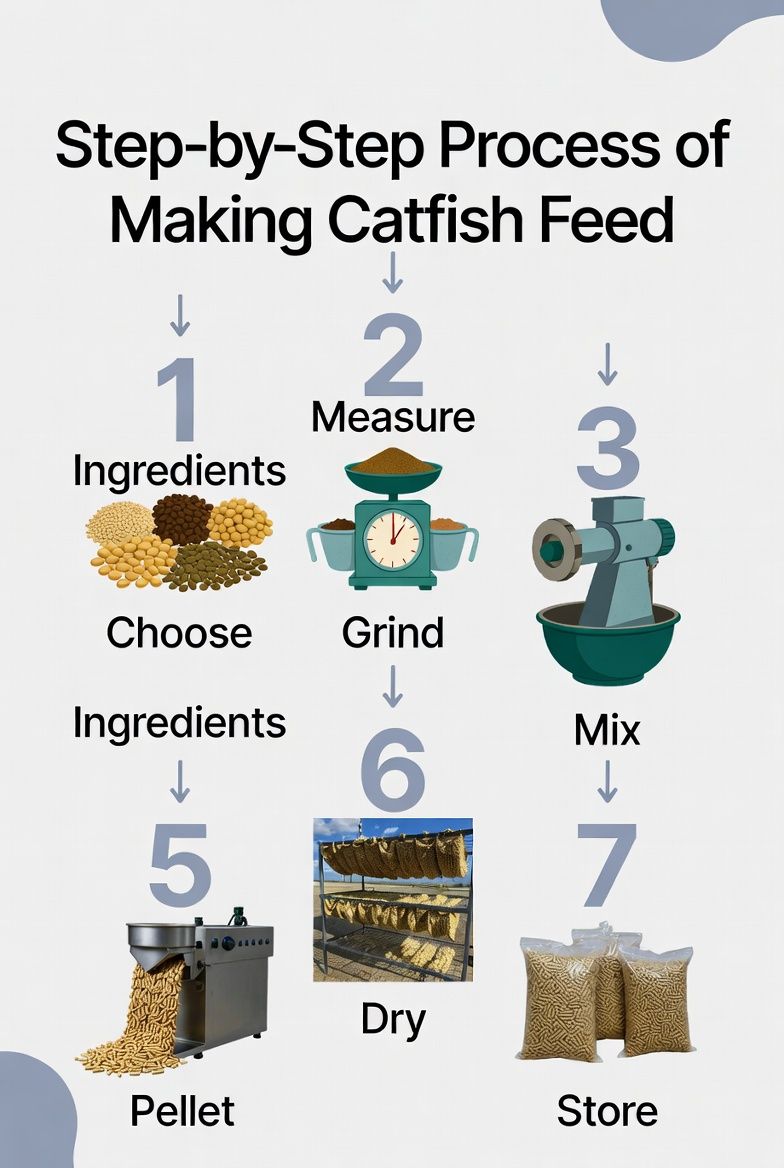
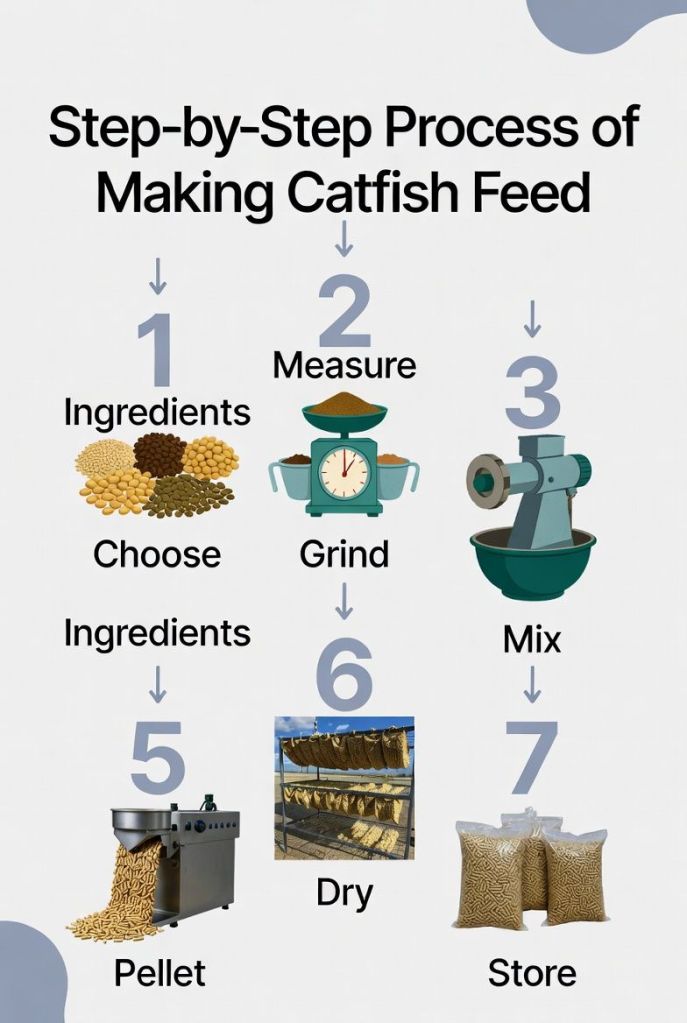
To make catfish feed, select and measure your protein and energy ingredients in the right proportions for your fish’s growth stage. Grind all dry ingredients to a fine, uniform texture, then mix thoroughly. Add water gradually to form a dough, then pelletize using a pellet machine or manual press. Dry the pellets fully before feeding or storing to prevent mold.
Here is the full process broken into four practical steps.
Step 1: Choose Your Ingredients
For a basic beginner formula, you need three categories of ingredients:
Protein sources (these make up the largest portion):
- Soybean meal most commonly used in Nigeria; good amino acid profile, widely available
- Fish meal highest quality protein but more expensive; use in smaller quantities to boost quality
- Groundnut cake (peanut cake) good plant protein, cheap, and widely available across Nigeria and West Africa
- Blood meal very high protein but use sparingly (no more than 5% of formula) as too much affects palatability and can cause health issues
Energy sources:
- Corn/maize the most common energy ingredient; cheap and available everywhere
- Wheat offal (wheat bran) a by-product of flour milling; affordable and adds bulk and carbohydrates
- Sorghum alternative to maize, especially in northern Nigeria where it is cheaper
Vitamins, minerals, and binders:
- Vitamin-mineral premix a commercial blend that covers all micronutrient requirements; available at agro-vet shops
- Vegetable oil or palm oil adds fat and helps bind the pellets
- Common salt small amounts support electrolyte balance
Step 2: Measure Your Ingredients
Proportions matter. A poorly balanced formula that has too much energy and not enough protein will produce slow-growing fish regardless of how much you feed them.
Here is a beginner-friendly starter formula for juvenile to adult catfish (producing approximately 32% crude protein):
- Soybean meal — 35kg
- Fish meal — 10kg
- Groundnut cake — 10kg
- Maize (corn) — 25kg
- Wheat offal — 12kg
- Fish oil or palm oil — 4kg
- Vitamin-mineral premix — 2kg
- Common salt — 0.5kg
- Blood meal (optional) — 1.5kg
Total: 100kg
This formula provides approximately 30–33% crude protein, suitable for juveniles (50g–200g) and grow-out catfish. For fingerlings, increase your fish meal and soybean meal portion and reduce the maize proportion.
Note: For precise nutritional analysis, especially at commercial scale, consult a local aquaculture extension officer or nutritionist who can verify your formula’s actual protein content before a large production run.
Step 3: Mix and Process
Once you have measured your ingredients:
1. Grind all dry ingredients to a fine, uniform texture. Use a hammer mill or hand grinder. Consistency in particle size matters, coarse, uneven particles reduce palatability and make the pellets crumble.
2. Mix dry ingredients thoroughly in a clean drum or on a clean, elevated surface. Mix for at least 10–15 minutes until the blend is completely uniform. Uneven mixing means some fish get too much of one nutrient and too little of another.
3. Add your oil and mix again. The oil also helps bind the dry ingredients.
4. Add water gradually and knead into a firm, slightly sticky dough. The mixture should hold its shape when pressed; not too dry, not too wet.
5. Pelletize. For beginners, a manual pellet press can form uniform pellets. For larger operations, a motorised pellet machine produces faster, more consistent results. Pellet size should match your fish:
- Fry and fingerlings: 1–2mm pellets
- Juveniles: 2–4mm pellets
- Adults: 4–6mm pellets
Step 4: Dry and Store
Wet pellets are dangerous if stored; they will develop mold within 24–48 hours in Nigeria’s humid climate.
- Spread freshly made pellets on clean, raised trays or mesh racks
- Dry in full sunlight for 4–8 hours, or use a food dryer for faster, more consistent results
- Pellets are ready when they are hard, dry, and snap cleanly when broken
- Store in a cool, dry, airtight container or sealed bag away from moisture and direct sunlight
- Properly dried and stored homemade feed lasts 2–4 weeks. Do not make more than you can use within this period.
Example Catfish Feed Formula (Beginner-Friendly)
For a beginner making a small batch, say 10kg of feed for a small trial pond, scale the formula down proportionally:
- Soybean meal — 3.5kg
- Fish meal — 1.0kg
- Groundnut cake — 1.0kg
- Maize (corn) — 2.5kg
- Wheat offal — 1.2kg
- Palm oil — 0.4kg
- Vitamin-mineral premix — 0.2kg
- Salt — 0.05kg
- Blood meal (optional) — 0.15kg
Total: ~10kg
This is a practical starting point. Observe your fish’s response over the first two weeks. Good growth, active feeding behaviour, and minimal leftover feed at the bottom of the pond are signs the formula is working.
How Often Should Catfish Be Fed?
Feed catfish based on their growth stage: fry and fingerlings need 3–5 feedings per day in small amounts because their digestive systems are small and they grow fastest during this period. Juveniles need 2–3 feedings daily. Adult grow-out catfish are typically fed once or twice daily. Feed at the same times each day, catfish adapt to feeding schedules and come to the surface reliably when trained.
A practical daily schedule for grow-out catfish (most common situation for beginners):
- Morning feeding: 7:00–8:00am main feed of the day
- Evening feeding: 4:00–5:00pm second feed
Avoid feeding in the middle of the day when water temperature peaks. Hot water holds less oxygen, and stressed fish in low-oxygen water eat poorly and may die.
How Much Should You Feed Catfish?
Feed catfish at 3–5% of their total body weight per day. Here is how that works in practice:
If you have 100 catfish each weighing 200g (total body weight = 20kg), feed approximately 600g–1kg of feed per day (3–5% of 20kg).
As fish grow heavier, the percentage drops slightly adult fish closer to harvest size are typically fed at 2–3% of body weight because their growth rate slows.
The best daily check is simple: watch what happens 10–15 minutes after feeding. If all the feed is eaten quickly and fish are still active at the surface, you may be underfeeding. If there is leftover feed sinking to the bottom, you are overfeeding reduce the quantity immediately.
Common Feeding Mistakes
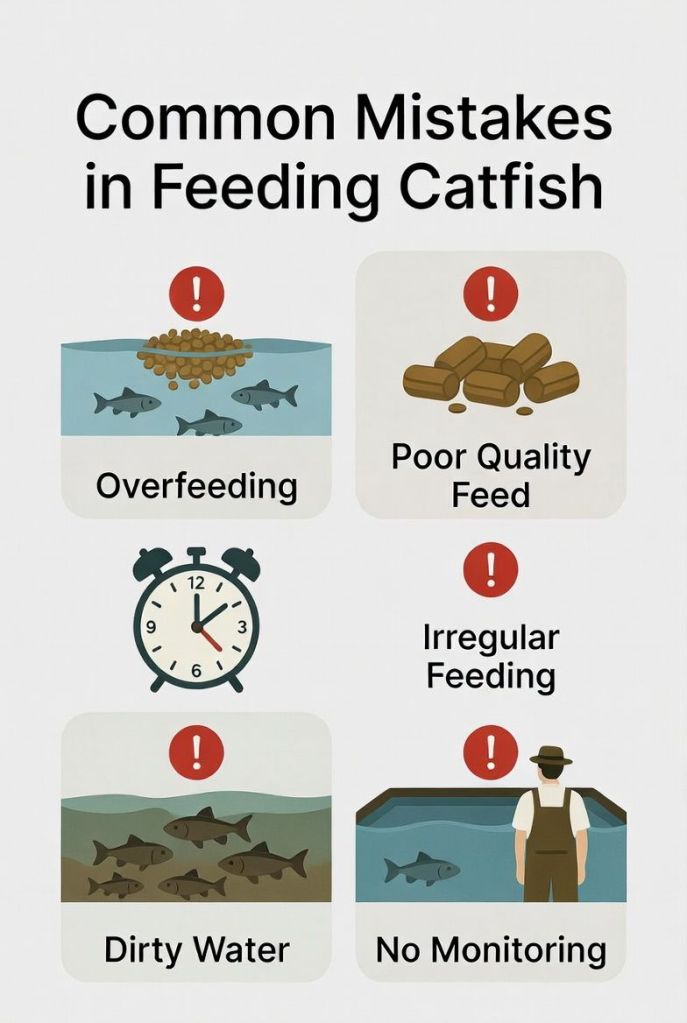
Overfeeding. Uneaten feed sinks, decomposes, and robs the pond of oxygen. It is one of the top causes of fish death in beginner ponds. Feed what your fish consume in 10–15 minutes and stop.
Feeding poor-quality or unbalanced feed. The cheapest feed is not the best feed. A formula too low in protein produces slow growth. A formula that has gone moldy can kill the fish. Always use fresh, properly stored feed.
Feeding at the wrong time. Midday feeding in hot weather stresses fish and reduces feeding response. Morning and evening feedings consistently produce better results.
Not adjusting as fish grow. Many beginners use the same formula and the same feed quantity throughout the entire grow-out period. Fish are growing continuously; their nutritional needs and appetite change every few weeks. Reassess and adjust monthly.
Storing feed too long. Homemade feed stored in humid conditions develops mold and loses nutritional value. Make batches you can use within two to three weeks.
Skipping the vitamin-mineral premix. It feels like a small addition but it matters. Catfish without adequate vitamins and minerals grow more slowly, get sick more easily, and have higher mortality rates.
How to Reduce Feed Cost and Increase Profit
Feed cost reduction does not mean buying the cheapest ingredients. It means getting the most growth per naira spent on feed.
Use locally available ingredients. Groundnut cake, wheat offal, and maize are often cheaper when sourced directly from mills or local markets than from agro-dealers. Build supplier relationships for regular bulk discounts.
Reduce waste with correct feeding amounts. Every gram of feed that sinks to the bottom uneaten is money lost. Feed precisely, use the 10–15 minute observation rule at every feeding.
Maintain a consistent feeding schedule. Catfish trained to a schedule feed more efficiently. They come to the surface at feeding time, consume feed quickly, and waste less.
Monitor your Feed Conversion Ratio (FCR). FCR measures how much feed you need to produce 1kg of fish. An FCR of 1.5 means 1.5kg of feed produces 1kg of fish. Lower is better. Track this number; it tells you directly whether your feeding programme is working or losing you money.
Grow fast, sell on time. Fish that reach market size quickly spend less time consuming feed. Every extra week a fish spends in the pond costs you feed money without proportional weight gain. For the full profit picture; how feeding efficiency translates to margin per batch, see our Catfish farming business plan guide.
How Feeding Affects Growth and Sales
This connection is direct and easy to understand.
Better feeding → faster growth → earlier harvest → lower total feed cost → higher profit per batch.
When fish grow consistently and reach 1–1.5kg in the expected timeframe (typically 4–6 months for Nigerian catfish from fingerling), you control your harvest schedule. You can plan deliveries to restaurants, alert buyers in advance, and sell at full market price rather than rushing to clear oversize fish.
When feeding is poor; wrong formula, wrong amounts, wrong timing, fish grow unevenly. Some reach market size while others lag. You end up with a mixed-weight harvest that is harder to sell at consistent prices.
Once your fish are growing well and harvest is approaching, read our guide on How to sell catfish effectively. It covers exactly how to find buyers, price your fish, and move stock before your feeding costs eat further into your margin.
Frequently Asked Questions
Can I make catfish feed at home?
Yes. A small-scale beginner can mix and pelletize feed manually using locally available ingredients. You need a hammer mill or grinder to process ingredients, a mixing drum, a pellet press, and a drying area. Many farmers start by buying commercial feed and transitioning to homemade feed once they are confident in their formula.
What is the best feed for catfish?
The best feed for catfish is a balanced formulation that meets the protein requirements for your fish’s growth stage 40–45% crude protein for fingerlings, 28–35% for grow-out fish, made from fresh ingredients and stored correctly. Whether you buy commercial feed or make your own, freshness and correct protein content matter more than brand name. A well-made homemade feed consistently outperforms a poorly stored commercial feed.
Why is my catfish not growing fast?
Slow growth in catfish is usually caused by one of these: insufficient protein in the feed formula, underfeeding (fish not getting enough daily feed), poor water quality (low oxygen or high ammonia from overfeeding or poor pond management), disease or parasites, or overstocking (too many fish competing for limited feed and oxygen). Start by checking your feeding amounts and protein levels, these are the most common causes.
How do I know my fish are eating well?
Watch your fish for 10–15 minutes after feeding. Healthy, well-fed catfish will surface actively, feed aggressively, and finish the feed within that window. Little or no leftover feed at the bottom is a good sign. Fish that do not respond to feeding, stay at the bottom, or show lethargy during feeding time may be stressed, sick, or water quality may have deteriorated. Check your pond’s water immediately if you notice this.
Conclusion
Feed formulation is not as complicated as it first appears. You need to know what your fish need at each stage, choose the right ingredients, mix and pelletize properly, and feed the right amount at the right times.
Start with the beginner formula in this guide. Observe your fish’s response. Adjust as they grow. Track your FCR number and improve it each batch.
The farmers who consistently reduce feed cost while maintaining good growth rates are the ones who build profitable, sustainable catfish businesses; not the ones who simply buy the cheapest feed available.
For the complete picture of running a catfish farm from start to profit, use these three guides together: our Step by step catfish farming guide for setup, this feed guide for production, and our Catfish marketing guide for turning your harvest into income.

 Kiki's Agroplace
Leave a reply to How to Fertilize Catfish on a Farm – Kiki's Agroplace Cancel reply