Table of Contents
- Why weekly pond management matters more than any other factor
- Understanding your pond — the basics
- Your weekly catfish pond management checklist
- Daily tasks you cannot skip
- Monthly tasks to keep your pond in top condition
- How to spot problems early before they become losses
- Record keeping — the habit that separates profitable farmers from struggling ones
- Key takeaways
- FAQ
Introduction
Catfish pond management in Nigeria is where most farmers lose money — not at the market, not at the hatchery, but right there on their farm, week after week, from small problems they did not catch in time. A sick fish today becomes a dead pond in two weeks. Water that looks clean can be silently killing your stock. This guide gives you a clear, practical checklist of what to do every week so your catfish grow well, stay healthy, and reach market size profitably.
1. Why Weekly Pond Management Matters More Than Any Other Factor
Many beginner catfish farmers in Nigeria spend money on the best fingerlings and the best feed — then lose everything because they did not manage their pond properly after stocking.
Most catfish diseases in Nigeria are directly linked to poor water quality. This leads to high ammonia levels, low dissolved oxygen, and serious problems.
The fish do not tell you when something is wrong. By the time you see dead fish floating, the problem started days or weeks earlier. Weekly checks catch problems early — when they are still cheap to fix.
2. Understanding Your Pond — The Basics
Before your weekly checklist, you need to understand the five things that keep your catfish alive and growing:
| Factor | What It Means | Why It Matters |
|---|---|---|
| Dissolved oxygen (DO) | The amount of oxygen in the water | Fish breathe through it. Low oxygen = stress, slow growth, death |
| pH | How acidic or alkaline the water is | Wrong pH stops fish from absorbing nutrients properly |
| Ammonia | Waste from fish and uneaten feed | High ammonia is toxic. It burns fish gills |
| Temperature | Water temperature | Affects how fast fish grow and how much they eat |
| Water colour | Visual sign of algae and bacteria levels | Green water = algae bloom. Black water = dangerous waste buildup |
Ideal water parameters for catfish in Nigeria:
| Parameter | Safe Range |
|---|---|
| Temperature | 24°C to 29°C (75°F to 85°F) |
| pH | 6.5 to 8.5 |
| Dissolved oxygen | Above 5mg per litre |
| Ammonia | Below 0.02mg per litre |
| Nitrite | Below 1mg per litre |
You do not need a laboratory to monitor these. A basic water testing kit costs between ₦5,000 and ₦15,000 and is available from agro-input suppliers. It is one of the best investments you can make.
3. Your Weekly Catfish Pond Management Checklist
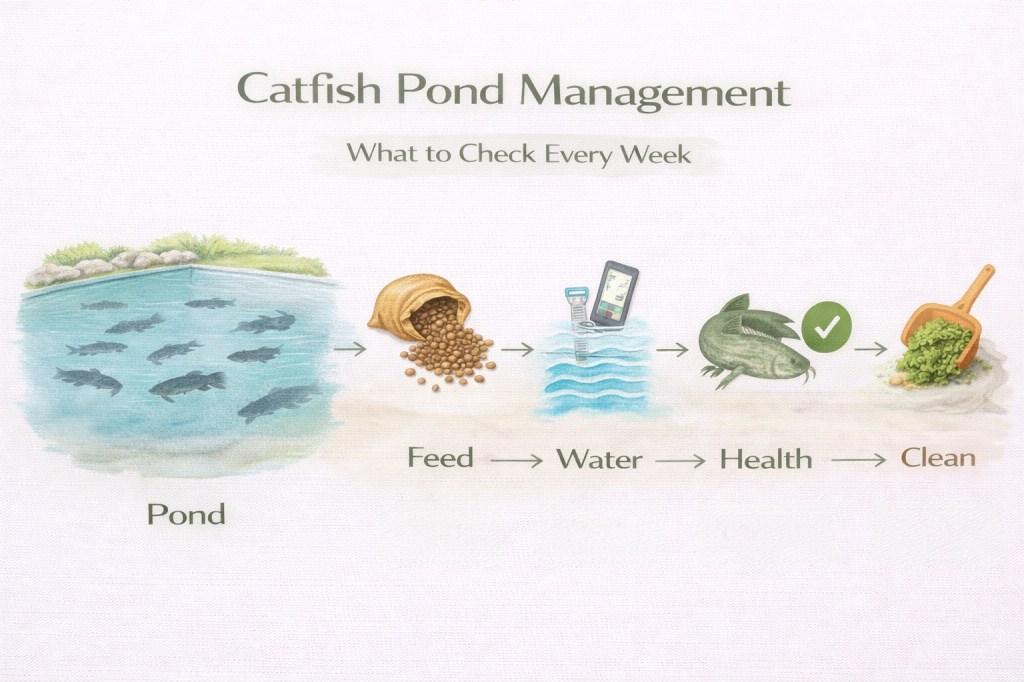
Do these every week without fail. Block out time — ideally the same day each week so it becomes a habit.
Check water quality
Water quality must be monitored at least twice daily because water parameters can change at short notice and fish are extremely sensitive to these changes. But if daily testing is not possible for you right now, do a full test at least once a week. Check:
- Dissolved oxygen level
- pH
- Ammonia and nitrite levels
- Water temperature
Act immediately if any reading is outside the safe range.
Observe fish behaviour
Spend 10 to 15 minutes watching your fish at feeding time. Healthy catfish:
- Come to the surface actively at feeding time
- Eat aggressively
- Move normally
Warning signs to watch for:
- Fish gasping at the surface (low oxygen)
- Fish swimming on their sides or erratically (disease or ammonia poisoning)
- Loss of appetite (stress, disease, or water problem)
- Unusual colour changes or skin lesions
- Fish gathering at the pond inlet (seeking fresher water)
Train yourself to recognise early signs of disease such as unusual swimming, colour changes, and lesions — and act quickly.
Check feeding and adjust quantity
Feeding is the most important work in catfish farming. The key skill is knowing the right amount of feed without wasting any.
Each week:
- Weigh a sample of your fish to estimate average body weight
- Adjust feed quantity based on current biomass — typically 3% to 5% of total fish body weight per day
- Remove any uneaten feed from the pond after 30 minutes. Leftover feed breaks down and raises ammonia levels fast
Do a partial water change
Change 20% to 30% of your pond water every week. This removes waste, lowers ammonia, and refreshes oxygen levels. Use clean borehole or river water — never treated tap water without dechlorination.
Inspect pond structure
Walk around your pond and check:
- Inlet and outlet pipes — clear and working properly
- Pond walls or tarpaulin — no cracks, tears, or leaks
- Aeration equipment — running correctly
- Nets or covers — secure to prevent fish jumping out or predators getting in
Grade your fish (every 2 to 3 weeks)
Catfish grow at different rates. Bigger fish bully smaller ones for feed, which slows overall growth and increases mortality. Every 2 to 3 weeks, sort your fish by size and move smaller ones to a separate pond or section. This single habit can increase your final yield significantly.
4. Daily Tasks You Cannot Skip
These take less than 30 minutes but protect everything:
Morning (before 8am):
- Feed your fish — first feeding for grow-out ponds should be by 10am at the latest. Nursery fish need feeding from 7am.
- Check that aeration equipment is running
- Quickly observe fish behaviour — any floating fish or signs of distress?
Evening:
- Second feeding
- Check dissolved oxygen levels — they drop at night when there is no sunlight for algae to produce oxygen
- Remove any dead fish immediately. A dead fish left in the pond spreads bacteria to healthy fish fast
5. Monthly Tasks to Keep Your Pond in Top Shape
Once a month, do a deeper maintenance check:
- Full water quality analysis — test all parameters including nitrate levels
- Biomass estimation — weigh a 10% sample of your fish to estimate total pond weight and adjust your feeding and harvest timeline
- Equipment check — inspect pumps, aerators, pipes, and filters for wear
- Pond floor cleaning — for concrete ponds, remove sludge and waste buildup from the floor
- Review your records — compare this month’s growth rate, feed conversion, and mortality to the previous month. If growth is slowing, investigate why.
6. How to Spot Problems Early Before They Become Losses
Here are the most common warning signs Nigerian catfish farmers miss — and what they mean:
| Warning Sign | Likely Cause | What to Do |
|---|---|---|
| Fish gasping at surface | Low dissolved oxygen | Increase aeration immediately. Do a 30% water change |
| Cloudy or foamy water | High ammonia from waste buildup | Reduce feeding. Do a 30% water change. Check drainage |
| Green water | Algae bloom | Partial water change. Reduce direct sunlight on pond |
| Black or smelly water | Dangerous waste buildup | Emergency water change. Check for dead fish and remove |
| Fish not eating | Stress, disease, or water problem | Check all water parameters. Observe for disease signs |
| Lesions or wounds on fish | Bacterial infection | Isolate affected fish. Consult a vet or fish health expert |
| Slow growth despite regular feeding | Wrong feed size, poor water quality, or overcrowding | Grade fish. Check stocking density. Review feed type |
Research in 2025 showed that over 50% of fish farmers in Nigeria reported disease outbreaks affecting their stock — and most of those outbreaks were preventable with earlier detection.
7. Record Keeping — The Habit That Separates Profitable Farmers From Struggling Ones
Most catfish farmers in Nigeria keep everything in their head. That is how they lose track of costs, growth rates, and problems.
Keep a simple weekly farm record. You do not need a computer — a notebook works fine. Record:
| What to Record | Why It Matters |
|---|---|
| Date and quantity of fish stocked | Tracks your starting point |
| Daily feed quantity and type | Calculates your feed conversion ratio |
| Weekly water test results | Shows trends before they become emergencies |
| Fish mortality (daily) | Flags disease outbreaks early |
| Weekly estimated average weight | Tracks growth rate |
| Expenses (feed, medication, labour) | Tells you your real cost of production |
| Harvest date, quantity, and sale price | Calculates your actual profit per cycle |
At the end of each cycle, you will have clear data on what worked and what did not. This is how you improve with every batch.
8. Key Takeaways
- Most catfish losses in Nigeria come from water quality problems — not disease or bad fingerlings.
- Test your water at least weekly. Daily is better.
- Watch your fish every day at feeding time. Behaviour changes are your earliest warning system.
- Change 20% to 30% of your pond water every week.
- Grade your fish every 2 to 3 weeks to prevent bullying and uneven growth.
- Keep records. Every cycle should teach you something that makes the next one more profitable.
9. FAQ
How often should I change water in my catfish pond?
Change 20% to 30% of your pond water every week. In hot weather or when stocking density is high, you may need to change water twice a week.
What is the ideal stocking density for catfish in Nigeria?
For concrete or tarpaulin ponds, 50 to 100 fish per cubic metre of water is common for grow-out. Overcrowding causes stress, slows growth, and increases disease risk.
How do I know if my catfish water quality is bad?
The first signs are behavioural — fish gasping at the surface, reduced appetite, or unusual swimming patterns. Cloudy, foamy, or smelly water is a clear warning. Use a water testing kit to confirm and act immediately.
Why are my catfish not growing despite feeding them regularly?
The most common reasons are poor water quality, wrong feed size for the fish stage, overcrowding, or disease. Grade your fish by size, test your water, and check that you are using the right feed type for your fish’s current weight.
How do I prevent diseases in my catfish pond?
Source healthy fingerlings from reputable hatcheries, use quality commercial feeds, and limit movement of people and equipment between ponds without proper cleaning. Good water management is your strongest disease prevention tool.
Is catfish farming still profitable in Nigeria in 2026?
Yes. Nigeria’s demand for fish is 2.66 million metric tonnes but only 1.4 million metric tonnes is available locally — the supply gap is enormous. Farmers who manage their ponds well and sell directly to buyers consistently make strong returns.
Published by Kiki’s Agroplace — Digital Marketing for African Agribusinesses.


Leave a Reply