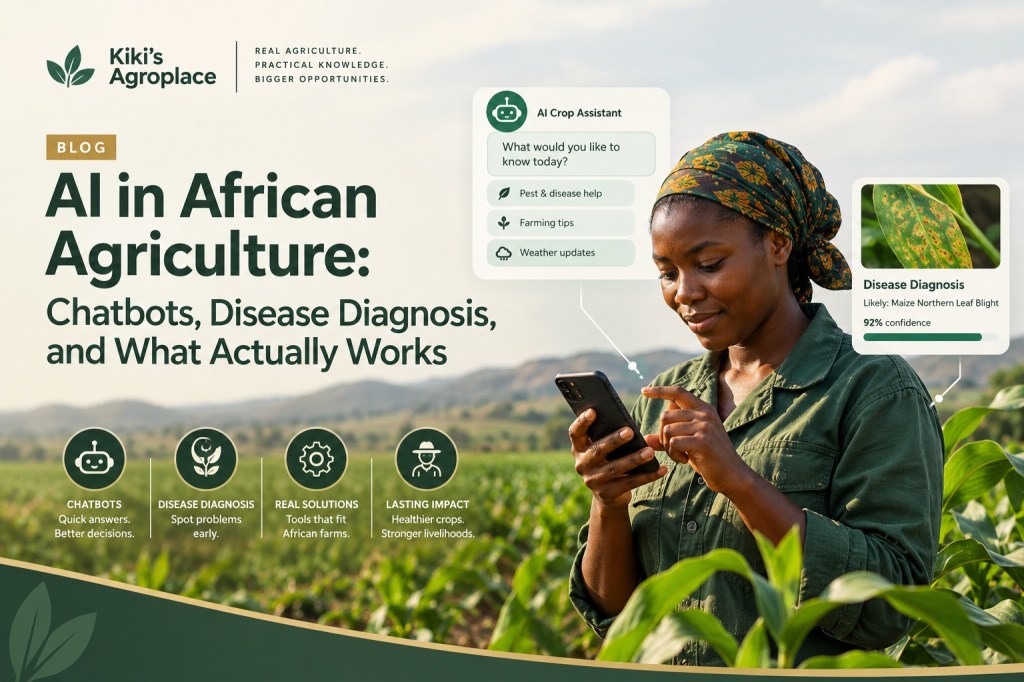
AI (artificial intelligence; software that can learn patterns from data and respond to new situations, rather than following fixed instructions) has become the newest layer of phone-first precision agriculture (using data and technology to farm more exactly, delivered through a basic mobile phone). It’s showing up on African farms in two distinct forms: a chatbot a farmer can talk to in their own language, and a camera that can diagnose a sick plant on the spot. This post covers what each one actually does, who’s using them, and how accurate they really are.
AI chatbots: an extension officer in your pocket
Most African countries have far too few agricultural extension officers (government or NGO-employed advisors who visit farmers to give hands-on growing advice) to reach every farmer who needs one. In some countries, a single officer is responsible for advising thousands of farmers spread across a wide area. AI chatbots are being built specifically to close that gap, delivered through apps most farmers already use.
A few examples, already reaching quite a number of farmers:
- Farmer.Chat, built by Digital Green, supports over 670,000 farmers across India, Kenya, Ethiopia, and Nigeria. Farmers can type, speak, or send a photo, and get advice back in their own language.
- Darli AI, built by Ghana-based Farmerline, works in 27 African languages and has reached 110,000 farmers since launching in 2024. A farmer in Uganda can send a photo of a discoloured yam and ask what’s wrong with it, or ask how to get their harvest to market.
- FarmerAI and UlangiziAI, built by Opportunity International with Safaricom in Kenya and the Malawian government in Malawi, were designed specifically for farmers with low literacy; the chatbot responds by voice, so reading isn’t required.
None of this happened by simply pointing a general AI model like ChatGPT at farming questions. Digital Green found that general AI models, trained mostly on data from outside Africa, gave generic or locally inaccurate advice when asked about specific African growing conditions. Their fix was retraining the model using thousands of real, expert-reviewed farming answers specific to the regions it serves. This matters for the site’s accuracy standard: a chatbot is only as good as the local knowledge it was actually trained on, not the general intelligence behind it.
AI disease diagnosis: a camera instead of a lab
The second use case works differently. Instead of answering open questions, it does one specific job well: a farmer photographs a plant, and the app tells them what disease or pest they’re looking at.
PlantVillage Nuru (built by Penn State University, with the International Institute of Tropical Agriculture, the UN Food and Agriculture Organization, and CGIAR research centres) diagnoses cassava mosaic disease, cassava brown streak disease, fall armyworm, and potato and sweetpotato blight, all from a single phone photo. Its most useful feature for this cluster’s phone-first thesis: it works completely offline, with no data connection needed at all, a meaningful advantage given how much mobile data costs relative to income, covered in our financing and affordability post.
Nuru’s accuracy is worth being honest about. A 2020 study measured its cassava disease diagnosis accuracy at around 65%; better than an average extension worker managed in the same test, but well below a specialist plant pathologist. That’s not a reason to dismiss the tool. It’s a reason to treat it as a useful first opinion, not a replacement for expert diagnosis on a serious or unfamiliar problem.
Where these two approaches fit together
Chatbots and diagnosis apps solve different problems, and increasingly overlap. A farmer might photograph a diseased leaf, get an instant diagnosis from an image-recognition tool, then ask a chatbot in their own language what to do about it next. Neither replaces the other, one recognises a specific problem, the other explains and answers follow-up questions.
Both approaches also raise the same evaluation questions covered in our piece on data ownership and hype. Most of these tools are backed by NGOs, universities, or telecom partnerships rather than farmer subscriptions, which means the same pilot-to-scale risk applies here too; worth checking farmer numbers and years of operation, not just the pilot announcement, before recommending one.
Key takeaways
- AI chatbots like Farmer.Chat, Darli AI, and FarmerAI now reach hundreds of thousands of African farmers, in local languages, by text, voice, or photo.
- A general AI model trained mostly on non-African data gives inaccurate local farming advice; tools retrain on local, expert-reviewed answers to fix this.
- AI disease-diagnosis apps like PlantVillage Nuru work from a single photo, often fully offline, but around 65% accuracy on some diseases means they’re a first opinion, not a replacement for expert diagnosis.
- Both tools are mostly backed by NGOs, universities, or telecoms rather than farmer payments; the same pilot-to-scale questions from elsewhere in this cluster apply here too.
Frequently asked questions
Can I just use ChatGPT for farming advice instead of a local app?
You can ask, but be cautious with the answer. General AI models are often trained mostly on data from outside Africa and can give generic or locally inaccurate advice for African crops, soils, and pests. Tools built and retrained specifically for local conditions, like Farmer.Chat or Darli AI, are a more reliable source for region-specific advice.
Do AI disease diagnosis apps need an internet connection?
Not always. PlantVillage Nuru works fully offline, which is a real advantage given how much mobile data costs relative to income across much of Africa. AI chatbots, by contrast, usually need an internet or SMS connection to work.
How accurate are AI plant disease diagnosis apps?
It varies by disease and app. PlantVillage Nuru’s cassava disease diagnosis was measured at around 65% accuracy in a 2020 study; useful as a first opinion, but not a substitute for an expert diagnosis on a serious or unclear case.
Kiki’s Agroplace: Bridging the knowledge gap.


Leave a Reply