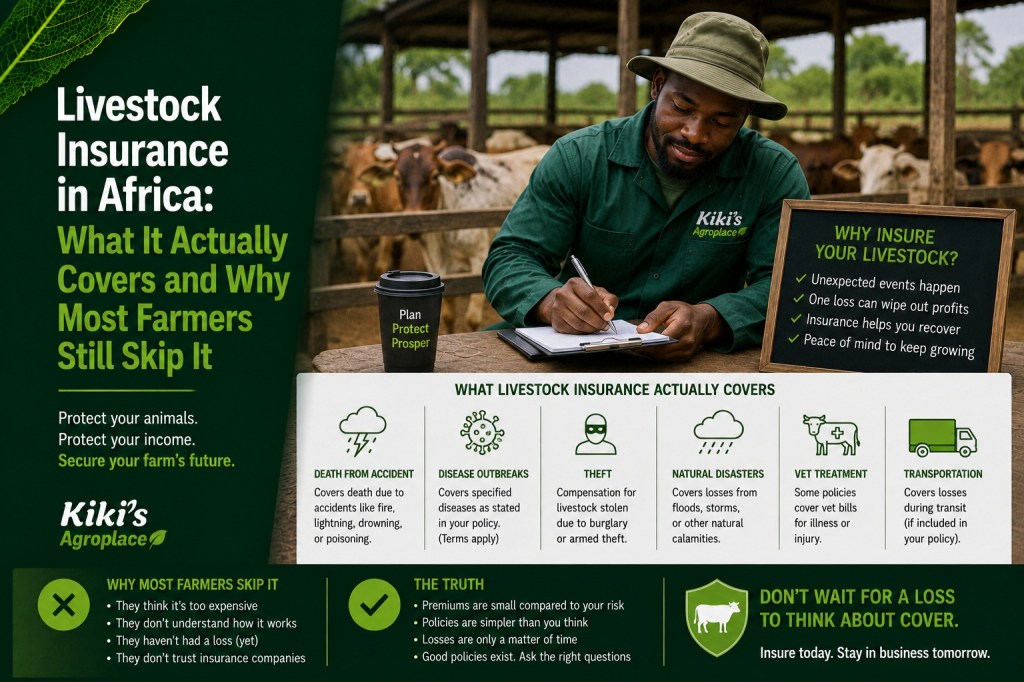
Two very different products fall under “livestock insurance” in Africa, and most farmers only vaguely know either exists. One works like standard business insurance: pay a premium, get compensated if an animal dies, gets sick, or is stolen. The other pays out based on satellite data measuring drought severity, sometimes before you’ve lost a single animal. Livestock insurance in Africa has real scale behind it now, but uptake still lags the payouts being made.
Conventional livestock insurance: the standard cover most commercial farms use
This is indemnity-based cover, meaning you get compensated for an actual, verified loss. It works for confined and semi-confined operations; dairy, poultry, beef, pigs, sheep, and goats, and typically covers:
- Accidental death and disease-related death of insured animals, often including emergency slaughter advised by a vet.
- Theft, particularly relevant for higher-value breeding stock or dairy herds.
- Fire and other named risks affecting housing, production facilities, or the animals themselves.
Premium rates in Kenya, for example, commonly run 4 to 9% of the total sum insured, with a minimum premium around Ksh 3,000 to 5,000 depending on your herd size. Nigerian insurers offer similar products structured around commercial poultry and livestock operations specifically.
A real, often-overlooked benefit: an insured farm generally has easier access to agricultural credit, since lenders are more willing to accept livestock as loan security when a policy backs it. If you’re planning to borrow against your herd or flock, insurance can be the thing that makes that borrowing possible in the first place.
Index-based livestock insurance: built for pastoralists and drought risk
This is where African livestock insurance has genuinely innovated. Index-Based Livestock Insurance (IBLI) doesn’t wait for an animal to die. It uses satellite-tracked vegetation data (essentially a “greenness map” of pastureland, updated every 10 to 16 days) to predict livestock mortality risk across a given area. When forage conditions cross a set threshold, indicating a severe drought is likely to cause significant herd losses, payouts trigger automatically, often before the worst losses have actually happened.
This matters specifically for pastoralist communities across the Horn of Africa, where drought is responsible for over half of all livestock losses and formal financial services are scarce. In 2023 alone, IBLI-linked programmes provided over $100 million in drought coverage to more than 200,000 households across the region, largely through subsidised schemes like Kenya’s DRIVE programme.
The gap: real payouts, still-low adoption
This is worth being straightforward about rather than overselling the technology. Research suggests IBLI could theoretically eliminate 25 to 40% of total livestock mortality risk across Africa’s drylands. In practice, adoption remains stubbornly low; one study in a Kenyan county found only around 10% of eligible pastoralists had actually purchased a policy, even where the product was available and functioning.
- Why adoption lags: Cost remains a real barrier even with subsidies, alongside limited trust in a product that pays based on satellite data rather than a visible, verified loss, and low general awareness in remote pastoralist areas.
- Where it’s working best: Government-backed schemes, like Kenya’s KLIP, which purchase policies directly for targeted households as part of social protection programming, have driven meaningfully higher uptake than commercial-only offerings.
- What this means for you: If IBLI is available in your area and you herd cattle, camels, sheep, or goats across drought-prone rangeland, it’s worth investigating directly with your county agricultural office or a local insurer, rather than assuming it’s inaccessible or too expensive without checking.
Which type actually fits your operation
- Confined or semi-confined commercial farms (dairy, poultry, feedlot beef, pig operations): conventional indemnity-based livestock insurance is the relevant product, covering death, disease, theft, and fire.
- Open-range pastoralist herding in drought-prone areas: IBLI, where available, addresses the specific risk that matters most; drought-driven herd loss across the Horn of Africa’s drylands in particular.
- Mixed or transitioning operations: It’s worth asking any insurer serving your region directly which product actually applies to your setup, since coverage availability varies significantly by country and even by county or state.
Mistakes that cost farmers the protection they could have had
- Assuming livestock insurance doesn’t exist or isn’t accessible. Both product types have real, functioning markets in multiple African countries; the gap is often awareness, not availability.
- Not asking how insurance affects your credit access. Insured livestock can be a stronger form of loan collateral, something worth raising directly with lenders if you’re seeking finance.
- Dismissing IBLI as untrustworthy without checking the track record. Government-backed programmes have made substantial, verified payouts; skepticism is reasonable, but it’s worth confirming the current state of the product in your area rather than assuming it doesn’t work.
- Buying cover without comparing providers. Premium rates and coverage terms vary; comparing at least two providers before committing is standard practice worth following here too.
Key takeaways
- Conventional livestock insurance covers death, disease, theft, and fire for confined and semi-confined operations, with Kenyan premiums typically running 4 to 9% of the insured sum.
- Index-based livestock insurance (IBLI) uses satellite vegetation data to trigger drought-related payouts, sometimes before major losses occur, and has delivered over $100 million in coverage to Horn of Africa pastoralists in a single recent year.
- Adoption of IBLI remains low relative to its scale and potential, held back by cost, trust, and awareness gaps rather than the product not working.
- Insured livestock can improve your access to agricultural credit, since lenders view insured herds as stronger collateral.
- Which product fits depends entirely on your system; confined commercial operations need conventional cover, while open-range pastoralists in drought-prone regions are the specific audience IBLI was built for.
FAQ
What does conventional livestock insurance cover?
It typically covers accidental death, disease-related death, theft, and fire affecting insured animals and, in some policies, related facilities. Coverage details and premiums vary by provider and country.
How does index-based livestock insurance (IBLI) work?
IBLI uses satellite data tracking pasture vegetation quality to predict area-wide livestock mortality risk from drought. When conditions cross a set threshold, payouts trigger automatically for policyholders in that area, rather than requiring proof of individual animal loss.
Why don’t more pastoralists buy livestock insurance if it works?
Cost, limited trust in a payout system based on satellite data rather than visible loss, and low awareness in remote areas are the main documented barriers. Government-backed subsidy programmes have measurably improved uptake compared to commercial-only offerings.
How much does livestock insurance cost in Kenya?
Conventional livestock insurance premiums in Kenya commonly range from 4 to 9% of the total sum insured, subject to a minimum premium of roughly Ksh 3,000 to 5,000 depending on herd size and type. IBLI premium structures differ and are often subsidised through government programmes in eligible areas.
Does livestock insurance help with getting a farm loan?
Yes, in many cases. Insured livestock is generally viewed as stronger loan collateral by lenders, since the policy protects the lender’s security against unexpected animal loss. If you’re seeking agricultural finance, it’s worth asking your lender directly how insurance affects your application.
Kiki’s Agroplace: Bridging the knowledge gap in agriculture.


Leave a Reply