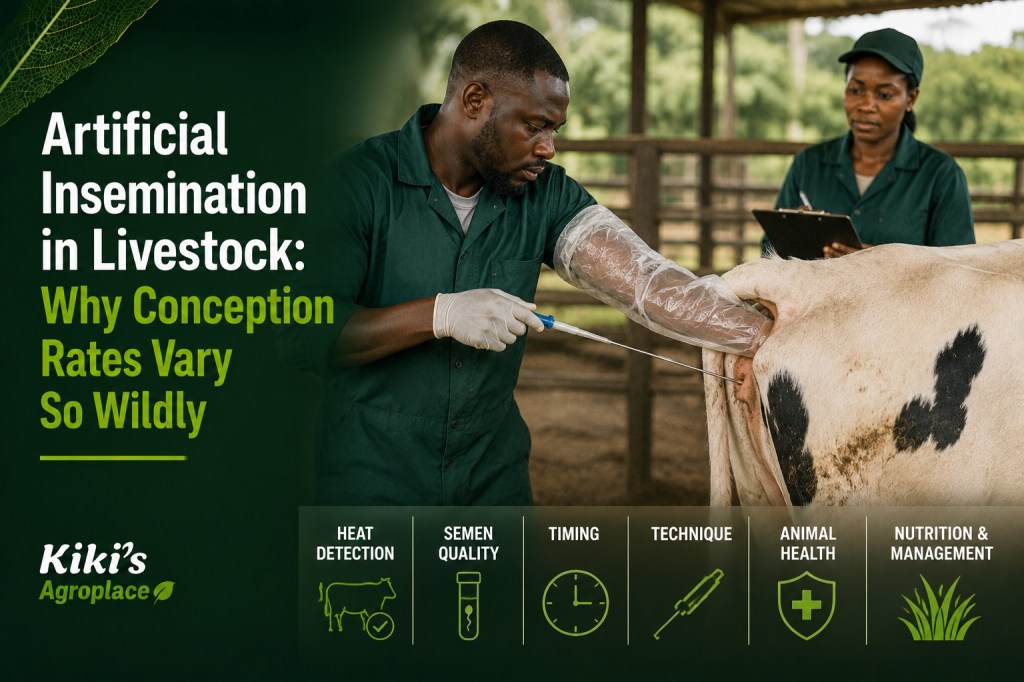
Studies of dairy AI programmes across Ethiopia report conception rates anywhere from 45% to 62%, sometimes within the same region. That gap isn’t random, and it’s rarely about the technology failing. Artificial insemination can genuinely transform your herd’s genetics without you ever owning a bull, but getting the conception rate that makes it worthwhile comes down to a short list of fixable practices, starting with timing.
See our beef cattle reproductive performance guide for the wider picture on breeding management.
What AI actually offers your herd
- Genetic improvement without buying a bull. AI gives you access to proven, high-performing genetics (better milk yield, growth rate, or disease resistance) without the cost of purchasing and maintaining a breeding bull yourself.
- Faster genetic progress across a herd. A single quality bull’s semen can be used across far more cows through AI than through natural mating, spreading genetic improvement faster.
- Reduced disease transmission risk. Without direct bull-to-cow contact, AI can lower the risk of spreading certain reproductive diseases through natural mating.
- Crossbreeding access. AI makes it realistic to breed local cows to exotic or improved genetics even where you couldn’t otherwise access or afford that breed of bull directly.
Why conception rates vary so wildly between farms
The research is consistent on this point, even where the specific numbers differ: heat detection timing is the single biggest lever most farmers actually control. One Ethiopian study found a significant difference in conception rate between cows inseminated within 6 hours of showing heat signs versus those inseminated after 12 hours had passed. Miss the window, and even perfect semen and a skilled technician won’t save the service.
- Heat detection timing: The most consistently cited, most fixable factor across the research. Learning to recognise and act on heat signs promptly matters more than almost anything else on this list.
- Liquid nitrogen and semen supply gaps: AI semen is stored at minus 196°C in liquid nitrogen, and unreliable supply of either input is repeatedly flagged as a major constraint across multiple African AI delivery studies. A break in this cold chain damages semen quality before it ever reaches your cow.
- Distance to AI services and technician availability: Farms further from an AI centre or technician face delays that work directly against the tight timing AI requires.
- Breed: Crossbred cows have shown higher conception rates than local breeds in comparative studies, likely reflecting broader differences in overall herd management and nutrition alongside genetics.
- Seasonal service gaps: AI technician workload in Ethiopia has been shown to swing sharply by season, with roughly three times more daily inseminations performed in peak months than in the slowest months, meaning service reliability itself isn’t constant year-round.
What a failed first insemination actually costs you
This is worth putting a number on. Research from Eastern Ethiopia found that cows failing to conceive at their first AI service incurred an additional cost of roughly 440 Ethiopian birr per day until they eventually conceived, driven by lost milk production, extra feed, and labour during the extended wait. Multiply that by however many extra days or repeat services it takes, and a poorly timed first insemination is an expensive mistake, not a minor inconvenience.
Practical steps to improve your odds
- Learn heat signs properly, or train whoever manages your herd day to day. Standing to be mounted, mucus discharge, restlessness, and reduced feed intake are common signs; the goal is catching these early enough to inseminate within the effective window.
- Use a cow-side confirmation test where available. Simple field tests, like a progesterone-based test trialled in Kenyan smallholder herds, can help confirm correct timing and avoid inseminating a cow that’s already pregnant, which wastes semen and money.
- Work with a reliable, ideally nearby, AI technician or service. Distance and availability directly affect whether you can act within the timing window that matters most.
- Keep records. Track heat dates, insemination dates, and outcomes so you can identify whether your farm’s conception rate is actually improving or where it’s consistently falling short.
- Check subsidised public options in your area. Some countries, including Ethiopia, offer heavily subsidised public AI services at a fraction of the cost of private alternatives; it’s worth checking what’s available locally before assuming AI is out of reach financially.
Is AI worth it for a smallholder?
Honestly, it depends on your access to reliable infrastructure more than anything else. AI works best where you have a functioning liquid nitrogen and semen supply chain, a technician you can reach quickly when a cow shows heat, and the discipline to track and act on timing. Where any of these pieces are unreliable, natural mating with a good bull may deliver more consistent results, even if it’s slower for genetic improvement across your whole herd. Check what infrastructure exists in your area before committing, rather than assuming AI will work the same way it does in better-resourced regions.
Mistakes that waste an AI service
- Inseminating too late after heat signs appear. This is the most consistently documented cause of poor conception rates across the research.
- Not verifying the local supply chain before committing. If liquid nitrogen and semen aren’t reliably available in your area, AI conception rates will suffer regardless of anything else you do right.
- Skipping records. Without tracking outcomes, you can’t tell whether a poor result was a one-off or a pattern worth addressing.
- Assuming AI is always the better choice. Where infrastructure is unreliable, natural mating with a quality bull can outperform a poorly supported AI programme.
Key takeaways
- AI gives you access to better genetics and faster herd-wide improvement without owning a bull, but real-world conception rates vary widely, from roughly 45% to over 60% across different studies.
- Heat detection timing is the biggest fixable factor; inseminating within 6 hours of heat signs meaningfully outperforms waiting past 12 hours.
- Liquid nitrogen and semen supply reliability, technician distance, and breed all affect your realistic conception rate.
- A failed first insemination carries a measurable cost in lost milk, feed, and time; this isn’t a minor setback.
- AI works best where the supporting infrastructure is genuinely reliable; check what exists in your area honestly before committing to it over natural mating.
FAQ
What is the best time to inseminate a cow after she shows heat signs?
Research points to a significant advantage in conception rate when insemination happens within 6 hours of heat signs appearing, compared to waiting past 12 hours. Prompt heat detection and action are the most important factors most farmers can directly control.
Why do AI conception rates vary so much between farms and regions?
The main documented factors are heat detection timing, reliability of liquid nitrogen and semen supply, distance to AI technicians and services, and breed differences, with crossbred cows generally showing higher conception rates than local breeds in comparative studies.
How much does a failed AI service actually cost?
One study in Eastern Ethiopia found an additional cost of roughly 440 Ethiopian birr per day for cows that failed to conceive at their first service, driven by lost milk production, feed, and labour during the extended open period until eventual conception.
Is artificial insemination better than natural mating?
It depends on your infrastructure. AI offers faster genetic improvement and access to better genetics without owning a bull, but it depends on reliable liquid nitrogen and semen supply and prompt technician access. Where that infrastructure is unreliable, natural mating with a quality bull can deliver more consistent results.
Can I use a cow-side test to know when to inseminate?
Yes, in some areas. A progesterone-based cow-side test has been trialled successfully in Kenyan smallholder dairy herds to help confirm correct timing and avoid inseminating cows that are already pregnant, reducing wasted services.
Kiki’s Agroplace: Bridging the knowledge gap in agriculture.


Leave a Reply