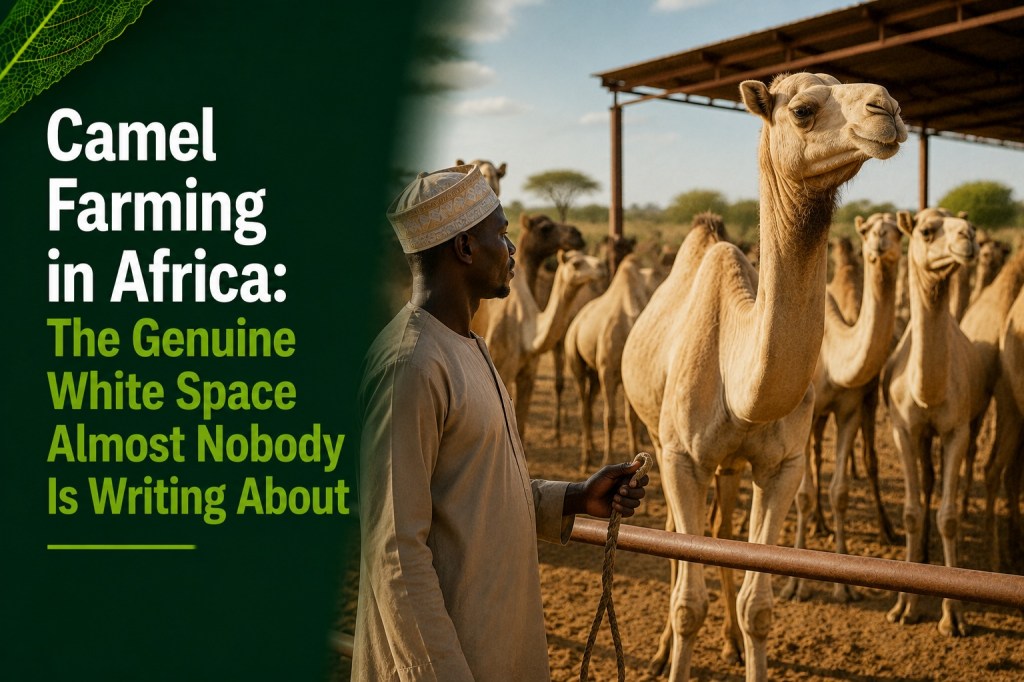
There’s an old pastoralist saying worth knowing before anything else in this guide: the cow is the first animal to die in a drought, and the camel is the last. Africa holds over 80% of the world’s dromedary camels, and in parts of West Africa, camel populations have multiplied twelvefold since 1963. Camel farming in Africa is a white space in agricultural content, not because it’s obscure, but because it’s growing fast in real life while almost nobody is writing about it.
Why herders are actively switching to camels right now
This isn’t a theoretical opportunity. In parts of Kenya, county governments have directly purchased and distributed camels to cattle-keeping communities as a deliberate climate adaptation strategy, speeding up a shift that had already been underway for decades in several cattle-dependent regions. The global camel population has doubled over the past 20 years, a trend the UN’s agriculture agency attributes partly to the animal’s suitability for a changing climate.
The core advantage is simple: camels continue to produce milk under drought conditions that would dry up cattle entirely. In Northern Kenya, camels account for up to 50% of the total nutrient intake for pastoralist communities during extended droughts, making them a crucial food security tool, not just an income source.
Breeds worth knowing in East Africa
| Breed | Weight (live) | Best suited to |
|---|---|---|
| Turkana | 250–500kg | Steep, rocky, hilly terrain; the most resilient breed to feed scarcity among Kenya’s camel breeds |
| Rendile / Gabbra | 300–550kg | Poor pasture and rough terrain; strong drought tolerance |
| Somali | 450–850kg | Open, less rocky terrain; the largest of the three, with four recognised subtypes, but too large for steep or hilly ground |
Terrain, more than any other single factor, should guide your breed choice. A Somali camel’s size is an asset on open ground and a liability on the hills; a Turkana camel handles easily.
What it actually costs to start
Be honest with yourself about this before committing: camels cost more upfront than the cattle most farmers are used to. Kenyan livestock market data from 2021 put a single camel at $421 to $526, roughly equivalent to 2 to 3 cattle or about 10 goats at the time. More recent purchases by a Kenyan county government paid around $600 per camel as part of a herder support programme. Female camels in particular tend to cost more than dairy cattle, which is one of the clearest financial barriers to farmers considering the switch.
The other barrier is knowledge, not just money. Most agricultural extension services and farmer networks across the continent are built around cattle, goats, and poultry; camel-specific husbandry knowledge is far less widely available, and a lack of skills and experience is consistently cited as an obstacle for farmers considering camels for the first time.
The milk economics behind the growth
Kenya and Somalia rank among the world’s top camel milk producers, and Somalia in particular has seen rapid, documented growth in demand and the broader camel milk value chain in recent years, even amid decades of political instability. This isn’t a niche product with uncertain demand; it’s a real, growing market with established regional trade patterns.
Camel milk also holds a genuine nutritional edge worth knowing about if you’re positioning your product: it’s notably rich in Vitamin C and iron compared to cow’s milk, a detail that matters both for the pastoralist communities that depend on it and for any market positioning beyond subsistence use.
Closing the knowledge gap
- Seek out experienced camel-herding communities directly. Groups with generations of camel husbandry experience, such as Turkana herders in Kenya, are a more reliable knowledge source than generic livestock extension services not built around this species.
- Start smaller than you would with cattle. Given the higher upfront cost per animal and the steeper learning curve, a smaller starting herd limits your financial exposure while you build real husbandry experience.
- Match your breed to your actual terrain, not just to whichever breed happens to be available nearby; a mismatch here works against the animal’s natural resilience rather than with it.
- Look for regional government or NGO support programmes. Given the active climate-adaptation push behind camel adoption in parts of Kenya and elsewhere, county or regional programmes may offer subsidised access, training, or veterinary support worth investigating before buying at full market price.
Mistakes that cost new camel farmers the most
- Underestimating the upfront cost. A single camel can cost more than 2 to 3 cattle; budget accordingly rather than assuming camel farming is automatically cheaper because the animals need less feed.
- Assuming cattle knowledge transfers directly. Camel husbandry has real differences from cattle management; skipping this learning curve costs more in animal health and productivity than the time invested in learning it properly.
- Choosing breed by availability rather than terrain fit. A Somali camel on steep, rocky ground, or a Turkana camel where a larger breed would thrive, both underperform their potential.
- Overlooking the milk market opportunity. With Kenya and Somalia both established as major global camel milk producers, this isn’t just a subsistence animal; there’s a commercial market worth planning toward from the start.
Key takeaways
- Africa holds over 80% of the world’s dromedary camels, and populations are growing fast, driven partly by active, real-world climate adaptation shifts away from cattle.
- Camels keep producing milk through drought conditions that dry up cattle, making them a food security asset in pastoralist regions, not just an income source.
- Breed choice should match your terrain; Turkana suits steep, rocky ground, while larger Somali camels need open terrain.
- Camels cost more upfront than cattle, roughly 2 to 3 times as much per animal based on recent Kenyan market data, and husbandry knowledge is a real, honest barrier given limited camel-specific extension support.
- Kenya and Somalia are already established as major global camel milk producers, meaning real commercial demand already exists for anyone entering this space seriously.
FAQ
How much does a camel cost in Africa?
Kenyan livestock market data from 2021 recorded prices of $421 to $526 per camel, roughly equivalent to 2 to 3 cattle. More recent purchases by a Kenyan county government paid around $600 per camel. Prices vary by breed, region, and market conditions.
Why are camels considered more drought-resistant than cattle?
Camels continue producing milk under drought conditions that typically cause cattle production to fail, reflected in the pastoralist saying that cattle are the first animal to die in a drought and camels the last. This is a major reason herders in parts of Kenya and elsewhere are actively shifting toward camel keeping.
Which camel breed is best for hilly or rocky terrain?
Turkana camels are best suited to steep, rocky, and hilly ground, and are considered the most resilient of Kenya’s main camel breeds to feed scarcity. Larger Somali camels perform better on open, less rocky terrain due to their size.
Is there a commercial market for camel milk in Africa?
Yes. Kenya and Somalia both rank among the world’s top camel milk producers, and Somalia in particular has seen documented, rapid growth in camel milk demand and value chain development in recent years.
What is the biggest barrier to starting camel farming?
Cost and knowledge are the two most commonly cited barriers. Camels cost more upfront than cattle, and camel-specific husbandry knowledge is far less widely available through standard agricultural extension services than cattle, goat, or poultry knowledge is.
Kiki’s Agroplace: Bridging the knowledge gap in agriculture.


Leave a Reply