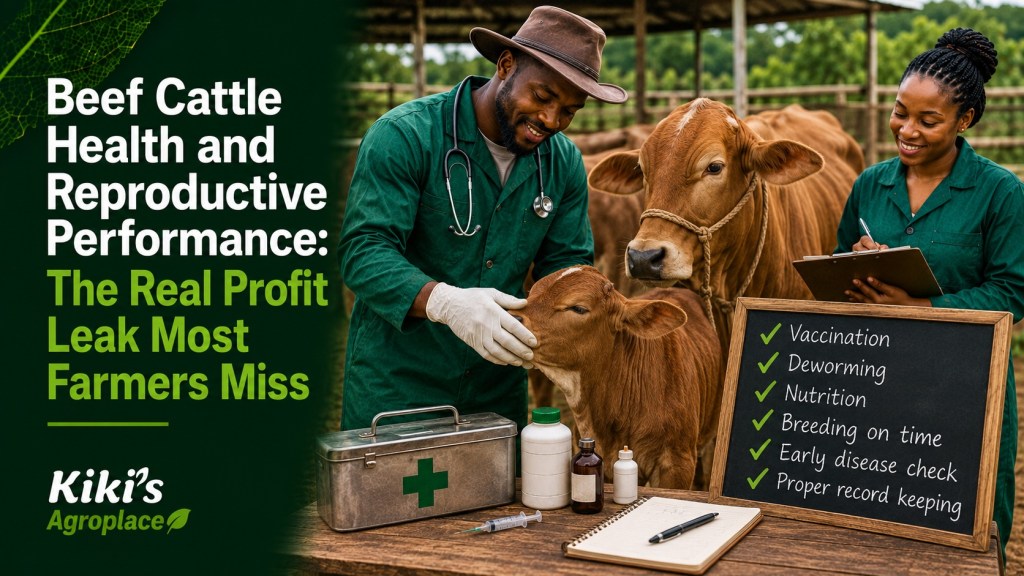
Most beef cattle health content focuses on disease. That matters, but for a lot of smallholder herds, it’s not the biggest leak. A South African benchmarking study of nearly 3,700 cows across 40 smallholder herds found an average calving interval of 608 days, against an achievable target of 425. Beef cattle health and reproductive performance go together, and the reproduction side is where most farmers are quietly losing the most money.
Start with the breed and systems guide if you haven’t already.
What the reproduction gap actually costs you
A 608-day calving interval means a cow produces a calf roughly every 20 months. At the study’s target benchmark of 425 days, that same cow produces a calf every 14 months instead. Over a cow’s productive lifetime, that difference adds up to noticeably more calves, and noticeably more income, from the same animal.
The same study found smallholder herds averaging a 50% pregnancy rate and 12% fetal and calf losses, against derived target benchmarks of 54% pregnancy rate and just 1.4% fetal and calf losses. That fetal and calf loss gap in particular represents calves conceived but never reaching a sale, which is money spent on breeding with nothing to show for it.
Four fixable practices behind the gap
The same research identified specific, correctable management gaps linked to poor reproductive performance. None of these require new technology; they’re practices, not purchases.
- Body condition scoring before breeding. Farms with no knowledge of body condition score (BCS) prior to breeding showed measurably worse reproductive performance. A cow in poor condition at breeding time is less likely to conceive and more likely to lose a pregnancy. Check condition ahead of the breeding season, not after.
- Culling old and non-productive cows. Keeping cows past their productive years drags down herd-wide averages. A cow that hasn’t calved in the expected window is a candidate for culling, not another breeding season.
- Record keeping. Farms without records can’t identify which cows are underperforming or track calving intervals at all. Even a basic notebook tracking calving dates and breeding dates gives you the data to make culling and management decisions.
- Bull-to-cow ratio. A low bull-to-cow ratio was directly linked to poorer reproductive outcomes in the study. If your bull is covering more cows than he can effectively manage, some simply won’t get bred during the fertile window.
The weaning age trade-off
A separate South African study compared early weaning (90 days) against conventional weaning (205 days) in Bonsmara cow-calf pairs, and the results cut both ways rather than pointing to one clear winner.
- Early weaning’s advantage: Cows with early-weaned calves achieved a 94% pregnancy rate, compared to 84% for cows with conventionally weaned calves. Weaning earlier reduces the energy drain of lactation, letting the cow recover body condition and rebreed more successfully.
- Conventional weaning’s advantage: Calves weaned conventionally were, on average, 27kg heavier at weaning than early-weaned calves, a real difference in sale weight and value.
- The honest takeaway: There’s no universally correct answer here. If your herd is struggling with rebreeding rates, especially in first-calf heifers or during dry, nutritionally stressed periods, earlier weaning is a legitimate tool worth considering, even though it costs you some weaning weight per calf.
Disease still matters, especially around calving
The major diseases affecting beef cattle largely overlap with what we’ve already covered for dairy cattle; East Coast Fever in East and Southern Africa, trypanosomiasis in the West African tsetse belt, brucellosis, and Foot and Mouth Disease. Rather than repeat that ground, see our full dairy cattle disease guide for symptoms, treatment, and prevention detail that applies equally to beef herds.
What’s worth calling out specifically for beef herds is how directly these diseases connect to the reproduction numbers above. Brucellosis causes late-term abortion. FMD and other stress-inducing illness can disrupt a cow’s cycle enough to push her outside the breeding window. A disease problem in your herd doesn’t just risk an animal’s health; it shows up months later as a wider calving interval and a lower pregnancy rate, even after the animal has recovered.
Building a basic breeding season routine
- Before the breeding season: Score body condition across the herd and address any cows in poor condition before turning bulls in, rather than hoping they improve during breeding.
- Define a breeding season, not continuous breeding. A defined breeding window, rather than year-round exposure to a bull, makes calving predictable and easier to manage around feed and labour.
- Check your bull-to-cow ratio. Confirm your bull can realistically cover the number of cows in your herd within the breeding window.
- Keep records from day one. Track breeding dates, calving dates, and any losses. This is the foundation for every other decision on this list.
- Review annually. Compare your herd’s pregnancy rate and calving interval against the benchmarks above, and cull or adjust management based on what the numbers show, not guesswork.
Mistakes that cost you calves
- Breeding cows in poor body condition. This is one of the most consistently identified, and most fixable, drivers of poor reproductive performance.
- Keeping unproductive cows out of sentiment or habit. Every cow not calving on schedule is dragging down your herd average and taking up resources a productive cow could use.
- Running cattle without records. Without records, you can’t know your actual calving interval or pregnancy rate, which means you can’t know whether your management is working.
- Treating disease and reproduction as separate problems. They’re connected. A disease outbreak this season can show up as a wider calving interval next season.
Key takeaways
- South African smallholder beef herds average a 608-day calving interval against an achievable 425-day target, a gap that directly costs you calves over a cow’s lifetime.
- Four fixable practices drive most of the gap: body condition scoring before breeding, culling unproductive cows, record keeping, and an adequate bull-to-cow ratio.
- Early weaning improves rebreeding rates but costs weaning weight; there’s a genuine trade-off rather than one correct answer.
- Disease and reproduction are connected; illness around breeding or calving time can widen your calving interval even after the animal recovers.
- None of the highest-impact fixes here require new equipment or major capital; they’re management practices you can start this breeding season.
FAQ
What is a good calving interval for beef cattle?
Research on South African smallholder herds derived a target benchmark of 425 days, compared to an average of 608 days actually observed across the herds studied. A calving interval close to 12 to 14 months is generally considered strong performance.
Why does body condition score matter for breeding?
A cow in poor body condition at breeding time is less likely to conceive and more likely to lose a pregnancy. Checking and managing body condition ahead of the breeding season, rather than during or after it, is one of the most consistently identified fixes for poor reproductive performance.
Should I wean calves early or conventionally?
It depends on your priority. Early weaning (around 90 days) improves the cow’s pregnancy rate for the next breeding season, since it reduces the energy demand of lactation. Conventional weaning (around 200 days) produces heavier calves at weaning. If rebreeding rates are a bigger problem in your herd than weaning weight, early weaning is worth considering.
What bull-to-cow ratio should I use?
This varies by bull age, fertility, and terrain, but research has directly linked a low bull-to-cow ratio to poorer reproductive outcomes in smallholder herds. If you’re unsure whether your current ratio is adequate, ask your local vet or extension officer for a recommendation suited to your specific bull and herd size.
Can disease affect my herd’s calving interval even after animals recover?
Yes. Diseases like brucellosis can cause direct pregnancy loss, and general illness or stress around breeding time can disrupt a cow’s cycle enough to push conception outside the intended breeding window, widening the calving interval even months after the animal has physically recovered.
Kiki’s Agroplace: Bridging the knowledge gap in agriculture.


Leave a Reply