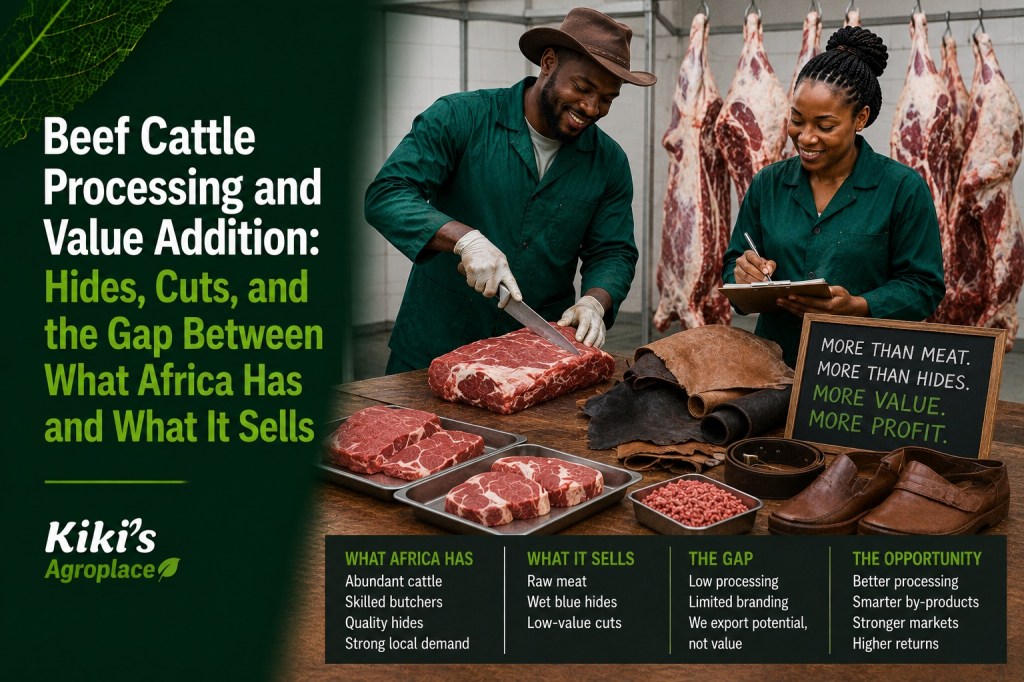
Africa holds roughly 10% of the world’s cattle population, yet produces only about 4.5% of the world’s bovine hides. That gap isn’t about herd size; it’s about offtake, handling, and how much value gets captured after the animal leaves the farm. Beef cattle processing and value addition covers more than meat, and the hide is often the most under-exploited part of the whole animal.
Start with the breed and systems guide if you haven’t already.
The hide gap, and where it actually comes from
Ethiopia offers a clear illustration of the problem. Its cattle offtake rate (the share of the herd slaughtered each year) sits at around 7%, well below both the African average of roughly 12.7% and the world average of over 20%. Fewer animals reaching slaughter each year means fewer hides reaching tanneries, quite apart from any handling issues.
Handling adds a second layer to the problem. Industry estimates suggest that a quarter to a third of skins reaching tanneries are unsuitable for export due to defects picked up during slaughter and handling; branding marks, scratches, flay cuts, and poor preservation are the most commonly cited causes.
- What raw hides are actually worth: Recent pricing puts raw cow hide at roughly $1.50 to $3 per square foot in Kenya and $1.80 to $3.50 per square foot in Nigeria, with tanning generally doubling the value of the raw material.
- Basic handling that protects that value: Avoid flay cuts (accidental knife marks, gouges, or full perforations on the flesh side of a hide or skin) during skinning, keep branding away from prime hide areas where possible, salt the hide promptly after removal, and dry it in a shaded, ventilated space rather than direct sun.
- Where the value actually lands: Most African hide production is exported raw or semi-processed rather than finished. Ethiopia, Nigeria, and several other countries have real, if underused, domestic tanning capacity; selling to a local tannery rather than a raw-hide exporter captures more of that doubling in value locally.
Cuts, offal, and getting more from the carcass
Beyond the hide, how you sell the meat itself shapes your margin as much as how you raise the animal.
- Sell to your market, not just tradition. Urban buyers, supermarkets, and restaurants increasingly want specific cuts, sold pre-portioned and labelled, rather than a whole or half carcass. This opens relationships whole-animal sales generally can’t.
- Don’t discount offal. Organ meats, tongue, and other offal cuts are in demand across African urban markets and are often sold separately rather than bundled cheaply into a whole-carcass sale.
- Nothing needs to go to waste. Kenya Meat Commission’s processing model, though industrial in scale, illustrates the principle at work: alongside meat, they process hides, skins, hooves, horns, and blood into separate saleable by-products rather than treating anything as waste. A smaller operation can apply the same logic at a smaller scale.
Turning beef into a shelf-stable product
Fresh beef needs a cold chain to hold its value, and that cold chain is exactly what a lot of African beef producers don’t reliably have access to. Two paths solve this differently:
- Industrial canning: Corned beef canning, as run by operations like the Kenya Meat Commission, produces a shelf-stable product that needs no refrigeration at any point. This is capital-intensive and generally out of reach for an individual smallholder, but worth understanding as the model larger cooperatives or processing partnerships might eventually work toward.
- Traditional dried and cured products: Kilishi, suya, and biltong, covered in depth in our goat and sheep processing guide, work just as well with beef as with chevon or mutton, and need far less capital than a canning line. If you’re a smallholder without cold storage, this is the more realistic entry point.
A constraint worth knowing about: research on Northern Ghana’s beef supply chain found that older corned-canned beef producers were losing ground to modern sausage products that need refrigeration, even though the canned product itself doesn’t. Consumer preference is shifting toward chilled and frozen products in many urban markets, which raises the cold-chain investment bar even for producers who’d rather avoid it.
Mistakes that leave value in the abattoir yard
- Careless flaying and branding placement. A quarter to a third of hides get rejected for export-grade processing due to handling defects that are almost entirely avoidable.
- Selling hides raw to the first buyer. Local tanneries and cooperatives generally offer better rates than exporters buying raw, untreated hides.
- Treating offal as waste rather than product. Organ meats have real, distinct market demand and shouldn’t be bundled in at a discount out of habit.
- Assuming shelf-stable means low investment. Traditional dried products like kilishi and biltong are the accessible entry point; industrial canning is a different scale of investment entirely, and conflating the two leads to unrealistic planning.
Key takeaways
- Africa produces far fewer bovine hides than its cattle population suggests it could, driven by low offtake rates and avoidable slaughter defects.
- Basic hide handling (clean flaying, prompt salting, proper drying) protects value that’s otherwise routinely lost.
- Selling to a local tannery rather than a raw-hide exporter captures more of the roughly doubled value that tanning creates.
- Offal and by-products like hooves, horns, and blood have market value and shouldn’t be treated as waste.
- Traditional dried and cured products are the realistic value-addition entry point for most smallholders; industrial canning is a different scale of business entirely.
FAQ
Why does Africa export so little processed leather despite having so much cattle?
A combination of low cattle offtake rates in several countries, avoidable hide damage during slaughter and handling, and a continued reliance on exporting raw or semi-processed hides rather than finished leather. Domestic tanning capacity exists in countries like Ethiopia and Nigeria but remains underused relative to the raw material available.
How much is a raw cattle hide worth?
Recent pricing places raw cow hide at roughly $1.50 to $3 per square foot in Kenya and $1.80 to $3.50 per square foot in Nigeria, though prices shift with quality, demand, and season. Tanning generally doubles the value of the raw hide.
What causes hides to be rejected for export?
The most commonly cited causes are branding marks, scratches, flay cuts from careless skinning, and poor preservation or storage after slaughter. An estimated quarter to a third of hides reaching tanneries fail export-grade standards for these reasons.
Can I make biltong or kilishi from beef?
Yes. Both traditionally use beef as a base meat, alongside mutton and goat in some regional variations. See our goat and sheep processing guide for the full method and hygiene considerations, which apply the same way to beef.
Is corned beef canning realistic for a smallholder to start?
Generally not on an individual scale. Industrial canning operations require significant capital investment in processing equipment and food safety infrastructure. Traditional dried and cured products like kilishi or biltong offer a far more accessible starting point for adding shelf-stable value to beef.
Kiki’s Agroplace: Bridging the knowledge gap in agriculture.


Leave a Reply