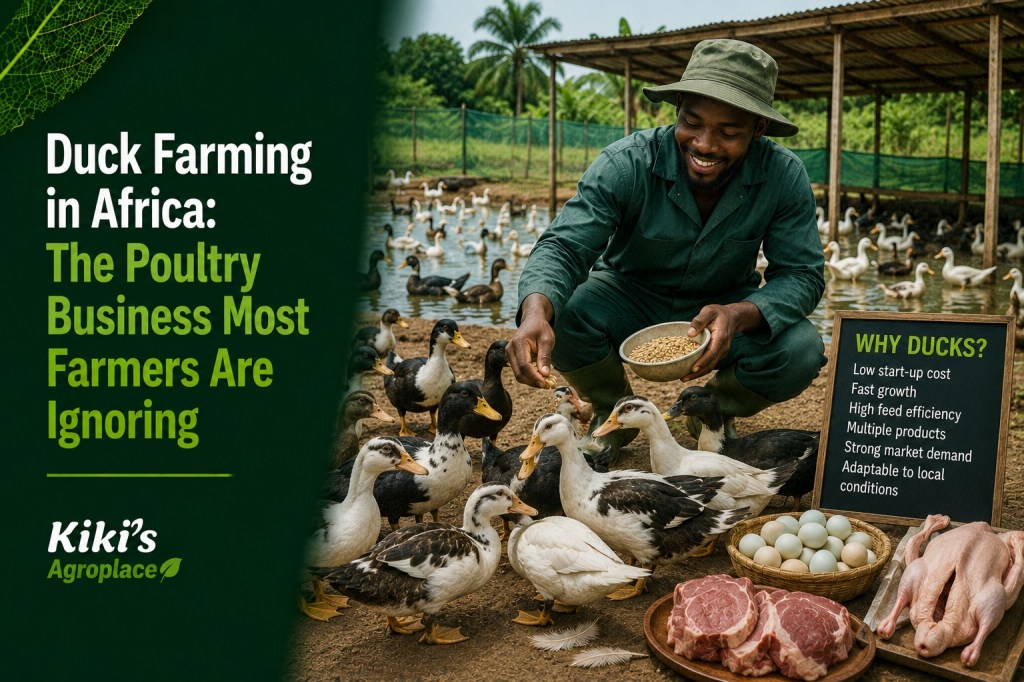
Africa is home to roughly 2% of the world’s duck production, a strikingly small share for a continent with the climate and smallholder farming structure to support it well. Most farmers default straight to chicken without seriously weighing this option. Duck farming in Africa deserves more attention than it gets, and the reasons come down to lower investment, hardier birds, and a myth about water that keeps a lot of would-be duck farmers from ever starting.
Compare against chicken economics in our broiler vs layer guide.
Why ducks are genuinely underrated here
Ducks bring a few practical advantages that get overlooked because most agricultural extension attention and policy focus goes to chicken and, to a lesser extent, turkey. Research and field reporting consistently point to lower mortality rates, strong feed conversion efficiency, and better natural disease resistance in ducks compared to chicken kept under similar smallholder conditions.
And here’s the myth worth clearing up immediately: you don’t need a pond. Ducks are waterfowl by classification, but they can be raised successfully in confined housing on a free-range or semi-confined system without access to a swimming pond, the same way any other poultry bird is kept. Access to water for drinking and light bathing helps, but a full water body is not a requirement to start.
Breeds worth knowing
| Breed | Best for | Notes |
|---|---|---|
| Muscovy | Smallholder meat production | The most popular choice across West Africa; quiet, an excellent forager, and broody, meaning hens hatch their own eggs without needing an incubator. Nigerian local Muscovy males reach 4.5 to 6.8kg, females 2.3 to 3.1kg, market-ready around 12 weeks |
| Pekin | Fast commercial meat growth | Rapid weight gain and white feathers for a cleaner carcass, but needs more intensive management and a higher-protein diet than Muscovy |
| Mule (Mulard) | Premium lean meat | A hybrid of Muscovy drake and Pekin duck; sterile, fast-growing, and marketable as early as 8 weeks, bred specifically for lean meat |
| Khaki Campbell / Indian Runner | Egg production | Strong layers if you’re prioritising eggs over meat, though less common in West African smallholder systems than Muscovy |
| Local/indigenous duck | Low-input, high resilience | Slower growing but highly adapted to local disease pressure and climate stress, with minimal input requirements |
For most first-time duck farmers in West Africa, Muscovy is the sensible starting point. The self-hatching trait alone removes one of the biggest cost barriers new poultry farmers face elsewhere.
Housing and basic setup
- Housing doesn’t need to be elaborate. A simple, secure, well-ventilated structure that keeps birds safe overnight and protected from predators covers the basics.
- Start small. Beginning with 50 to 100 ducklings sourced from a certified hatchery gives you birds with a known vaccination and health background, rather than an unknown mix from an informal source.
- Backyard flock structure: A common smallholder setup pairs one drake with 5 to 10 ducks, letting the ducks hatch and raise their own broods without additional equipment.
- Free-range works well in riverine and high-rainfall areas. Ducks in Nigeria are commonly raised free-range alongside chickens in regions with higher rainfall, though this isn’t a strict requirement for smallholder success.
What the economics actually look like
Egg production varies sharply by management level. Local Muscovy ducks kept under scavenging, backyard conditions typically lay 60 to 80 eggs a year, while the same breed under improved management can reach 100 to 125 eggs a year, at roughly 72g per egg.
On the meat side, Muscovy and Mule ducks both reach market weight faster than most people expect, at 8 to 12 weeks depending on breed. In Nigeria, live ducks sell in a wide range, typically between ₦5,000 and ₦20,000, depending on breed and size, giving you real flexibility in how you position your product.
Where duck products actually sell
- Local markets: The default channel for most smallholder duck farmers, particularly for Muscovy and local breeds.
- Restaurants and hotels: Duck holds a specific culinary niche, and Chinese and Japanese restaurants in particular are a documented, ongoing market for duck meat in Nigeria beyond the general poultry market.
- Food processors and retail: A smaller but growing channel as urban demand for duck products increases alongside broader poultry consumption.
Mistakes that hold new duck farmers back
- Assuming you need a pond before you can start. This misconception alone likely keeps a meaningful number of would-be duck farmers from ever trying. Confined or free-range housing works without a swimming water body.
- Choosing Pekin without the management capacity for it. Pekin’s fast growth comes with a higher management and protein-feed requirement than Muscovy; mismatch here costs you performance.
- Ignoring the broody trait as a cost-saving tool. Muscovy hens hatching their own eggs is a genuine advantage over chicken systems that require incubators; not using it wastes a built-in efficiency.
- Overlooking niche markets. Restaurant and hospitality demand for duck meat is real and often underserved by mainstream poultry-focused suppliers.
Key takeaways
- Africa produces only around 2% of world duck output despite favourable conditions; this is a genuinely underexploited poultry opportunity.
- Ducks don’t need a pond to be raised successfully; this common misconception keeps many farmers from considering the option.
- Muscovy is the strongest starting breed for most West African smallholders, thanks to its broody, self-hatching trait and lean meat quality.
- Market weight comes fast, 8 to 12 weeks depending on breed, comparable to or faster than many chicken systems.
- Restaurant and hospitality demand offers a real, often underserved market channel beyond general local sales.
FAQ
Do ducks need a pond to be raised commercially?
No. Ducks can be raised successfully in confined housing or on a free-range system with just drinking water access, without a swimming pond. This is one of the most common misconceptions holding back new duck farmers.
Which duck breed is best for a beginner in Africa?
Muscovy is generally the strongest starting point for West African smallholders. It’s a good forager, broody (meaning it hatches its own eggs without an incubator), and produces lean, well-regarded meat.
How long does it take for ducks to reach market weight?
This varies by breed. Mule (Mulard) ducks can reach market weight in as little as 8 weeks, while Muscovy typically takes around 12 weeks. Pekin grows fast too, but generally needs more intensive management to hit its full growth potential.
How many eggs does a Muscovy duck lay per year?
Under backyard, scavenging conditions, local Muscovy ducks typically lay 60 to 80 eggs a year. Under improved management, this can rise to 100 to 125 eggs a year.
Where can I sell duck meat in Nigeria?
Local markets are the most common channel for smallholder duck farmers, but restaurants (particularly Chinese and Japanese restaurants), hotels, and food processors represent a real and often underserved niche market for duck meat specifically.
Kiki’s Agroplace: Bridging the knowledge gap in agriculture.


Leave a Reply