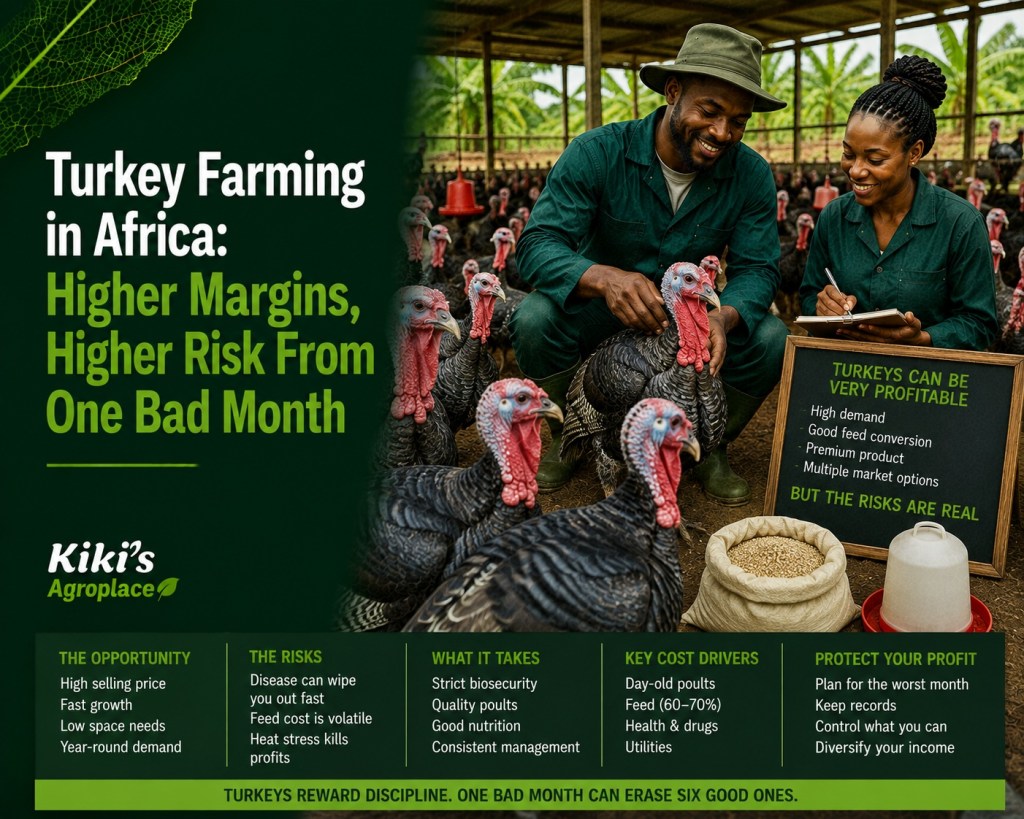
Turkey consistently fetches a higher price than chicken, and demand spikes hard around Christmas, Easter, and New Year. But that same festive concentration cuts both ways: across Nigeria’s poultry sector, December alone can carry 30 to 60% of a farmer’s annual income. Turkey farming in Africa rewards good planning and punishes farmers who treat one festive window as their whole business model.
Compare against chicken economics in our broiler vs layer guide.
Why turkey is having a real moment
A few forces are pushing turkey farming forward across the continent right now. Nigeria’s ban on frozen food importation pushed local turkey production to fill a gap that used to be met by imports. Beyond policy, farmers switching from broiler to turkey production commonly report lower disease pressure, calmer birds, and better tolerance of environmental fluctuation compared to broiler chickens, alongside the higher per-bird price turkey commands.
Breeds worth knowing
| Breed | Best for | Notes |
|---|---|---|
| Broad Breasted White | Commercial meat production | Fast growth and high meat yield; the standard commercial choice |
| Standard Bronze / White Holland | Meat production | Established, widely available meat breeds |
| Heritage (Bourbon, Narragansett) | Foraging and pest control | Medium-sized birds, strong foragers, and genuinely useful for pest control around the farm alongside meat production |
| Royal Palm | Niche and ornamental markets | Distinctive appearance opens a smaller ornamental or specialty market alongside standard meat sales |
| Local Nigerian turkey | Low-input smallholder production | Crossbred lines already in wide circulation, generally hardier and less input-intensive than fully exotic imported breeds |
Growth timeline and basic management
- Maturity: Turkeys typically reach market maturity around 20 weeks (roughly 5 to 6 months), depending on breed, meaning your production planning needs to start well ahead of your target sale window, not a few weeks before it.
- Egg production: A good turkey hen can lay up to around 90 eggs a year, giving you a secondary revenue stream if you choose to breed rather than sell purely for meat.
- Movable roosts and clean housing: Keeping the environment clean, with movable roosts and consistent access to clean water and feed, is a basic but frequently cited requirement for keeping turkeys healthy.
- Managing aggression: Toms (male turkeys) can fight, sometimes seriously. Claw clipping, removing the sharp tip of the inside and middle toe, is a common preventive step, usually done at the hatchery or around 5 weeks old.
The festive revenue concentration risk
This is the part most turkey farming guides gloss over. Yes, turkey demand spikes hard around Christmas, Easter, and New Year. But building your entire business around that spike carries real risk, and the risk is already showing up in the market.
- Poult (baby turkey) shortages before Christmas are a documented, recurring problem. Nigeria’s broader poultry sector has faced day-old chick and poult shortages heading into the festive season in recent years, driven by limited breeder farm capacity relative to demand. If you’re sourcing poults last-minute for a December sale, you may not get them at all.
- Plan your hatching or sourcing months ahead. Given the roughly 20-week growth timeline, birds destined for a December market need to be started by July or August at the latest, and earlier still if poult availability is uncertain in your area.
- Don’t rely on one festive window alone. Easter and New Year offer secondary demand peaks. Staggering your production across more than one festive target reduces how much of your annual income depends on a single season landing perfectly.
- Year-round demand is real, even if smaller. Some farmers report a steady, if smaller, year-round market beyond the festive peaks, particularly since import restrictions pushed more consistent local demand onto domestic producers.
Don’t ignore the feathers
Turkey feathers have a real, if smaller, secondary market in fashion, crafts, and home decor. If you’re processing birds yourself rather than selling live, this is revenue that’s otherwise thrown away by default.
Mistakes that cost turkey farmers the most
- Starting poults too late for the target market. A roughly 20-week growth cycle means Christmas-ready birds need to start in the middle of the year, not October.
- Betting the whole year on one festive window. When December alone can represent 30 to 60% of annual poultry income, a single supply hiccup, disease event, or market disruption around that window is disproportionately damaging.
- Skipping claw clipping in mixed-tom housing. Fighting between toms can cause real injury and losses; this is a small, low-cost preventive step worth taking.
- Throwing away feathers. A small but real secondary revenue stream that costs nothing extra to capture if you’re already processing birds.
Key takeaways
- Turkey commands a real price premium over chicken and benefits from lower disease pressure and calmer bird behaviour than broilers in many farmers’ experience.
- A roughly 20-week growth cycle means Christmas-market production needs to start by mid-year, not a few weeks before the festive season.
- Poult shortages before Christmas are a real, recurring supply risk; source early or build a relationship with a reliable hatchery well ahead of season.
- Spreading production across Christmas, Easter, and New Year reduces the risk of one bad month wiping out your annual income.
- Feathers offer a small additional revenue stream if you process birds yourself rather than selling live.
FAQ
How long does it take a turkey to reach market weight?
Roughly 20 weeks, or about 5 to 6 months, depending on breed. This means production for a specific festive market needs to start well in advance, not just a few weeks before the target sale date.
Which turkey breed is best for meat production?
Broad Breasted White is the standard commercial choice for fast growth and high meat yield, alongside Standard Bronze and White Holland. Heritage breeds like Bourbon and Narragansett grow more slowly but forage well and offer genuine pest-control value around the farm.
Is turkey farming risky because of seasonal demand?
It can be, if you concentrate all your production around a single festive window. December alone can represent 30 to 60% of a poultry farmer’s annual income in Nigeria, which means a supply issue, poult shortage, or market disruption around that period disproportionately affects farmers who haven’t diversified their sale timing across Easter and New Year as well.
Why do turkeys need claw clipping?
Male turkeys (toms) can fight, sometimes causing real injury with their claws during aggressive encounters or mating. Claw clipping, usually done at the hatchery or around 5 weeks old, reduces this risk.
Can I make additional income from turkey feathers?
Yes, turkey feathers have a real secondary market in fashion, crafts, and home decor. If you’re processing birds yourself, collecting and selling feathers is close to free additional revenue.
Kiki’s Agroplace: Bridging the knowledge gap in agriculture.


Leave a Reply