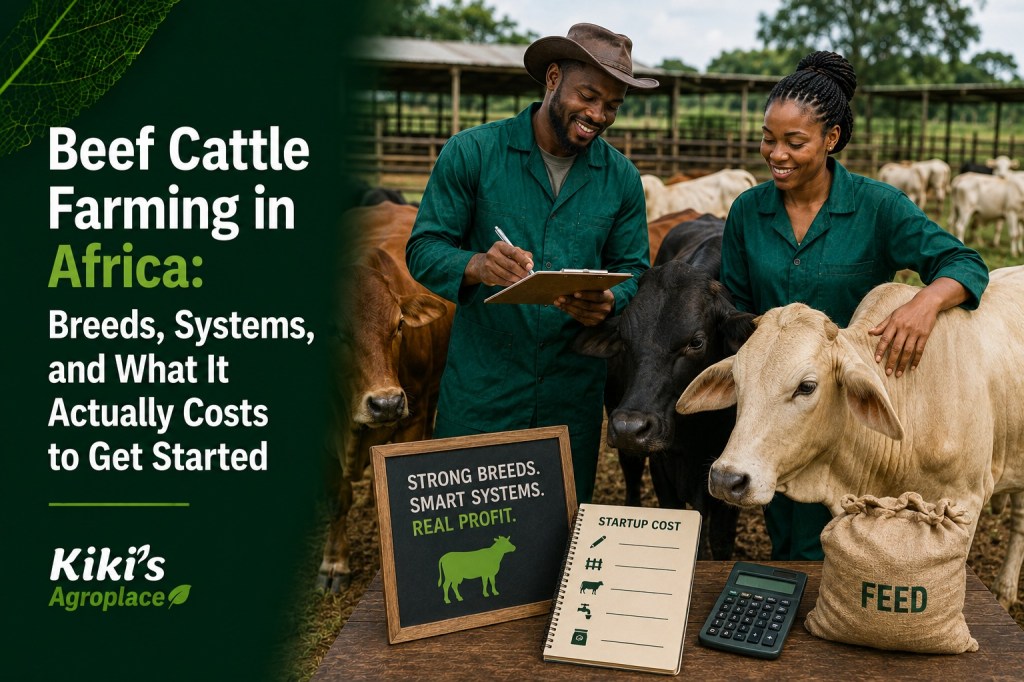
Beef cattle ask more of you than any other livestock covered on this site. Bigger capital outlay, longer production cycles, and a cash-flow gap between buying an animal and selling it that can stretch for months. Beef cattle farming in Africa spans everything from pastoral herding across the Sahel to fenced commercial ranches in Kenya’s Rift Valley to 90-day feedlot operations in South Africa. Here’s how to make sense of it, and what it honestly costs to get in.
Why beef cattle plays by different rules than the rest of your herd
A goat can go from birth to market in under a year. A dairy cow starts paying you back daily once she’s in milk. Beef cattle don’t work that way. You’re either raising an animal for years before slaughter, or buying in weaners and feeding them for months before you see a return. That gap between spending and earning is the single biggest thing to plan around before you commit.
Breeds by region
Africa is home to roughly 180 recognised cattle breeds, and which one makes sense for you depends heavily on where you farm. Three broad breed families dominate the beef landscape:
| Breed group | Examples | Region | Strengths |
|---|---|---|---|
| West African Zebu | White Fulani (Bokolo/Bunaji), Red Fulani (Mbororo), Gudali | Sahel, Northern Nigeria, Cameroon | Heat and drought tolerance, long-distance herding endurance; White Fulani is Nigeria’s most numerous breed |
| Trypanotolerant taurine | N’Dama, Muturu, West African Shorthorn | Humid West and Central Africa, tsetse belt | Natural resistance to trypanosomiasis where Zebu breeds struggle; smaller frame but reliable in high disease-pressure zones |
| Sanga (Bos taurus africanus) | Nguni, Tuli, Mashona, Tswana, Barotse | Southern Africa | Drought tolerance, tick and tick-borne disease resistance, strong adaptation to local rangeland |
| Improved indigenous Zebu | Boran, Sahiwal | Kenya, Ethiopia, Somalia | Strong dryland resilience with better beef yield than unimproved Zebu; Boran is one of Africa’s most exported beef genetics |
If you farm in a tsetse-heavy zone, breed choice matters more than almost any other decision you’ll make. A trypanotolerant breed like N’Dama can stay productive under disease pressure that would cripple an unadapted Zebu, even if it doesn’t match a Boran’s raw growth rate on paper.
Three production systems, compared
| System | Land needs | Capital needs | Timeline to market |
|---|---|---|---|
| Extensive/pastoral | High; open rangeland or communal grazing | Low to moderate | Slow; 2 to 4 years to slaughter weight |
| Commercial ranch | High; fenced private or leased land | Moderate to high | Moderate; managed breeding and grazing shorten the cycle somewhat |
| Feedlot finishing | Low; pens rather than pasture | High; feed is the dominant cost | Fast; 90 to 120 days to finish animals already at a good frame |
Most smallholders don’t need to pick just one. A common entry point across East and Southern Africa is buying weaned or partially grown animals from pastoral or ranch producers, then finishing them in a small feedlot for a faster return; this splits the slow, capital-light breeding stage from the fast, capital-heavy finishing stage between different parts of the value chain.
What it actually costs to start
Numbers vary sharply by country and scale, but a few documented examples give a useful sense of the range:
- South Africa, small feedlot pilot: A documented 25-head feedlot pilot model ran roughly R80,000 in setup costs plus R135,000 in operating costs for the first cycle, with setup costs recovered within that same cycle under normal market conditions. Feed accounted for over 80% of ongoing costs.
- Kenya, feedlot finishing: Commercial finishing operations in Kenya typically take animals from grazed condition to slaughter weight in 90 to 120 days, with target weights commonly in the 450 to 550kg range depending on breed.
- Nigeria, cattle fattening: A common small-scale fattening model buys an animal, feeds it over a fattening period, then sells at a meaningful markup over the original purchase price, though margins depend heavily on feed costs and market timing around demand peaks like Sallah.
The pattern across all three: feed is consistently the largest cost, and market timing around seasonal demand peaks measurably affects your margin. Plan your finishing period to land before a demand spike, not after it.
Getting your first cattle
- Source from registered breeders where possible. Breed societies exist for major beef breeds in several countries (Kenya’s Boran Cattle Breeders Society, for example), and buying from a registered source gives you a clearer picture of an animal’s genetics and health history than an open market purchase.
- Register with your local veterinary authority. Most countries require livestock registration, and having a vet on retainer from the start saves you scrambling when a health issue actually shows up.
- Plan your cash flow before you plan your herd. The gap between buying animals and getting paid for them is the single biggest reason new beef cattle ventures run into trouble. Know how many months you need to cover before your first sale.
- Line up buyers before you need them. Building a relationship with at least two abattoirs or feedlot buyers ahead of your first sale gives you leverage and a backup if one relationship falls through.
Mistakes that cost new beef cattle farmers the most
- Underestimating the cash-flow gap. Beef cattle take longer to pay back than any other livestock on this site. Undercapitalising the wait is one of the most common reasons new operations fail.
- Choosing a breed for its reputation rather than your conditions. A high-performing breed in the wrong disease zone or climate underperforms a well-matched local breed almost every time.
- Jumping straight to a feedlot without breeding-stage experience. Finishing bought-in animals is a reasonable entry point, but understanding the breeding and rearing side of the business pays off even if you never run that stage yourself.
- No buyer relationships in place before slaughter weight. Scrambling for a buyer at the last minute weakens your negotiating position exactly when you need it most.
Key takeaways
- Beef cattle require more capital and patience than any other livestock covered on this site; plan your cash flow before your herd.
- Breed choice should follow your local disease and climate conditions, not just reputation; trypanotolerant breeds matter more than growth rate in tsetse zones.
- Extensive, ranch, and feedlot systems can be combined; buying weaned animals for feedlot finishing is a common, faster-return entry point.
- Feed consistently makes up the largest share of production costs across every system and country studied.
- Line up buyers and a vet relationship before you need them, not after.
FAQ
What is the fastest way to start a beef cattle business?
Buying weaned or partially grown animals and finishing them in a small feedlot offers the fastest return, typically 90 to 120 days to slaughter weight, compared to years for a full breeding-to-slaughter cycle.
Which cattle breed is best for beginners in Africa?
There’s no single best breed; the right choice depends on your region’s climate and disease pressure. Zebu breeds like White Fulani suit hot, dry Sahel conditions, Sanga breeds like Nguni suit Southern African rangeland, and trypanotolerant breeds like N’Dama matter most in tsetse-affected zones.
How much capital do I need to start a small feedlot?
Documented small-scale models, like a 25-head pilot feedlot in South Africa, show setup and first-cycle operating costs in the range of R200,000 combined, with feed making up the majority of ongoing costs. Costs vary significantly by country, scale, and local feed prices.
What is the biggest financial risk in beef cattle farming?
The cash-flow gap between purchasing or breeding animals and eventually selling them. Beef cattle take longer to generate a return than most other livestock, and undercapitalising that waiting period is one of the most common reasons new operations struggle.
Do I need to register my cattle with a breeders’ association?
It’s not always mandatory, but sourcing stock from a registered breeder and, where relevant, registering your own animals gives you clearer genetics and health records than buying informally, which pays off at resale.
Kiki’s Agroplace: Bridging the knowledge gap in agriculture.


Leave a Reply