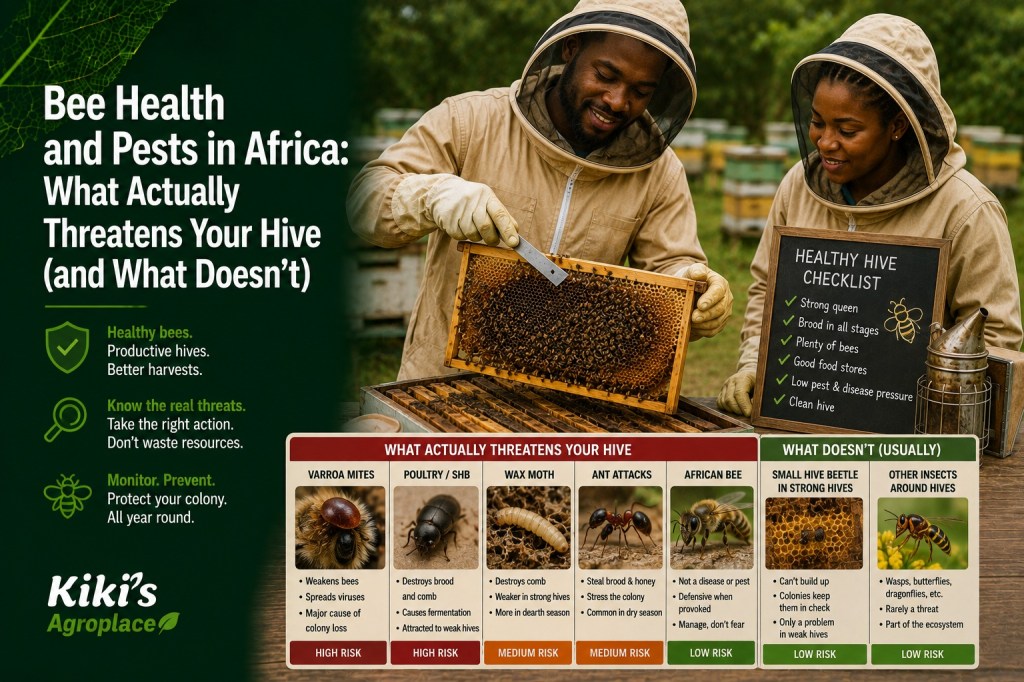
Search for beekeeping pest advice online, and most of it is written for a mite that barely bothers your bees. Bee health and pests in Africa looks different from the picture painted by Western beekeeping content, because African honeybees have a genetic advantage most guides never mention. Here’s what to actually watch for, and where you can safely ignore the imported advice.
Start with the beekeeping setup guide if you’re just getting going.
Varroa mite: the pest you probably don’t need to treat
Varroa destructor is the parasite most global beekeeping content treats as the top threat, and for European honeybee subspecies, that’s fair; it’s considered the most damaging parasite affecting honeybees worldwide. But research across South Africa and Kenya has consistently found something different in Apis mellifera scutellata, the African honeybee: colonies infested with Varroa develop normally, with little measurable difference between treated and untreated hives.
The reason isn’t luck. Studies point to genuine behavioural resistance; African honeybees show strong hygienic behaviour, detecting and removing Varroa-infested brood cells at a far higher rate than typically seen in European subspecies, along with grooming behaviour that physically dislodges mites.
- What this means for you: If you’re keeping local African bee stock, routine acaricide treatment for Varroa is likely an unnecessary expense. Save the money.
- When it might still matter: If you’ve imported European queens or hybrid stock, or if you notice a colony declining without an obvious cause, Varroa is still worth ruling out rather than assumed irrelevant.
Small hive beetle: a pest that started here
The small hive beetle actually originated in Africa, which is part of why African bee colonies generally handle it better than the European colonies it went on to devastate after spreading to the United States and elsewhere. Strong African colonies typically keep beetle populations low without major losses.
- Where it becomes a problem: Weak or already-stressed colonies, and stored comb or equipment left unprotected. Beetle larvae tunnel through comb and leave behind a slime that ferments stored honey and gives it a sour smell.
- Prevention: Keep colonies strong, avoid leaving excess drawn comb or equipment sitting unused, and store any spare equipment somewhere beetles can’t easily access.
Wax moth: the real threat in tropical beekeeping
This is the pest that deserves your attention. Damage from the greater wax moth (Galleria mellonella) is documented as especially severe in tropical and subtropical regions, and it’s currently widespread across Africa. Unlike Varroa, this isn’t a pest your bees have a strong natural defence against.
- How it damages a hive: Larvae tunnel through wax comb, leaving silk webbing and destroyed cells behind. Severe infestations trap developing bees in their cells (a condition called galleriasis) and can push a weakened colony to abscond entirely.
- The pattern to understand: Wax moths are opportunists. They rarely take down a genuinely strong colony; they move in once a colony is already weakened by another stressor, whether that’s a failing queen, a pest, or a food shortage. A wax moth problem is usually a symptom, not the root cause.
- Prevention: Keep colonies strong and well-populated, remove and store excess comb properly rather than leaving it in an unused hive body, and inspect regularly for early signs of webbing before an infestation takes hold.
- Connection to absconding: Given how readily African bee colonies abscond under stress, a wax moth infestation can be the final trigger that pushes an already-struggling colony to leave rather than fight through it.
Predators most beekeeping guides never mention
Western beekeeping content focuses almost entirely on mites and moths, but African beekeepers deal with a category of threat that barely gets a mention elsewhere: larger animals actively raiding hives for honey and brood.
- Honey badgers: Notorious hive raiders across much of the continent, capable of tearing apart poorly secured hives to get at honey and brood. Elevated hive placement and sturdy, well-anchored hive stands are the main defence.
- Ants: Certain ant species can invade and overwhelm a weak colony, particularly one already stressed by another issue. Ant guards, water moats around hive stands, or greased hive legs help keep them out.
- Birds: Bee-eaters and other birds can pick off foraging bees near the hive entrance, though this rarely threatens a healthy colony’s overall survival the way hive-raiding predators do.
Building a basic hive inspection routine
- Every 2 to 3 weeks: Check for signs of wax moth webbing, small hive beetle activity, and overall colony strength and brood pattern.
- After harvest: Inspect and properly store any removed comb, since unprotected stored comb is one of the easiest ways to invite a wax moth infestation.
- Whenever a colony looks weak: Investigate the underlying cause (queen failure, food shortage, disturbance) rather than only treating whatever secondary pest has moved in.
- Hive placement check: Periodically confirm hive stands are still secure and elevated, especially after heavy rain or in areas with known predator activity.
Key takeaways
- Varroa mite, the top concern in most global beekeeping content, is generally not a priority for African honeybee colonies thanks to natural hygienic and grooming resistance.
- Small hive beetle originated in Africa and is usually well-managed by strong local colonies, though stored equipment still needs protection.
- Wax moth is the pest that deserves real attention in tropical African beekeeping; it can trigger absconding in an already-weakened colony.
- Predators like honey badgers and ants are a genuinely African beekeeping concern that most international guides skip entirely.
- A weak colony with a pest problem usually has an underlying cause worth investigating, not just a pest worth treating.
FAQ
Do I need to treat my hives for Varroa mite in Africa?
For colonies of local African honeybee stock, generally no. Research consistently shows minimal impact from Varroa infestation on African honeybee colony development, thanks to natural hygienic and grooming behaviours. This changes if you’re keeping imported or hybrid European stock.
What is galleriasis?
Galleriasis is the damage caused by heavy wax moth infestation, where larval silk webbing traps developing bees in their cells, preventing them from emerging. Severe cases can push an already-weakened colony to abscond.
How do I protect stored honeycomb from pests?
Store comb in a sealed, well-ventilated container away from warm, dark conditions that wax moths and small hive beetles prefer. Inspect stored comb periodically and freeze or otherwise treat it if you spot early signs of infestation.
How do I keep honey badgers away from my hives?
Elevate hives on sturdy, well-anchored stands, since honey badgers are strong and persistent diggers and climbers when motivated by an accessible hive. Some beekeepers also use fencing or thorny barriers around apiary sites in areas with known honey badger activity.
Is a wax moth infestation a sign of a bigger problem?
Usually, yes. Wax moths are opportunists that take hold in colonies already weakened by something else, whether that’s a failing queen, food shortage, or another pest. Treating the wax moth without identifying the underlying cause often means the problem returns.
Kiki’s Agroplace: Bridging the knowledge gap in agriculture.


Leave a Reply