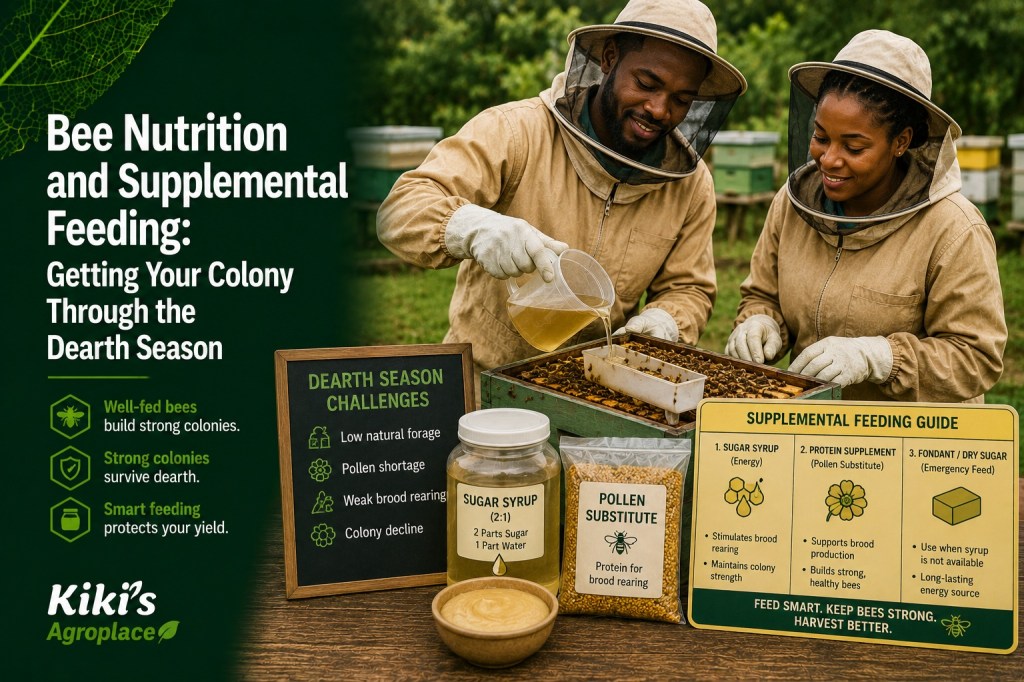
A European honeybee colony that runs short on food sits tight and slowly starves. An African honeybee colony does something different: it leaves. This single behavioural difference is why bee nutrition and supplemental feeding deserves more attention than most beekeeping guides give it, and why getting the timing wrong doesn’t just cost you honey; it can cost you the whole hive.
Start with the beekeeping setup guide if you’re just getting going.
Why African bees don’t just tough out a food shortage
Apis mellifera scutellata, the honeybee subspecies found across most of sub-Saharan Africa, doesn’t hoard large honey reserves the way European honeybee subspecies do. Instead, colonies rely on mobility; absconding to a new location, or swarming to reproduce, whenever food, water, or space runs short. Research in Botswana’s Okavango Delta found that colonies preparing to abscond showed a clear pattern in the weeks beforehand: declining food stores, erratic brood-rearing, and rising brood mortality, all building toward the colony simply leaving.
This changes how you should think about feeding. In temperate beekeeping, supplemental feeding is mostly about winter survival. In African beekeeping, it’s about keeping a colony committed to your hive through the dearth season, when natural nectar and pollen are scarce, rather than giving it a reason to move on.
When to feed
- Dearth periods (a time when flowers produce little to no nectar or pollen): Stretches of the year, often during the dry season, when flowering plants thin out and natural forage drops. This is when supplemental feeding matters most.
- Newly hived swarms or captured colonies: A colony that hasn’t yet built comb and established stores benefits from light feeding to help it settle rather than abscond in search of better conditions elsewhere.
- After an over-harvest: If you’ve taken more honey than the colony can spare, feeding sugar syrup replaces some of what was removed and prevents a self-inflicted food shortage.
- Ahead of an expected dearth: Light feeding a few weeks before a known dry season can help build colony strength ahead of the shortage rather than reacting after stores are already low.
What to feed: sugar syrup and pollen substitutes
Bees need two things from their diet: carbohydrates for energy, which they normally get from nectar, and protein, vitamins, and minerals for brood-rearing, which they normally get from pollen. Supplemental feeding replaces one or both when natural forage falls short.
- Sugar syrup: A simple mix of white sugar and water, typically 1:1 by weight for stimulating brood rearing during a dearth, or thicker (roughly 2:1) if you want the colony to store the feed as reserves rather than use it immediately.
- Pollen substitutes: Used when natural pollen is scarce and brood-rearing needs protein. Research from Ethiopia tested locally available ingredients directly relevant to African beekeepers, including roasted barley powder, spiced pea powder (shiro), sorghum powder, skimmed milk powder, and even a stinging nettle infusion, all mixed with sugar syrup as a carrier.
- What performs best: Research comparing pollen substitutes to plain sugar syrup consistently finds that protein-supplemented diets outperform sugar alone for brood production and eventual honey yield; one study found colonies fed a pea flour supplement produced meaningfully more honey than colonies fed only sugar syrup.
A simple local pollen substitute recipe
Based on the Ethiopian trial ingredients, a workable, low-cost pollen substitute patty can be built from ingredients available in most African markets:
- Roasted barley or sorghum powder, finely ground
- A legume flour such as spiced pea powder or soybean flour, for protein
- Skimmed milk powder, in a smaller proportion, for additional protein and micronutrients
- Sugar syrup, mixed in gradually until the mixture forms a soft, workable patty rather than a dry crumble
Place the patty directly above the brood area, where the colony can access it easily without needing to travel far from the cluster.
Feeding methods and where they go wrong
- Entrance feeders: Simple and cheap, but they sit right at the hive entrance, which can trigger robbing from other colonies and is a particular risk given how defensively African bees respond to disturbance and competition.
- Top or hive-top feeders: Keep syrup inside the hive rather than at the entrance, reducing robbing risk. Generally the safer choice for scutellata colonies.
- Frame or division board feeders: Sit inside the hive body itself; effective but require more careful hive design to install.
Whichever method you use, feed in the evening when foraging activity has slowed. This reduces the chance of triggering robbing behaviour from nearby colonies drawn in by the scent of syrup.
When feeding does more harm than good
- Feeding with honey supers (an extra box added to a beehive for honey storage) on. Sugar syrup fed while you’re actively collecting honey can end up mixed into your harvest, which is both a quality issue and, in some markets, a labelling and export compliance problem.
- Overfeeding outside a dearth. Feeding when natural forage is already abundant wastes money and can crowd the brood nest with stored syrup instead of encouraging natural foraging.
- Triggering robbing. Spilled syrup or exposed feed near the entrance attracts bees from other colonies, which can escalate into a full robbing event that weakens or destroys the colony being robbed.
- Treating feeding as a permanent fix. Supplemental feeding is an emergency bridge through a dearth, not a substitute for a colony with access to good forage. A hive placed near diverse, flowering vegetation will need far less supplemental feeding than one that isn’t.
Key takeaways
- African honeybee colonies respond to food scarcity by absconding, not slowly starving; feeding through a dearth is about retention, not just survival.
- Sugar syrup covers carbohydrate needs; pollen substitutes are needed too when brood-rearing demands protein during a pollen dearth.
- Local ingredients like roasted barley, legume flours, and skimmed milk powder can build an effective, low-cost pollen substitute.
- Top feeders are generally safer than entrance feeders for reducing robbing risk in defensive African bee colonies.
- Never feed syrup while honey supers are on the hive, and treat feeding as a temporary bridge, not a permanent replacement for good forage access.
FAQ
What is the best sugar-to-water ratio for feeding bees?
A 1:1 ratio by weight works well for stimulating brood rearing during a dearth, since it’s thin enough for bees to use immediately. A thicker 2:1 ratio encourages the colony to store the syrup as reserves rather than consume it right away.
Will feeding sugar syrup contaminate my honey?
It can, if you feed while honey supers are on the hive during an active nectar flow. Stop feeding syrup before adding supers, and only resume once you’ve finished harvesting for that period.
Why do African honeybee colonies abscond instead of starving?
Apis mellifera scutellata evolved in environments with unpredictable forage availability, and colony mobility (absconding and swarming) became the more successful survival strategy compared to hoarding large stores like European honeybee subspecies do. This makes proactive feeding during dearth periods more important for retention than it typically is in temperate beekeeping.
What can I use as a pollen substitute if I can’t buy commercial bee feed?
Locally available ingredients like roasted barley or sorghum powder, legume flours such as pea or soybean flour, and skimmed milk powder, mixed into a patty with sugar syrup, have shown good results in African field trials and cost far less than imported commercial substitutes.
How do I avoid triggering robbing when I feed my bees?
Use a top or hive-top feeder rather than an entrance feeder, feed in the evening when foraging activity has slowed, and clean up any spilled syrup immediately. These steps reduce the scent cues that draw in bees from other colonies.
Kiki’s Agroplace: Bridging the knowledge gap in agriculture.


Leave a comment