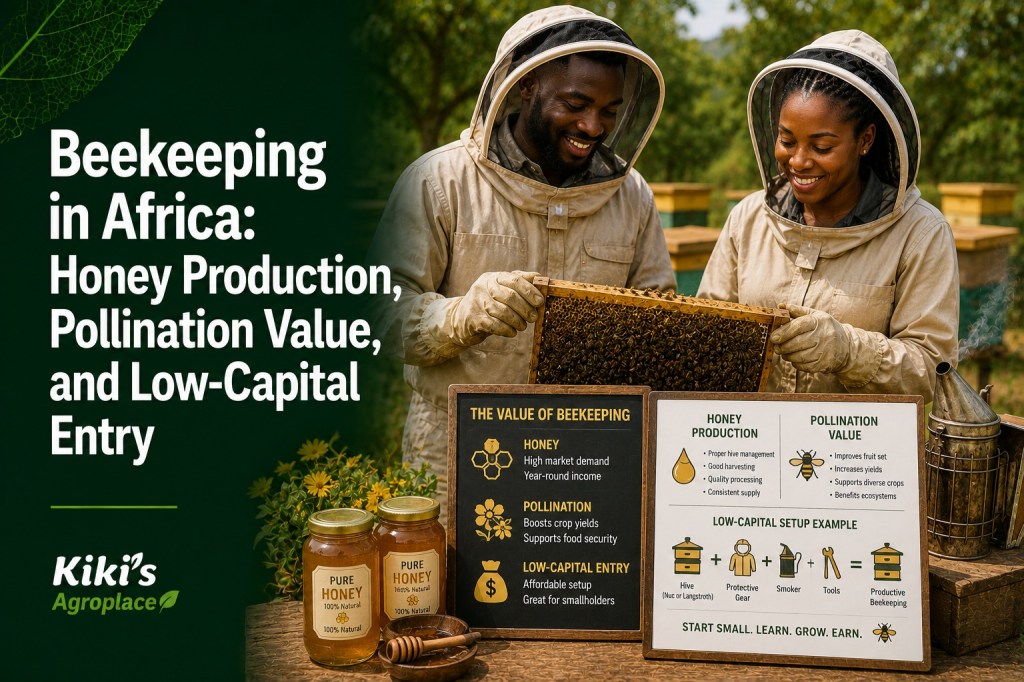
You don’t need land to own, a loan to take, or years of saved capital to start. Beekeeping in Africa is one of the few agricultural businesses that scales down to a single hive without losing viability. Ethiopia proves what’s possible at scale; it’s the continent’s leading honey producer and one of the top producers in the world. Here’s how honey production actually pays, what your bees do for the rest of your farm, and how to start without much money.
Why beekeeping is the lowest-barrier entry point in agriculture
Most livestock businesses need land, housing, and feed budgets before you see a single sale. Beekeeping doesn’t work that way. It’s a non-land-based activity that fits alongside whatever else you’re already farming, and it demands no large infrastructure. Global demand for honey has consistently exceeded supply for years, and honey plays a role well beyond the breakfast table; pharmaceutical companies buy it for cough medicine, and cosmetics manufacturers use it in soaps and hair products.
Across sub-Saharan Africa, beekeeping already contributes meaningfully to household income, particularly for women and small landholders. In one documented Kenyan program, small-scale beekeepers using improved hives earned roughly $200 to $250 a year in additional income; money that went toward food, medicine, school fees, and farm inputs. That’s one program’s results, not a guarantee, but it shows the kind of supplemental income a well-run setup can realistically generate.
Getting started without much money
| Hive type | Cost | Honey yield | Best for |
|---|---|---|---|
| Traditional log/basket hive | Lowest — built from local materials | Lower, and harder to manage | Absolute beginners testing the activity with minimal risk |
| Top-bar hive (Kenyan Top Bar) | Low to moderate — can be built locally | Better yield and easier colony management than traditional hives | Most smallholders — the standard low-capital recommendation |
| Langstroth hive | Higher upfront cost, often needs purchased frames | Highest yield and easiest to inspect and manage | Farmers ready to scale beyond a hobby setup |
The Kenyan Top Bar Hive is the classic low-capital starting point across the continent; it’s been promoted by development organizations specifically for low-income households because it’s affordable to build and doesn’t disturb the bees as much as older traditional methods. You don’t need all your hives to be the same type either. Many smallholders start with one or two top-bar hives, prove the concept works on their land, then reinvest honey sales into upgrading to Langstroth hives as they scale.
Be realistic about the timeline. If you’re starting from wild colony capture rather than buying an established colony, it commonly takes two to three years to reach meaningful production volume. Beekeeping rewards patience more than most agricultural ventures; rushing the process by overstocking hives or expecting a first-year harvest to match a mature apiary is where new beekeepers get discouraged.
What bees do for the rest of your farm
Here’s a claim worth being precise about: paid pollination services, where farmers hire beekeepers to bring hives to their fields for a fee, are common in places like the United States but remain what researchers have called an unexplored opportunity for African beekeepers. That market largely doesn’t exist yet on the continent in any organized way, so don’t plan your business around it.
What is well documented is the value bees add to your own crops just by being nearby. In sub-Saharan Africa, bee pollination lifts cotton yield to around 62%, compared to about 37% without it. In Western Kenya’s Kakamega region, bee pollination has been found to contribute to roughly 40% of annual crop yield for smallholder farmers growing crops like beans and cowpea. West Africa’s total insect pollination economic value is estimated at $5.6 billion, the highest of any African region.
The practical takeaway: if you grow other crops alongside your hives, you’re likely already getting a yield boost from your bees without charging anyone for it. That’s real value even before you sell a single jar of honey.
Getting hive placement right
- Morning sun, afternoon shade. Bees need early warmth to start foraging, but full sun all day risks overheating the colony, especially in hot climates. Full shade all day tends to leave hives damp and more prone to pests.
- Entrance direction matters. In the Northern Hemisphere, face the entrance east to southeast to catch morning sun. In the Southern Hemisphere, face it east to northeast for the same effect.
- Keep hives off the ground. A few inches of elevation helps prevent dampness and keeps pests like small hive beetles from moving in as easily.
- Water source nearby. Bees need consistent access to water. Providing your own source keeps them from bothering neighbors’ water tanks or ponds.
Key takeaways
- Beekeeping needs no land purchase and scales down to a single hive without losing viability; one of the lowest-capital entry points in agriculture.
- The Kenyan Top Bar Hive is the standard low-cost starting point; Langstroth hives cost more but yield more once you’re ready to scale.
- Paid pollination services aren’t yet an established market in Africa; the real, documented value is the yield boost bees give your own nearby crops.
- If starting from wild colony capture, expect 2 to 3 years to reach meaningful production; rushing this timeline is a common source of frustration.
- Morning sun with afternoon shade, and an entrance facing the morning sun direction for your hemisphere, gives your hive the best start.
FAQ
Is beekeeping hard for beginners?
It’s manageable but not instant. Most beekeepers need a season or two of hands-on experience to get comfortable with hive inspections and colony management, and if you’re starting from wild capture rather than a purchased colony, it can take 2 to 3 years to reach meaningful production. Starting with a top-bar hive and learning alongside an experienced local beekeeper makes the learning curve much easier.
Will I get honey in my first year of beekeeping?
Often not a full harvest. New colonies typically spend their first year building comb and establishing the hive rather than producing a surplus you can take. Treat your first year as a setup year, with meaningful honey harvests becoming more realistic from year two onward.
How much money do I need to start beekeeping?
Far less than most livestock ventures. A traditional or top-bar hive can be built from local materials at low cost, and you don’t need to own land to place a hive. Costs rise if you move to Langstroth hives and purchased protective gear, but you can start small and reinvest honey sales into upgrades as you grow.
How many times a year can you harvest honey from a hive?
This depends heavily on your local climate and flowering seasons rather than a fixed number, since nectar availability drives how often a hive builds a harvestable surplus. Talk to beekeepers in your specific region for a realistic harvest schedule, since it varies too much by location to state one figure for all of Africa.
How long does raw honey last, and can it go bad?
Properly stored raw honey essentially doesn’t spoil. Its low moisture content, natural acidity, and the hydrogen peroxide bees produce while making it all create conditions where bacteria and mold can’t survive. Archaeologists have even found honey in ancient Egyptian tombs, over 3,000 years old, that was still edible. Honey can crystallize or darken over time, but that’s a texture change, not spoilage; it stays safe to eat as long as it’s kept sealed and free of added moisture.
Should beehives be placed in shade or sun?
A mix of both works best. Morning sun helps warm the hive and gets bees foraging earlier in the day, while afternoon shade prevents overheating, particularly in hot climates. Avoid placing hives in full shade all day, since this tends to create damp conditions that attract pests.
Why can’t beekeepers eat bananas before inspecting a hive?
Bananas contain isoamyl acetate, the same compound that makes up a bee’s alarm pheromone: the chemical signal a bee releases to alert others to a threat. Strong banana scent on your hands or breath can trigger the same defensive, alert response in a colony, which is why many experienced beekeepers avoid eating bananas or wearing banana-scented products before opening a hive.
What is another word for beekeeping?
The formal term is apiculture, and a beekeeper is sometimes called an apiarist. A collection of hives kept together is called an apiary.
Kiki’s Agroplace: Bridging the knowledge gap in agriculture.


Leave a Reply