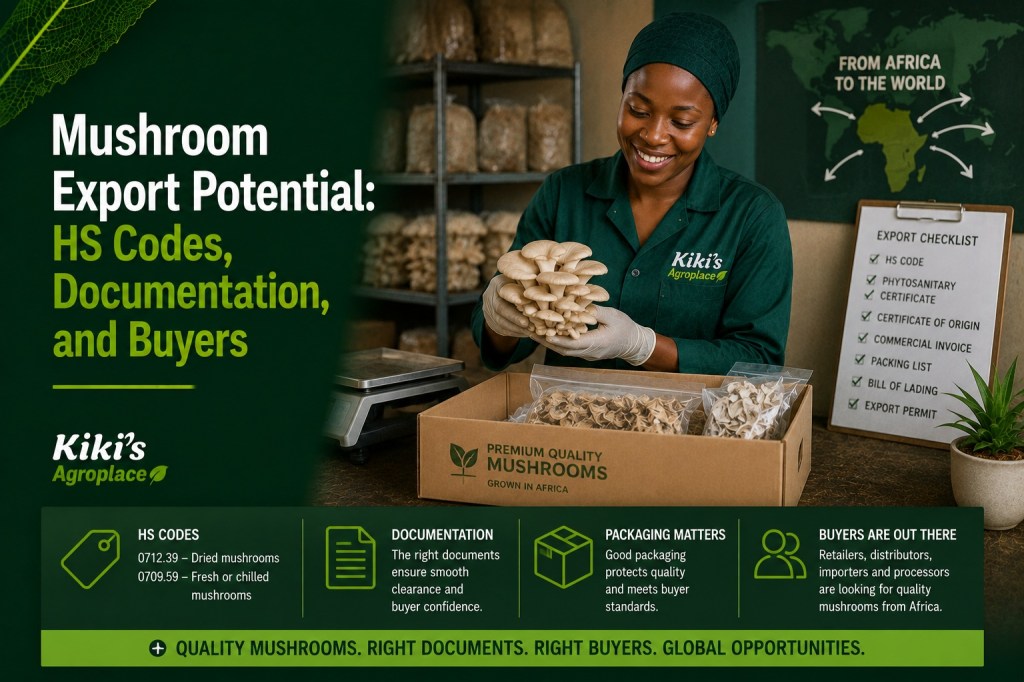
This post covers mushroom export at the commodity level — the paperwork, product forms, and buyer markets that apply whether you’re growing oyster, button, shiitake, or dried medicinal species. For species-specific market details, see our dedicated posts on lion’s mane and shiitake.
One Piece of Good News First
The EU Deforestation Regulation (EUDR) doesn’t apply to mushrooms. It covers exactly seven commodities — cattle, cocoa, coffee, palm oil, rubber, soy, and wood — and mushrooms aren’t among them. This applies regardless of the country you’re exporting from. If mushrooms are your product, you can set this particular compliance burden aside entirely.
Getting Your HS Codes Right
The Harmonized System (HS) code you use determines your tariff rate and customs handling, so getting it wrong causes real delays.
| Product form | HS code range |
|---|---|
| Fresh Agaricus (button) mushrooms | 0709.51 |
| Fresh non-Agaricus (shiitake, oyster, etc.) | 0709.59 |
| Dried mushrooms | 0712.31 – 0712.39 |
| Preserved or processed (canned, powdered) | 2003.10 – 2003.90 |
Confirm the exact subheading with a customs broker before your first shipment — some countries add extra digits for specific species, and getting it wrong can trigger inspections or rejected paperwork.
Dried Beats Fresh for Most First-Time Exporters
This is the single most important decision for a new exporter. Fresh mushrooms need continuous cold chain from harvest to buyer — refrigerated storage, refrigerated transport, and a buyer set up to receive perishable stock quickly. Any break in that chain and the shipment loses value fast.
Dried mushrooms sidestep almost all of that. They’re shelf-stable, tolerate normal shipping conditions, and give you far more room for error on your first few shipments while you’re still working out logistics. Unless you already have proven cold chain infrastructure and a fresh-focused buyer lined up, start with dried product.
Documentation You’ll Need
- Phytosanitary certificate — issued by your national plant protection authority, confirming the shipment is pest-free. This is close to universal for mushroom exports.
- Certificate of origin and commercial invoice — standard for any export shipment.
- GlobalG.A.P. certification — increasingly expected by EU buyers as proof of good agricultural practice.
- Organic certification, if applicable — commands a real premium in Europe and North America specifically.
See our export documentation guide for the full general process — it applies to mushrooms without modification.
Where the Buyers Are
- Europe — Germany, France, and the Netherlands are major importers of both fresh and processed mushrooms, with strong buyer interest in organic and traceable supply.
- Asia — China, Japan, and South Korea lead on premium and medicinal varieties, with rigorous quality and lab-testing expectations.
- Middle East — the UAE and Saudi Arabia are described as emerging markets for exotic mushrooms, with rising demand tied to growing interest in health-focused food.
Before chasing any of these, check your own region first. AfCFTA is lowering the practical barriers to trading within Africa itself — and a neighboring country’s market may be an easier first export than a container to Rotterdam. Several African countries already import a significant share of the mushrooms they consume, including shiitake specifically — see our shiitake market post for the numbers.
Packaging and Labeling
- Fresh mushrooms: breathable packaging (vented punnets or bags) — sealed packaging traps moisture and speeds up spoilage.
- Dried or processed mushrooms: vacuum-sealed or moisture-proof packaging to keep them shelf-stable.
- Labels should show product name and variety, net weight, packaging date, country of origin, storage instructions, and any certifications — missing label elements are a common cause of shipments getting held at customs.
Key Takeaways
- EUDR doesn’t apply to mushrooms — one less compliance burden compared to cocoa, coffee, or timber exports.
- Get your HS code right before your first shipment — fresh, dried, and processed mushrooms all sit under different codes with different requirements.
- Start with dried product. It removes the cold chain dependency that trips up most first-time exporters.
- A phytosanitary certificate is close to mandatory — sort this out with your national plant protection authority early.
- Check your own region and neighboring African markets before assuming Europe or Asia is your only option.
FAQ
Do mushrooms need EUDR compliance to enter the EU?
No. EUDR covers only cattle, cocoa, coffee, palm oil, rubber, soy, and wood. Mushrooms fall outside its scope entirely.
Should I start exporting fresh or dried mushrooms?
Dried, in almost all cases, unless you already have reliable cold chain logistics in place. It’s a far more forgiving product for a first export attempt.
What’s the single most common reason mushroom shipments get held at customs?
Incomplete or incorrect documentation — usually a missing phytosanitary certificate or an incorrect HS code, rather than a problem with the product itself.


Leave a Reply