Table of Contents
- Why exporting farm products from Nigeria makes financial sense
- What farm products can you export from Nigeria?
- The registrations you must have before you export
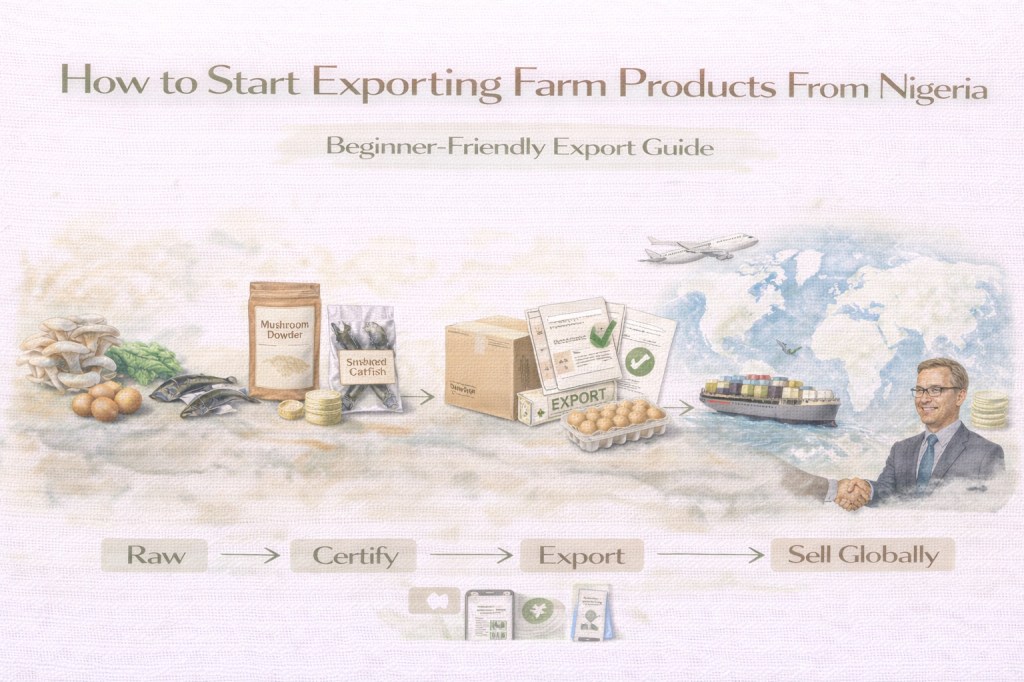
- Your step-by-step export process
- The documents every agricultural export needs
- How to find international buyers
- How to get paid safely on export transactions
- Costs to budget for before your first export
- Common mistakes first-time exporters make
- Key takeaways
- FAQ
Introduction
Exporting farm products from Nigeria is one of the most financially rewarding moves a small-scale agribusiness can make. The logic is straightforward: you produce in naira and sell in dollars, euros, or pounds. That currency gap alone; without changing what you grow or produce, multiplies your income significantly.
Most Nigerian farmers assume export is only for large companies. It is not. With the right registrations, documentation, and buyer connections, a small-scale agro-processor or farm owner can ship their first container within 6 to 12 months of starting the process. This guide shows you exactly how.
How to package and brand your farm products to sell at higher rates.
1. Why Exporting Farm Products From Nigeria Makes Financial Sense
Nigeria’s leading non-oil agricultural exports in 2026 include cashew nuts, sesame seeds, cocoa, ginger, shea butter, and palm oil. The strongest international markets for these products are India, Germany, the Netherlands, the UK, the USA, and China.
Here is what the currency advantage looks like in practice:
- You sell fresh ginger at ₦500 per kg locally
- The same ginger exported to Germany sells at €3 to €5 per kg; roughly ₦2,500 to ₦4,200 per kg at current rates
- Same product. Same farm. Five to eight times the income per kilo
Beyond the currency advantage:
- Global demand is growing. International buyers are actively looking for verified African agricultural suppliers; especially for organic, traceable, and sustainably sourced products.
- Registered Nigerian exporters can apply for incentives such as the Export Expansion Grant (EEG) through the Nigerian Export Promotion Council (NEPC). Nigerian exporters may also benefit from preferential trade arrangements such as AGOA for eligible exports to the US market, alongside various trade access opportunities with the EU market.
- Your competition is thinner internationally. Far fewer Nigerian farmers are exporting than selling locally, meaning less price competition for certified, properly documented products.
2. What Farm Products Can You Export From Nigeria?
Most agricultural products can be exported with the right certification. Here is a breakdown of high-demand Nigerian agricultural exports and their key markets:
| Product | Key Export Markets |
|---|---|
| Sesame seeds | India, China, Japan |
| Cashew nuts | India, Vietnam, EU |
| Ginger (fresh and dried) | EU, USA, India |
| Cocoa beans | EU, USA |
| Shea butter | EU, USA, cosmetics industry |
| Hibiscus (Zobo) | EU, USA, Mexico |
| Dried catfish and smoked fish | UK, USA, Nigerian diaspora |
| Mushroom powder | UK, EU, USA |
| Palm oil | UK, EU, South Asia |
| Moringa powder | EU, USA |
| Dried vegetables | Nigerian diaspora in UK, USA, Canada |
| Plantain flour | Nigerian diaspora, health food markets |
What you cannot export: Unprocessed raw timber, certain wildlife products, and any product on Nigeria’s export prohibition list. Always verify current restrictions at the Nigerian Export Promotion Council (NEPC) website — nepc.gov.ng — before proceeding.
Value addition for farm products. (Complete guide)
3. The Registrations You Must Have Before You Export
You cannot export as an individual. Business registration and an NEPC certificate are both mandatory starting points. Here is the full list of what you need:
1. CAC Registration
Register your business with the Corporate Affairs Commission. This is the foundation, everything else builds on it.
2. NEPC Exporter’s Certificate
This is the most important single document for any Nigerian exporter. Register at nepc.gov.ng. It unlocks export incentives, trade support services, and official buyer-matching programmes.
3. NAFDAC Registration (for processed food products)
Any consumable agro product you intend to export; whether ginger powder, dried pepper, honey, or shea butter, must carry a NAFDAC Product Registration Certificate. This confirms your product meets Nigerian and international health and safety standards, which is a non-negotiable requirement for EU, USA, and Middle Eastern markets.
4. SON Certification (Standards Organisation of Nigeria)
SON verifies that your product and packaging meet both Nigerian and international quality standards. Destination country customs authorities check for this, it reduces the risk of rejection at the port of entry.
5. NAQS Phytosanitary Certificate (for raw agricultural produce)
This certificate, issued by the Nigerian Agricultural Quarantine Service, confirms that your raw produce; ginger, sesame seeds, cashew nuts, is free from pests and diseases before it leaves Nigeria.
6. Corporate Bank Account with Domiciliary Account
You need a domiciliary account to receive payment in foreign currency. Open one at any commercial bank using your CAC documents.
How to write a farm business plan that actually gets you funded.
4. Your Step-by-Step Export Process
- Register your business with the CAC
- Register with the NEPC and obtain your Exporter’s Certificate
- Register your product with NAFDAC (if processed food) or obtain a Phytosanitary Certificate from NAQS (if raw produce)
- Get SON certification for your product and packaging
- Complete the Form NXP (Nigeria Export Proceeds form) at your bank, this is the official foreign exchange record of your export transaction, submitted to your bank and copied to the Central Bank of Nigeria
- Obtain your inspection certificates from NAQS, NAFDAC, or SON depending on your product type
- Get a Certificate of Origin from NACCIMA or your local Chamber of Commerce, most importing countries require this as proof that your goods originated in Nigeria
- Engage a licensed freight forwarder to handle shipping, Bill of Lading, and port clearance, for a first-time exporter this is not optional
- Receive payment by Letter of Credit (L/C) or advance payment before shipment
- Repatriate export proceeds into your domiciliary account within 90 days of the shipment date
A guide to EUDR 2026 for African coffee and cocoa exporters
5. The Documents Every Agricultural Export Needs
| Document | Issued By | Purpose |
|---|---|---|
| CAC Certificate | Corporate Affairs Commission | Proof of business registration |
| NEPC Exporter’s Certificate | Nigerian Export Promotion Council | Mandatory export licence |
| NAFDAC Certificate | NAFDAC | Food safety compliance for processed products |
| Phytosanitary Certificate | NAQS (FMARD) | Pest and disease clearance for raw produce |
| SON Certificate | Standards Organisation of Nigeria | Quality and standards compliance |
| Certificate of Origin | NACCIMA / Chamber of Commerce | Proof of Nigerian origin |
| Form NXP | Your commercial bank | Foreign exchange record |
| Commercial Invoice | Your business | Buyer’s proof of transaction |
| Packing List | Your business | Contents and weight of shipment |
| Bill of Lading / Air Waybill | Shipping company / airline | Proof of shipment |
| Cargo Insurance Certificate | Insurance company | Protection against loss or damage |
6. How to Find International Buyers
Finding verified international buyers is the hardest part of starting your export business. Here is where to look:
NEPC Buyer-Seller Matchmaking
The Nigerian Export Promotion Council actively connects registered Nigerian exporters with verified international buyers. Once you have your NEPC certificate, access their buyer matching services at nepc.gov.ng.
International B2B Platforms
- Alibaba — the world’s largest B2B marketplace. Create a verified supplier profile and list your products.
- Kompass — widely used by European and Asian buyers sourcing from African suppliers.
- TradeKey — active in the Middle East and Asian markets.
- Comilmart — an African-focused export platform connecting Nigerian exporters to global buyers with logistics support.
Diaspora networks
Nigerian diaspora communities in the UK, USA, and Canada are your warmest market for food products; dried catfish, mushroom powder, plantain flour, zobo, and other Nigerian produce. Reach them through diaspora-focused Facebook Groups, Nigerian food stores abroad, and Instagram.
Trade shows and exhibitions
Attend agricultural export exhibitions locally, the NEPC organises several each year and internationally where your budget allows. In-person connections with buyers at trade shows convert faster than cold online outreach.
7. How to Get Paid Safely on Export Transactions
Payment security is the biggest risk in export. Do not ship until payment is confirmed or secured.
Letter of Credit (L/C):
The safest payment method for new buyer relationships. The buyer’s bank guarantees payment once you present the required shipping documents. Ask your commercial bank to guide you through the L/C process.
Advance payment (T/T — Telegraphic Transfer):
The simplest option for smaller shipments or trusted buyers. Buyer pays 100% before you ship. Never ship without full payment in hand from a new buyer.
Avoid open account terms with new buyers:
Open account means you ship first and get paid later. This is only appropriate for long-term, trusted buyer relationships. Until that trust is established, insist on advance payment or a confirmed Letter of Credit on every transaction.
8. Costs to Budget for Before Your First Export
Export has significant upfront costs beyond your product cost. Budget for all of these before your first shipment:
| Cost Item | Notes |
|---|---|
| NEPC registration | Annual renewal fee |
| NAFDAC registration | Per product — varies by product type |
| SON certification | Per product |
| NAQS Phytosanitary Certificate | Per shipment |
| Certificate of Origin | Per shipment — low cost |
| Freight forwarding fees | Per shipment — varies by destination |
| Shipping (sea or air freight) | Major cost — get quotes from multiple forwarders |
| Cargo insurance | Typically 0.5% to 1% of cargo value |
| NESS levy | 1% of FOB value — paid to Nigerian Customs at export stage |
| Bank charges | Varies by bank — factor in L/C or wire transfer fees |
Get a full cost breakdown from a licensed freight forwarder before you commit to a buyer price. Many first-time exporters underprice their product because they do not account for all export costs upfront.
9. Common Mistakes First-Time Exporters Make
- Exporting without NEPC registration. Without your Exporter’s Certificate, your shipment can be held at the port.
- Using the wrong HS code. Every product has an international Harmonised System classification number. Getting it wrong — even accidentally — can hold your shipment at customs, trigger unexpected inspections, or generate duties you never planned for. Verify your HS code at the Nigeria Customs website or with a licensed clearing agent before completing any export documents.
- Shipping before payment is confirmed. The most expensive mistake a new exporter can make.
- Underestimating total export costs. Product price is only part of the equation. Factor in every cost in Section 8 before quoting a buyer price.
- Poor product quality or inconsistent supply. International buyers drop suppliers who cannot maintain consistent quality across shipments. Get your quality right before taking your first export order.
- No insurance on the shipment. Cargo insurance is not optional, it protects your entire investment if goods are lost or damaged in transit.
10. Key Takeaways
- You produce in naira and sell in dollars, euros, or pounds, the currency advantage alone makes exporting worth pursuing.
- CAC registration and an NEPC Exporter’s Certificate are mandatory minimum requirements before any export.
- NAFDAC certification is required for processed food exports. NAQS Phytosanitary Certificate is required for raw agricultural produce.
- Never ship to a new buyer without advance payment or a confirmed Letter of Credit.
- Use a licensed freight forwarder for your first shipment, they navigate port documentation and logistics on your behalf.
- Factor in all export costs; freight, NESS levy, certification fees, insurance, before agreeing a price with any buyer.
11. FAQ
Can a small-scale farmer export from Nigeria?
Yes. There is no minimum export volume requirement. Small-scale farmers and agro-processors export successfully from Nigeria every year. The key requirements are CAC registration, NEPC certification, and the relevant product certificates, all accessible to small businesses.
How long does it take to complete all the export registrations in Nigeria?
Allow 3 to 6 months to complete all registrations — CAC, NEPC, NAFDAC, and SON — before your first shipment. Start the process well before you have product ready to ship.
What is the best farm product to export from Nigeria for a beginner?
Sesame seeds, dried ginger, and hibiscus (zobo) are among the most beginner-friendly export products because they are in high global demand, have established buyer networks, and are relatively straightforward to certify and ship.
Do I need a warehouse or cold storage to export perishable products?
For fresh perishables, yes — you need cold storage and fast logistics. Many beginners start with dried or processed products such as dried ginger, mushroom powder, or dried catfish because they have longer shelf lives and are far easier to ship without specialised storage.
Where can I register with NEPC?
Visit nepc.gov.ng or go to your nearest NEPC state office. Registration is done online and in person. The NEPC also offers free advisory services to registered exporters on finding buyers, accessing trade incentives, and understanding export procedures.
Published by Kiki’s Agroplace — Digital Marketing for African Agribusinesses.


Leave a Reply