Table of Contents
- Why packaging and branding change what buyers pay
- What branding actually means for a farm business
- Step 1 — Define your brand identity
- Step 2 — Choose the right packaging for your product
- Step 3 — Design your label
- Step 4 — Price your branded product correctly
- Step 5 — Take photos that sell
- Step 6 — Put your brand everywhere buyers see you
- Branding mistakes farmers make
- Key takeaways
- FAQ
Introduction
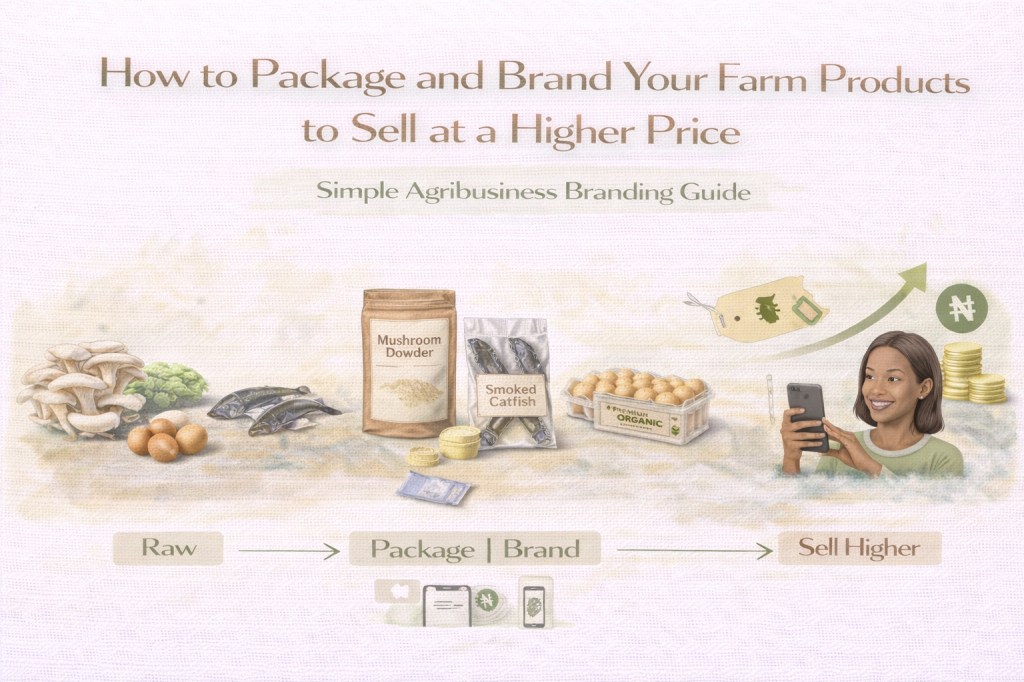
Farm product packaging and branding is the difference between selling a bag of mushrooms for ₦3,000 and selling a branded 500g pack for ₦3,500 — same mushrooms, same farm, different story. Most farmers never invest in packaging and branding because they think it is only for big companies. That is a mistake that costs real money every single market day.
Strong branding differentiates agricultural products in crowded marketplaces and builds customer loyalty. Effective agricultural branding goes beyond attractive logos; it communicates values, quality standards, and unique selling propositions. This guide shows you how to build that from scratch, practically and affordably, wherever you are in the world.
1. Why Packaging and Branding Change What Buyers Pay
Think about two identical bottles of honey at a market stall. One is in a plain jar with a handwritten label. The other is in a clean glass jar with a professional label showing the farm name, origin, harvest date, and a short story about how it was made.
Both jars contain the same honey. But most buyers will pay more for the second one and trust it more.
Packaging serves dual purposes in agricultural marketing: protecting products during transportation and storage while serving as a powerful marketing tool at the same time.
How to export farm products from Nigeria (Beginners’ Guide)
Here is what good packaging and branding do for your farm:
- Commands a higher price. A branded product signals quality, care, and professionalism. Buyers expect to pay more for it and they do.
- Opens new sales channels. Supermarkets, health food stores, online platforms, and export markets all require proper packaging. Without it, these channels are closed to you.
- Reduces price haggling. When a buyer sees a professional package with a clear price, they are far less likely to negotiate than when buying a loose, unpackaged product.
- Builds repeat buyers. A branded package with your name, logo, and WhatsApp number turns a one-time buyer into a repeat customer. They know exactly where to find you again.
- Underestimating the role of design, quality packaging, and food safety standards is one of the most common and costly mistakes in value-added agribusiness.
How to add value to your farm products to earn more money
2. What Branding Actually Means for a Farm Business
Branding is not just a logo. It is the complete impression your farm makes on a buyer before, during, and after they buy from you.
Your brand includes:
- Your farm name
- Your logo or visual identity
- Your packaging style and colours
- The words you use to describe your product
- How you present yourself on WhatsApp, Instagram, and in person
- The story behind your farm
You do not need a graphic design degree or an expensive agency to build a brand. You need clarity on three things:
- Who you are — your farm name and what makes you different
- Who your buyer is — a health-conscious urban household, a restaurant chef, an export buyer
- What you promise — freshness, consistency, quality, local origin
Once you are clear on these three things, every packaging and branding decision becomes much easier.
3. Step 1 — Define Your Brand Identity
Before you design anything, answer these questions:
What is your farm name?
Keep it short, memorable, and relevant to what you sell or where you are from. Examples: Green Valley Farms, Mama Ngozi’s Kitchen Garden, Fresh Roots Co.
What makes your product different?
Are you chemical-free? Do you deliver same-day? Do you grow heritage varieties? Are you a family farm with generations of experience? Your difference is your brand story. A brand story might emphasise family farming traditions, organic certification, or innovative growing techniques that set products apart from competitors.
What do you want buyers to feel when they see your product?
Trust? Health? Freshness? Authenticity? Premium quality? Your packaging, colours, and words should all point toward that feeling.
What colours represent your brand?
Colours communicate before words do. Green signals nature and freshness. Brown signals earthiness and organic. White signals cleanliness and purity. Blue signals trust and reliability. Pick two to three colours and use them consistently everywhere.
Instagram Vs Facebook for Agribusiness which one should you use
4. Step 2 — Choose the Right Packaging for Your Product
Your packaging must do three things: protect your product, present it well, and carry your brand.
| Product | Recommended Packaging | What to Avoid |
|---|---|---|
| Fresh mushrooms | Clear punnet or perforated plastic bag with label | Black nylon bags — they hide the product |
| Dried mushrooms or powder | Sealed kraft paper pouch or clear zip-lock bag with label | Loose bags with no seal |
| Smoked or dried catfish | Sealed vacuum bag or clear plastic with heat seal | Newspaper wrapping |
| Portioned frozen chicken | Sealed zip-lock or vacuum bag with label and date | Loose wrapping |
| Eggs | Branded cardboard carton (6 or 12 eggs) | Loose in a tray with no branding |
| Honey or oil | Glass jar or food-grade plastic bottle with label | Unlabelled containers |
| Vegetable flakes or flour | Sealed kraft pouch or food-grade sachet with label | Loose packaging |
| Fresh vegetables | Clean rubber-banded bunches or mesh bags | Random loose piles |
Practical packaging sources:
- Local printing companies print custom labels at low cost, even 100 to 500 labels is a viable minimum order
- Kraft pouches and zip-lock bags are available from packaging suppliers in most major cities
- Vacuum sealers for home use start from a low cost and significantly extend shelf life
- For glass jars, source from local wholesalers who supply restaurants and food producers
5. Step 3 — Design Your Label
Your label is your packaging’s most important element. A buyer who has never heard of you makes a buying decision based on your label in seconds.
What every farm product label must include:
- Farm or brand name — clear and prominent
- Product name — what it is, exactly (e.g. “Organic Oyster Mushrooms”)
- Net weight or volume — required for most retail channels
- Key claim — one short phrase that tells the buyer why it is better (e.g. “Farm-fresh, no chemicals” or “Harvested today”)
- Contact details — WhatsApp number and/or website
- Storage instructions — “Keep refrigerated” or “Store in a cool, dry place”
- Batch or date information — harvest date or best-before date where applicable
Optional but powerful:
- A short origin statement — “Grown in the hills of [your region]”
- A QR code linking to your WhatsApp Business or Instagram
How to create your label cheaply:
- Use Canva (free) to design a professional label without any design experience. Canva has ready-made food label templates you can customise with your farm name, colours, and product details.
- Print locally on glossy or kraft sticker paper. Many local print shops accept Canva files directly.
- Order minimum quantities first; test your label before printing in bulk.
6. Step 4 — Price Your Branded Product Correctly
The moment you brand your product, you are no longer competing on commodity price. You are selling a brand and brands command a premium.
Agribusiness farmers should think about marketing-related factors; including brand orientation and customer differentiation, to stand out from competitors and set prices that reflect real product value.
A practical pricing formula for branded farm products:
Branded Price = Production Cost + Packaging Cost + Branding Premium (20% to 50%)
The branding premium is what you charge above your base production and packaging cost simply because your product is presented professionally. For most products, 20% to 50% above cost is achievable, and buyers accept it willingly when the packaging justifies it.
How to write a farm business plan that actually gets you funded
7. Step 5 — Take Photos That Sell
Your packaging does not just work in person; it works online. And online, the photo of your product is your packaging.
Basic product photography rules for farm sellers:
- Use natural light. Photograph your products near a window or outside in shade. Avoid harsh direct sunlight and avoid artificial yellow lighting; both distort colours.
- Use a clean background. A white sheet, a wooden board, or a plain surface works perfectly. Clutter in the background distracts from the product.
- Show the product clearly. Customers want to see what they are buying. Do not hide your product behind shadows or other items.
- Show your packaging. Place your branded pack next to or in front of the loose product so buyers see both what they are getting and how it is packaged.
- Shoot from multiple angles. A front shot, a top-down shot, and a close-up of the label covers everything a buyer wants to see.
You do not need a professional camera. A modern smartphone in good natural light produces product photos that convert buyers.
8. Step 6 — Put Your Brand Everywhere Buyers See You
Once your brand identity, packaging, and label are in place, use them consistently everywhere:
- WhatsApp Business profile — use your logo as your profile photo, use your farm name as your business name
- Instagram and Facebook — consistent username, consistent visual style, same colours and font across all posts
- Delivery packaging — put a sticker or stamp with your name and WhatsApp number on every bag, box, or wrap you deliver in
- Business cards — a simple card with your farm name, what you sell, and your contact details costs very little and leaves an impression
- At markets and events — a branded banner, tablecloth, or simple printed sign makes your stall stand out from every unbranded competitor around you
Direct marketing eliminates intermediaries, allowing agricultural producers to capture higher profit margins while building direct relationships with consumers. Your brand is what makes buyers choose you over the unbranded competitor at the next stall, every time.
How to use WhatsApp to sell farm products
9. Branding Mistakes Farmers Make
- Using a personal WhatsApp photo instead of a farm logo. Your profile picture is your first impression. Make it professional.
- Inconsistent packaging across batches. If your label looks different every time, buyers cannot build brand recognition. Use the same design every time.
- Overclaiming on labels. Do not write “organic” unless you are certified. Do not write “100% natural” if you use any treatments. Buyers who feel misled do not come back.
- No contact details on packaging. Every package is a chance to generate a repeat order. If buyers cannot find you, they cannot reorder.
- Copying a competitor’s colours or style. Build your own identity. A brand that looks like someone else’s erodes the trust you are trying to build.
- Investing in branding before fixing product quality. Good packaging amplifies what is inside; good and bad. Fix any quality inconsistencies before investing in packaging.
10. Key Takeaways
- Branding is not just a logo; it is the complete impression your farm makes on every buyer, in person and online.
- Good packaging protects your product and commands a higher price. The same product in professional packaging sells for 20% to 50% more.
- Your label must include your farm name, product name, weight, a key claim, and your contact details.
- Use Canva to design your label for free and print locally in small quantities to test before ordering bulk.
- Natural light and a clean background are all you need for product photos that convert buyers online.
- Put your brand on everything; packaging, WhatsApp, Instagram, delivery bags, and business cards.
11. FAQ
Do I need a registered business to brand my farm products?
You do not need registration to start branding and selling locally. However, if you want to supply supermarkets, export, or register your brand officially, CAC registration (Nigeria), Companies House (UK), or the relevant body in your country is recommended. Registration also protects your brand name from being used by others.
How much does it cost to start packaging and branding my farm products?
You can start very affordably. A Canva label design is free. Printing 100 to 500 sticker labels typically costs the equivalent of $5 to $20 depending on your location. Basic packaging materials — zip-lock bags, kraft pouches, or simple cartons — add a small cost per unit. Factor all of this into your product price from the start.
Do I need food safety certification to sell branded farm products?
For retail sales through supermarkets or online platforms, food safety registration is strongly recommended and often required. For direct household and restaurant sales, professional packaging builds buyer trust even without formal certification. Start the registration process early, it opens more sales channels over time.
Can I sell branded farm products online?
Yes, and branded products perform significantly better online than unbranded ones. Clean packaging photographs well, builds trust on social media, and makes the product viable for courier delivery. Unpackaged loose products are difficult to photograph, hard to ship, and harder to price online.
What is the single most important branding investment for a small farm?
Your label. A professional, clearly designed label on your packaging does more for your perceived value than any other single investment. Start there before spending money on banners, websites, or paid advertising.
Published by Kiki’s Agroplace — Digital Marketing for African Agribusinesses.


Leave a Reply