Table of Contents
- What value addition actually means for farmers
- Why raw farm products leave money on the table
- Value addition for mushroom farmers
- Value addition for catfish farmers
- Value addition for poultry farmers
- Value addition for crop and vegetable farmers
- Equipment you need to get started
- How to price your value-added products
- Where to sell value-added farm products in Nigeria
- Key takeaways
- FAQ
Introduction
Value addition for agribusiness in Nigeria is the single biggest income opportunity most farmers are ignoring right now. You grow it, harvest it, and sell it raw; often at the price a middleman sets. But the moment you dry it, process it, package it, or turn it into something new, you earn significantly more per kilo for the same product you already produce.
Agro-processing is the conversion of raw agricultural products into finished or semi-finished goods that have higher value, longer shelf life, and wider market potential. This guide shows you exactly how to do that; for mushrooms, catfish, poultry, and crops step by step, without a large factory or expensive equipment.
Beginner’s guide on How to Export farm products from Nigeria.
1. What Value Addition Actually Means for Farmers
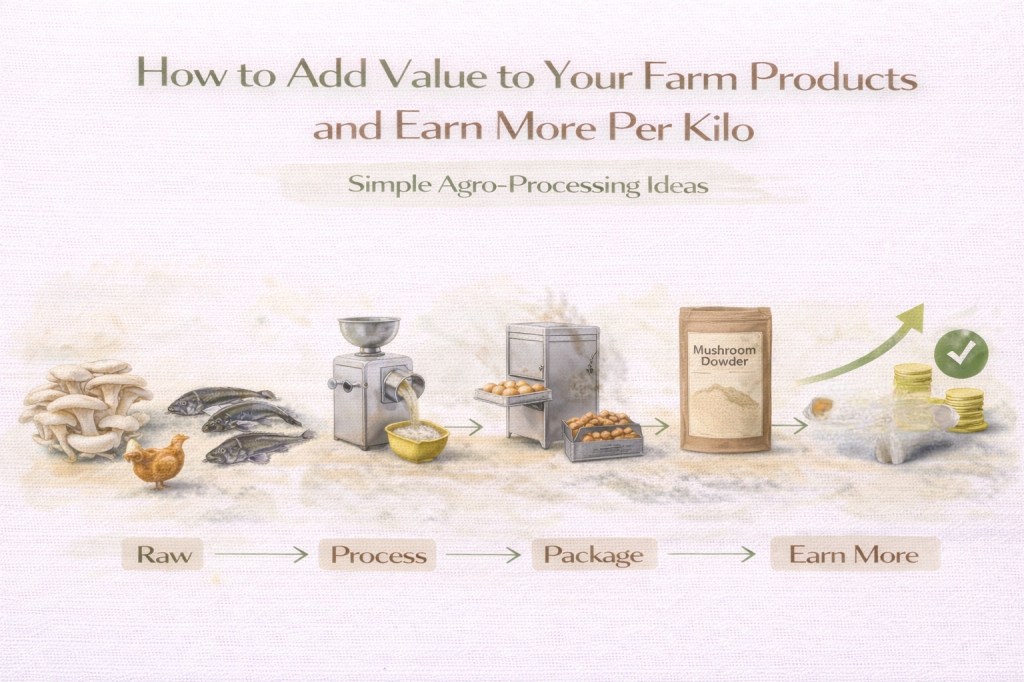
Value addition simply means doing something to your farm product that makes it worth more money before you sell it.
Think of it this way:
- A fresh oyster mushroom sells for ₦3,000 to ₦5,000 per kg
- The same mushroom dried and ground into powder sells for ₦8,000 to ₦15,000 per kg
- The same powder packaged in a branded 50g sachet sells for ₦500 to ₦800 per sachet; which is ₦10,000 to ₦16,000 per kg
Same mushroom. Same farm. Three to five times the income, just by adding a processing step.
Value addition can be as simple as:
- Drying your produce to extend shelf life
- Smoking or processing for preservation
- Packaging neatly with your brand name and weight
- Turning raw produce into a product; powder, paste, oil, or flour
- Portioning into smaller units that household buyers can afford
You do not need a factory. Many successful Nigerian agro-processors started in a kitchen or a small shed.
2. Why Raw Farm Products Leave Money on the Table
Most Nigerian farmers sell raw because it is faster. Harvest today, sell tomorrow. But that speed costs money.
Here is what happens when you sell raw:
- Perishable products spoil quickly: mushrooms last 3 to 5 days fresh. If buyers do not show up, you lose everything.
- Middlemen control your price: they know you need to sell before your product spoils, so they offer the lowest price they can.
- You compete on price alone: raw catfish looks the same whether it came from your farm or a neighbour’s pond. Buyers choose whoever is cheapest.
- Post-harvest losses eat your profit: post-harvest losses in Nigeria are estimated at 40% annually, meaning nearly half of what many farmers grow never generates income.
Value addition solves all of these problems at once. It extends shelf life, removes the pressure to sell immediately, differentiates your product, and lets you charge more.
A guide to EUDR 2026 for cocoa and coffee exporters.
3. Value Addition for Mushroom Farmers
Fresh oyster mushrooms are highly perishable. This is the biggest challenge mushroom farmers face, and value addition is the direct answer.
Option 1: Dried mushrooms
Slice your fresh mushrooms and dry them in a food dehydrator, solar dryer, or oven at 50°C to 60°C until fully dry and crisp. Dried mushrooms have a shelf life of up to 12 months. They sell at 3 to 5 times the price of fresh mushrooms by weight because you lose 80% to 90% of water weight during drying; meaning 10 kg of fresh mushrooms becomes 1 to 1.5 kg dried.
Option 2: Mushroom powder
Blend dried mushrooms into a fine powder. Sell it as a seasoning or soup ingredient. Packaged in 50g or 100g labelled sachets. Target health-conscious households, organic food stores, and restaurants that use it as a flavour base. Small-scale processors who can dehydrate, package, and brand these products will find huge retail opportunities in Lagos, Abuja, Port Harcourt, and even the diaspora market.
Option 3: Mushroom pepper soup mix
Blend dried mushroom powder with local spices; uda, uziza, and crayfish. Package as a ready-to-use pepper soup kit. This sells at a significant premium and has almost no direct competitors in the Nigerian retail market.
Option 4: Dried mushroom snacks
Season sliced mushrooms with salt, pepper, and spices before drying. Package as a healthy snack. Growing demand from health-conscious urban Nigerians makes this a strong market opportunity.
How to market mushrooms for beginners.
4. Value Addition for Catfish Farmers
Catfish value addition is well established in Nigeria; smoked catfish is already a mainstream product. But most farmers are not capturing the full profit opportunity.
Option 1: Smoked catfish
The most common value-added catfish product in Nigeria. Smoking extends shelf life from 3 to 5 days (fresh) to 3 to 6 months (smoked). Smoked catfish sells at 2 to 3 times the price of live catfish by weight. Invest in a clay or metal smoking kiln.
Option 2: Dried and salted catfish
A simpler alternative to smoking. Salt heavily, then sun-dry or use a food dryer. Shelf life extends to 2 to 3 months. Popular in markets across Nigeria and neighbouring countries.
Option 3: Portioned and packaged frozen catfish
Clean, gut, and cut your catfish into portions. Package in sealed plastic bags labelled with your farm name and weight. Freeze and sell directly to households and restaurants. Portioned catfish commands a higher price than whole live fish because buyers get convenience; no cleaning, no gutting, ready to cook.
Option 4: Catfish pepper soup packs
Package cut catfish portions with a seasoning sachet into a ready-to-cook pepper soup kit. This targets urban, busy households that want convenience. Price these at 40% to 60% above the equivalent raw catfish value.
5. Value Addition for Poultry Farmers
Most Nigerian poultry farmers sell live birds or whole dressed chickens. Both leave significant income on the table.
Option 1: Fully dressed and portioned chicken
Clean, dress, and cut your broilers into portions; breast, thigh, drumstick, wings. Package in labelled bags with your farm name and weight. Portioned chicken sells at a 20% to 35% premium over whole live birds because you are selling convenience.
Option 2: Smoked chicken
Marinate and smoke whole chickens or portions. Sell directly to households, restaurants, and event caterers. Smoked chicken has a shelf life of 5 to 7 days refrigerated and commands a premium price.
Option 3: Processed eggs
Rather than selling eggs loose, grade them by size, package them in branded cartons of 6 or 12, and label them with your farm name. Branded egg cartons sell at a 10% to 20% premium over loose eggs in markets; simply from better packaging.
Option 4: Chicken stock
An advanced option for those willing to invest more. Process chicken offcuts, bones, and skin into stock. Reduce and package as frozen stock blocks or dehydrated powder. Sell to restaurants and households as a cooking base.
6. Value Addition for Crop and Vegetable Farmers
- Tomatoes → tomato paste or dried tomato powder: Fresh tomatoes spoil within days. Tomato paste lasts for months. Processing tomatoes into paste addresses a critical industry gap and can generate consistent revenue.
- Cassava → garri, flour, or starch: Raw cassava sells cheaply. Garri and cassava flour sell at 3 to 5 times the price of the raw tuber.
- Leafy vegetables → dried vegetable flakes: Dry and package ugu, bitter leaf, or uziza into flakes. Sell to households, restaurants, and the diaspora market. Dried vegetables last 6 to 12 months.
- Plantain → plantain flour or chips: Unripe plantain sliced, dried, and milled into flour commands a premium in health food markets. Plantain chips are an established snack product with strong retail demand.
7. Equipment You Need to Get Started
You do not need a factory. Here is what a small-scale value addition setup requires:
| Equipment | What It Does | Estimated Cost |
|---|---|---|
| Food dehydrator or solar dryer | Dries mushrooms, vegetables, fish | ₦20,000 – ₦80,000 |
| Blender or grinder | Makes powder from dried produce | ₦15,000 – ₦50,000 |
| Vacuum sealer | Extends shelf life of packaged products | ₦25,000 – ₦70,000 |
| Weighing scale | Accurate portioning for packaging | ₦5,000 – ₦15,000 |
| Label printer or stickers | Branding and product identification | ₦3,000 – ₦20,000 |
| Smoking kiln (catfish) | Smokes fish for preservation | ₦30,000 – ₦80,000 |
| Freezer | Stores portioned poultry and fish | ₦80,000 – ₦200,000 |
Start with the minimum equipment for your chosen product. Do not buy everything at once, add equipment as your sales grow.
8. How to Price Your Value-Added Products
Value-added products are priced differently from raw farm produce. You are no longer competing on commodity price; you are selling convenience, shelf life, and quality.
Use this formula:
Value-Added Price = Raw Material Cost + Processing Cost + Packaging Cost + Your Profit Margin (40% to 70%)
Example for mushroom powder:
- 10 kg fresh mushrooms at ₦4,000 per kg = ₦40,000
- Drying and processing cost = ₦5,000
- Packaging (50g sachets with labels) = ₦3,000
- Total cost = ₦48,000
- This produces approximately 1 kg of powder = 20 sachets of 50g
- Cost per sachet = ₦2,400
- Add 60% margin = selling price ₦3,840 per sachet
- At ₦4,500 per sachet retail, profit per batch = ₦90,000 – ₦48,000 = ₦42,000
Compare that to selling 10 kg of fresh mushrooms at ₦4,000 per kg = ₦40,000 raw. Value addition on the same input almost doubles your income.
9. Where to Sell Value-Added Farm Products in Nigeria
- Supermarkets and grocery stores: they stock processed and packaged products, not raw produce.
- Health food stores: mushroom powder, dried vegetables, and organic processed foods are in growing demand in Lagos, Abuja, and Port Harcourt.
- Online (Instagram, WhatsApp, Jumia): packaged products photograph well and ship easily. Value-added products unlock e-commerce.
- Restaurants and hotels: chefs buy processed ingredients like mushroom powder, portioned chicken, and smoked fish regularly.
- Diaspora market: Nigerians abroad actively buy processed Nigerian food products. Dried mushrooms, smoked catfish, garri, and plantain flour all have strong demand in the UK, US, and Canada.
10. Key Takeaways
- Value addition means processing your raw farm product into something with a longer shelf life, better packaging, or higher convenience, and charging more for it.
- Dried mushrooms sell for 3 to 5 times the price of fresh mushrooms. Mushroom powder sells for even more.
- Smoked catfish lasts 3 to 6 months versus 3 to 5 days for fresh catfish. Same fish; much higher price and no spoilage pressure.
- Portioned, packaged poultry and eggs command a 20% to 35% premium over live or loose products.
- You do not need a factory to start. A food dryer, blender, and packaging materials are enough to begin.
- Post-harvest losses drop significantly when you process rather than sell everything raw.
How to package and brand farm products to sell at higher rate.
11. FAQ
What is the easiest value addition option for a beginner farmer in Nigeria?
Drying is the simplest starting point. A basic food dehydrator costs ₦20,000 to ₦80,000 and works for mushrooms, vegetables, and catfish. Start with drying before investing in more complex processing equipment.
Do I need NAFDAC approval to sell value-added farm products in Nigeria?
Yes, if you are selling packaged food products to the public through retail channels; supermarkets, stores, or online. NAFDAC registration for small-scale food businesses varies in price, depending on product type. Start the registration process early, it builds buyer confidence and opens more sales channels.
How much extra income can value addition realistically add for a small farmer?
Most small-scale farmers who add a basic processing step report earning 2 to 3 times more per kg of produce compared to selling raw. The exact figure depends on your product, processing method, and sales channel.
Can I do value addition at home or do I need a separate facility?
Many Nigerian agro-processors start at home. A clean kitchen, basic equipment, and proper hygiene are sufficient for small-scale production. As volume grows, a separate processing shed becomes worth the investment for both hygiene and efficiency.
Where can I learn more about agro-processing regulations in Nigeria?
Contact NAFDAC directly at nafdac.gov.ng or visit your nearest NAFDAC state office for guidance on product registration requirements. SMEDAN also offers free advisory support for small-scale agro-processors.
Published by Kiki’s Agroplace — Digital Marketing for African Agribusinesses.


Leave a Reply