Table of Contents
- Why most farmers underprice their products
- The two pricing methods every farmer should know
- Step 1 — Calculate your total production cost
- Step 2 — Add your profit margin
- Step 3 — Check the market price
- Step 4 — Adjust for your buyer type
- Examples: Catfish, mushroom, and poultry pricing
- Pricing mistakes that kill farm profit
- Key takeaways
- FAQ
Introduction
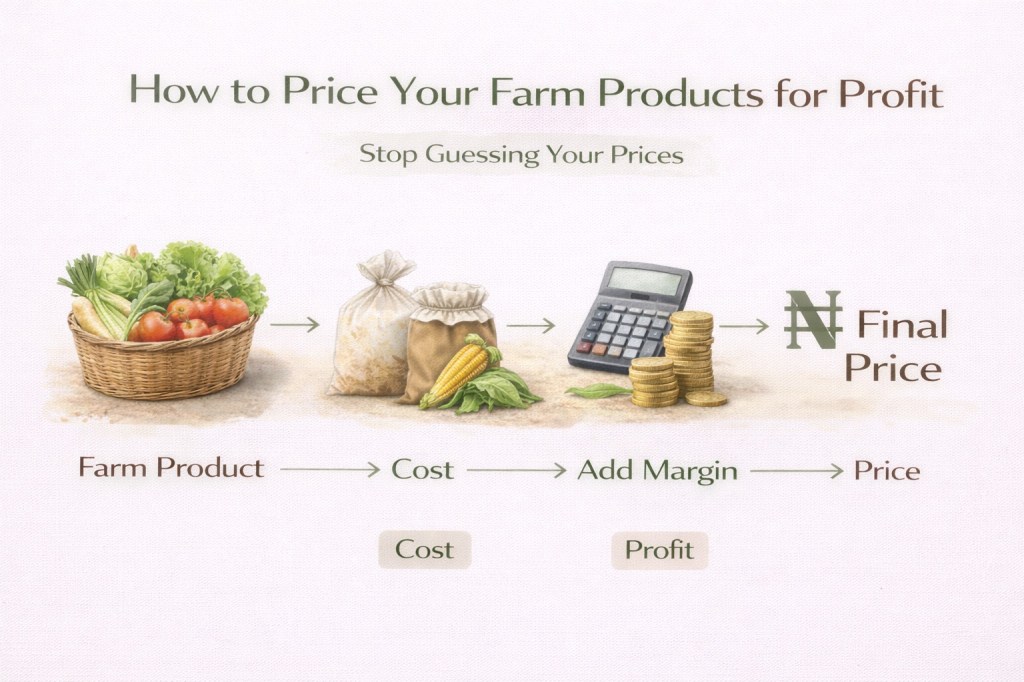
Knowing how to price farm products in Nigeria is one of the most important skills you can have as a farmer. Most farmers focus on growing and harvesting — then guess at a price when a buyer shows up. That guess usually costs them money. This guide shows you a simple, step-by-step method to price your farm products so you always cover your costs and make a profit.
1. Why Most Farmers Underprice Their Products
Here is what happens on most farms in Nigeria:
A buyer comes and asks, “How much for your catfish?”
The farmer thinks about what the neighbour charged last week, picks a number close to that, and sells.
The problem? That neighbour may also be losing money without knowing it. Copying someone else’s price does not mean you are making a profit. It just means you are both guessing.
The three reasons farmers underprice:
- They never calculated what it actually cost them to produce the product
- They are afraid buyers will walk away if the price is “too high”
- They do not know the difference between revenue (money coming in) and profit (money left after costs)
Pricing correctly starts with knowing your numbers.
2. The Two Pricing Methods Every Farmer Should Know
Method 1: Cost-Plus Pricing
This means you add up everything it cost you to produce your product, then add a profit margin on top. Simple and reliable. Best for beginners.
Formula:
Selling Price = Total Production Cost ÷ Units Produced + Profit Margin
Method 2: Value-Based Pricing
This means you charge based on what your product is worth to the buyer — not just what it cost you to produce. A farmer selling fresh oyster mushrooms directly to a Lagos restaurant can charge more than a farmer selling at a roadside market, even if both grew the same mushrooms. The value to the buyer is different.
Start with cost-plus pricing to make sure you are not losing money. Then move towards value-based pricing as you build your buyer relationships.
3. Step 1 — Calculate Your Total Production Cost
Write down every naira you spent to produce your product. Include:
Important: Many farmers forget to include their own labour. Your time has value. If you spent 60 hours producing a batch of catfish, that time must be costed. Use the minimum wage rate if you are unsure what to charge for your time.
Add everything up. That total is your Cost of Production.
Then divide by the number of units you produced:
Cost Per Unit = Total Production Cost ÷ Number of Units Produced
4. Step 2 — Add Your Profit Margin
Once you know your cost per unit, add a profit margin. Your profit margin is the extra amount above cost that goes into your pocket.
Simple guide:
The closer you sell to the final consumer, the higher your margin can be. This is why direct sales always beat selling through a middleman.
5. Step 3 — Check the Market Price
After you calculate your cost-plus price, compare it to what others are currently charging in your local market. This is your sanity check.
Current reference prices in Nigeria (2026):
If your cost-plus price is higher than the market price, you have a production cost problem — not a pricing problem. You need to reduce your costs, not sell below cost.
If your cost-plus price is lower than the market price, that is good news. It means you have room to price competitively and still profit.
Where to check current market prices in Nigeria:
- Visit your nearest open market once a week
- Join active WhatsApp groups for farmers in your sector
- Check platforms like Jiji, TradeDepot, or Farmcrowdy for current buyer prices
6. Step 4 — Adjust for Your Buyer Type
Not every buyer pays the same price — and that is normal. Adjust your price based on who is buying and how much they are buying.
Wholesale buyers (middlemen, market traders):
Expect a lower price because they buy in volume. Give them a lower margin but sell more units.
Retail buyers (households, neighbours, direct customers):
They buy small quantities but pay full retail price. Higher margin per unit.
Institutional buyers (restaurants, hotels, schools, hospitals):
They want consistency, quality, and reliable supply. They will pay a premium for this. Charge 40% to 60% above your production cost and deliver on time, every time.
Quick rule: Never let a middleman set your price for you. Know your cost per unit first. If their offer does not cover your cost plus at least a 20% margin, walk away or look for a different buyer.
7. Examples: Catfish, Mushroom, and Poultry Pricing
Catfish Example
Say you raised 500 kg of catfish and your total production cost was ₦750,000. How to sell catfish.
- Cost per kg = ₦750,000 ÷ 500 = ₦1,500 per kg
- Add 40% margin = ₦1,500 × 1.4 = ₦2,100 per kg
- Current market retail price = ₦2,600 to ₦4,400 per kg
Your ₦2,100 price covers your cost and profit. You are still below market price, which means you can price higher and earn more — especially if selling directly to households or restaurants.
Oyster Mushroom Example
Say you produced 20 kg of oyster mushrooms. Total cost: ₦30,000. How to market mushrooms.
- Cost per kg = ₦30,000 ÷ 20 = ₦1,500 per kg
- Add 50% margin (selling direct) = ₦1,500 × 1.5 = ₦2,250 per kg
- Current retail market price = ₦3,000 to ₦6,000 per kg
You have significant room to price higher, especially to restaurants. A hotel buyer may happily pay ₦4,000 per kg for consistent, fresh supply.
Poultry (Broiler) Example
Say you raised 100 broilers. Total cost: ₦350,000.
- Cost per bird = ₦3,500
- Average market weight = 2.5 kg per bird
- Cost per kg = ₦3,500 ÷ 2.5 = ₦1,400 per kg
- Add 35% margin = ₦1,400 × 1.35 = ₦1,890 per kg
- Current retail price = ₦6,000 to ₦7,500 per kg
This gap between your cost and market price is your opportunity. Direct sales to households or caterers will always outperform selling to a middleman.
8. Pricing Mistakes That Kill Farm Profit
- Copying competitor prices blindly — Their costs may be different from yours. Their price may be a loss-making price.
- Not including your own labour — If you work for free on your farm, you are not running a business. You are running a charity.
- Lowering your price to beat the market — Competing on price alone puts you in a race to the bottom. Compete on quality and reliability instead.
- Charging the same price to all buyers — A restaurant buyer and a roadside buyer are not the same. Price them differently.
- Never reviewing your prices — Input costs in Nigeria change often. Food price inflation in Nigeria has averaged close to 40% through much of 2024, and feed costs remain high. Review your production costs and prices every 3 months.
- Selling everything to middlemen — Every unit you sell through a middleman is margin you are giving away. Direct buyers always pay more.
9. Key Takeaways
- Pricing starts with your production cost, not the neighbour’s price.
- Cost Per Unit = Total Production Cost ÷ Units Produced.
- Add a profit margin of 20% to 70% depending on your buyer type.
- Direct buyers always pay more than middlemen.
- Review your prices every 3 months — input costs change.
- Never sell below your cost per unit, no matter how pressured you feel.
10. FAQ
How do I know what my farm products are worth in Nigeria?
Calculate your production cost per unit first. Then check current open market prices in your state. Your selling price must cover your cost and leave a profit margin. Use the examples in this guide as a starting point.
What is a good profit margin for farm products in Nigeria?
A margin of 30% to 50% above production cost is a realistic target for most small-scale farmers selling directly to buyers. Selling through middlemen usually reduces your effective margin to 10% to 20%.
What if buyers say my price is too high?
First, check that your production costs are reasonable. If they are, do not lower your price below profitability. Instead, find buyers who value quality — restaurants, hotels, and direct household buyers tend to pay better prices than market traders.
Should I charge the same price in dry season and rainy season?
No. Supply drops in dry season for many products, which means you can charge more. In rainy season when supply is high, prices usually fall. Plan your production cycles and pricing around the seasons.
How does pricing affect my ability to grow my farm?
Profit is what you reinvest into your farm. If you are not pricing for profit, you have no money to buy more inputs, hire help, or expand. Getting your pricing right is the foundation of a farm that actually grows.
Published by Kiki’s Agroplace — Digital Marketing for African Agribusinesses.


Leave a Reply