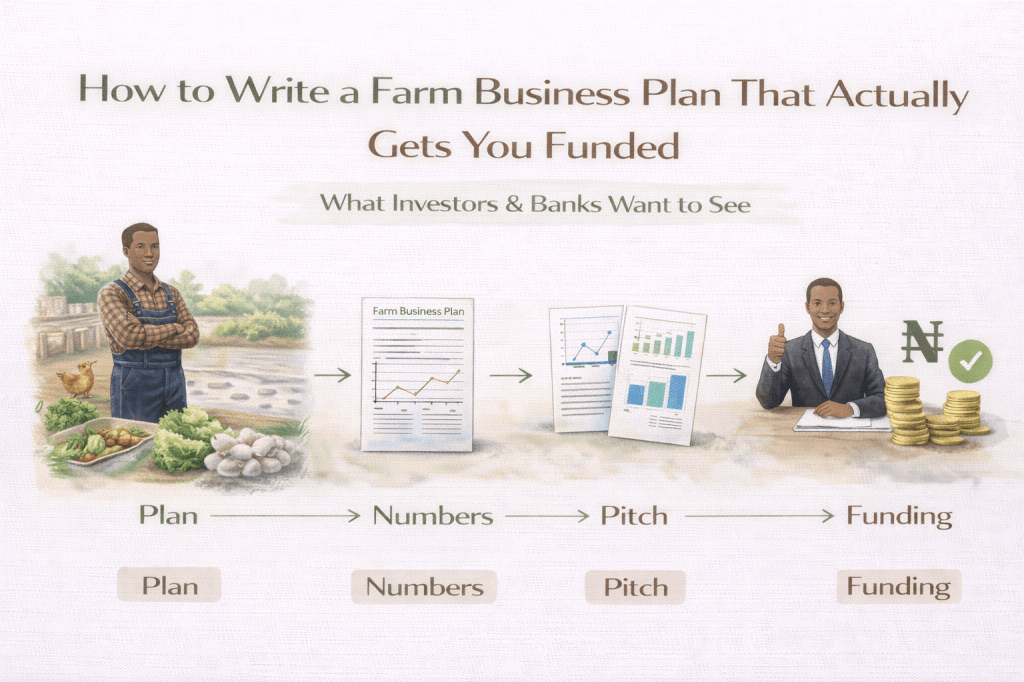
Table of Contents
- Why most farm business plans get rejected
- What a farm business plan actually is
- The 10 sections every fundable farm business plan must have
- Section 1 — Executive summary
- Section 2 — Business description
- Section 3 — Market analysis
- Section 4 — Production plan
- Section 5 — Marketing and sales plan
- Section 6 — Management and organisational structure
- Section 7 — Financial plan
- Section 8 — Risk analysis
- Where to get funding for your farm in Nigeria
- Key takeaways
- FAQ
Introduction
A farm business plan in Nigeria is not just a document you write to impress a bank. It is the single most important tool that separates farmers who get funded from those who do not. Nigerian financial institutions require detailed business plans for loan applications and the Bank of Agriculture specifically asks for a viable, profitable, and bankable business proposal before approving any loan.
This guide shows you exactly what goes into a farm business plan that gets approved; section by section.
Mushroom Farming Business Plan guide
1. Why Most Farm Business Plans Get Rejected
Many farmers miss out on funding opportunities simply because they lack accurate information, submit incomplete documentation, or have no formal business structure in place before applications open.
The most common reasons farm business plans fail:
- No financial projections. Many farmers describe what they want to do but never show the numbers. Banks and investors make decisions based on numbers, not descriptions.
- Vague market analysis. Saying “there is a big market for catfish in Nigeria” is not enough. You need to show specifically who your buyers are, what they pay, and how you will reach them.
- No risk section. Every serious investor expects you to identify what could go wrong and how you will handle it. A plan with no risk analysis looks naive.
- Unregistered business. Most funding programmes require at minimum a CAC registration or cooperative membership. Without it, your application is automatically disqualified.
- Copied templates. Banks and grant reviewers read hundreds of plans. A plan that looks copied or generic gets rejected fast.
How to Export farm products from Nigeria
2. What a Farm Business Plan Actually Is
A farm business plan is a written document that explains:
- What your farm produces
- Who buys it and at what price
- How much it costs to run your farm
- How much profit you expect to make
- What risks exist and how you will manage them
Think of it as telling a complete story about your farm; past, present, and future, in a way that convinces someone with money that giving it to you is a good idea.
It serves three purposes:
- Getting funded — loans, grants, or investor capital
- Running your farm better — a good plan forces you to think through every part of your operation
- Measuring your progress — you can compare actual results to your projections and adjust
3. The 10 Sections Every Fundable Farm Business Plan Must Have
- Executive summary
- Business description
- Market analysis
- Production plan
- Marketing and sales plan
- Management and organisational structure
- Financial plan
- Risk analysis
- Appendices (supporting documents)
- Cover page and table of contents
4. Section 1 — Executive Summary
This is the first thing a bank officer or grant reviewer reads. It must be clear, specific, and compelling. If the executive summary is weak, many reviewers will not read further.
What to include:
- Your farm name, location, and legal structure
- What you produce and your current scale
- How much funding you are requesting and what you will use it for
- A one-sentence summary of your financial projection (e.g. “We project ₦8.4 million in revenue in Year 1 with a net profit margin of 32%”)
- Your key competitive advantage — what makes your farm different or better positioned than others
Write this section last, after you have completed all other sections. That way you are summarizing what you have already worked out in detail.
Example opening:
“Green Harvest Catfish Farm is a registered aquaculture business in Ikorodu, Lagos State, producing live and processed catfish for direct sale to households, restaurants, and fish markets. We are seeking ₦5 million in loan financing to expand our pond capacity from 4 to 10 ponds, increasing annual production from 3,000 kg to 7,500 kg. With current confirmed buyers in place and a selling price of ₦3,800 per kg, Year 2 projected revenue is ₦28.5 million.”
5. Section 2 — Business Description
This section gives full background on your farm.
What to include:
- Full business name and registered address
- CAC registration number (if registered)
- Legal structure — sole proprietorship, partnership, or limited company
- Year established
- What you produce — species, variety, or product type
- Current farm size — number of ponds, hectares, or square footage
- Current production output — how much you produce per cycle or per year
- Your mission in one or two sentences
State your business name and legal structure clearly and say whether it is registered with the Corporate Affairs Commission. Unregistered businesses are automatically disqualified from most formal funding programmes.
6. Section 3 — Market Analysis
This is where most farm business plans fall short and where the strong ones stand out.
What to include:
- The size of your target market (local, state, or national)
- Who your specific buyers are; households, restaurants, hotels, processors, exporters
- Current market prices for your product in your area
- Your competitors; who else is producing the same product nearby
- Your competitive advantage; why buyers will choose you over others
- Demand and supply gap; evidence that the market needs more of what you produce
You do not need expensive market research. Walk your local market, call three restaurants, and check current prices on WhatsApp groups. That is real primary research and it is more convincing than generic statistics copied from the internet.
7. Section 4 — Production Plan
This section shows exactly how you produce your product. It demonstrates to funders that you know what you are doing.
What to include:
- Production cycle; how long from start to harvest
- Inputs required; seeds, fingerlings, spawn, feed, fertilizer, medications
- Labour; how many people you employ and what they do
- Equipment and infrastructure; ponds, grow rooms, storage, processing
- Production capacity; current and projected after funding
- Suppliers; where you source your inputs and why you chose them
- Quality control; how you maintain consistent product quality
Keep this section factual and specific. Numbers matter here; exact quantities, exact costs, exact timelines.
8. Section 5 — Marketing and Sales Plan
This section answers one question: how will you sell everything you produce?
What to include:
- Your target buyers; named and specific (e.g. “three restaurants in Lekki Phase 1, two hotels on the island, and a weekly market in Badagry”)
- Your pricing strategy; cost-plus or value-based, and why
- Your sales channels; direct, wholesale, online, institutional
- How you will reach new buyers; WhatsApp, Instagram, referrals, cold outreach
- Your packaging and branding approach
- Any existing buyer agreements or letters of intent
If you already have buyers committed, include their names and estimated monthly order volumes. Confirmed buyers are one of the strongest signals a bank or investor looks for.
Instagram or Facebook: which one works best for your agribusiness?
9. Section 6 — Management and Organisational Structure
Funders do not just invest in farms. They invest in the people running them.
What to include:
- Your name and background — relevant farming experience, training, or education
- Any team members — their roles and experience
- Advisory support — extension agents, consultants, or mentors you work with
- How decisions are made on the farm
If you are a solo operator with no team, be honest about it. Then explain the support systems you have in place; a cooperative network, a consultant, or a farming mentor.
10. Section 7 — Financial Plan
This is the section that determines whether you get funded. Every number must be realistic and traceable back to your production plan.
What to include:
Startup or expansion costs:
List every item you will spend the requested funding on, with exact amounts.
Revenue projection (3 years):
Show expected sales volume and price per unit for each of the next three years.
Operating costs (monthly and annual):
Feed, labour, water, electricity, medication, packaging, transport, loan repayment.
Profit and loss projection:
Revenue minus total costs = projected net profit per year.
Cash flow projection:
Month-by-month breakdown of money coming in and going out. This shows funders you can repay a loan on schedule.
Break-even point:
At what production level or sales volume do you cover all your costs?
Example structure:
| Item | Year 1 | Year 2 | Year 3 |
|---|---|---|---|
| Revenue | ₦8,400,000 | ₦14,200,000 | ₦20,800,000 |
| Operating costs | ₦5,700,000 | ₦9,100,000 | ₦13,200,000 |
| Net profit | ₦2,700,000 | ₦5,100,000 | ₦7,600,000 |
| Profit margin | 32% | 36% | 37% |
Use a simple spreadsheet. You do not need accounting software; a well-organised Excel or Google Sheets document is fully acceptable.
11. Section 8 — Risk Analysis
Every honest business plan acknowledges risk. Funders do not expect your farm to be risk-free. They expect you to have thought through what could go wrong and how you will respond.
Common risks for Nigerian farms and how to address them:
| Risk | Likelihood | How You Will Manage It |
|---|---|---|
| Disease outbreak | Medium | Biosecurity protocols, emergency vet contact, insurance |
| Feed price increase | High | Bulk purchasing, alternative suppliers, feed formulation |
| Flooding or drought | Medium | Elevated pond design, water storage, insurance |
| Market price drop | Medium | Diversified buyer base, processing to extend shelf life |
| Power failure | High | Generator backup, solar option for critical equipment |
| Theft or security | Medium | Farm security measures, cooperative support network |
Acknowledge these risks directly and show your mitigation plan for each. A plan that pretends nothing can go wrong raises red flags; not green lights.
12. Where to Get Funding for Your Farm in Nigeria
Once your plan is ready, here is where to take it:
Government programmes:
- The Anchor Borrowers’ Programme (ABP), AGSMEIS, and the National Agricultural Development Fund (NADF) are active programmes covering crop farming, aquaculture, livestock, and agro-processing.
- Minimum funding starts around ₦250,000 depending on the programme. Some zero-interest options exist under the Non-Interest Banking Window.
- Apply through the Bank of Agriculture (BOA), NIRSAL Microfinance Bank, or official CBN portals only. Legitimate government programmes do not charge registration or application fees — be wary of fake agents.
Development partners:
- IFAD, the World Bank, and the African Development Bank support various state-led agricultural projects with grants targeting rural communities, youth-led agribusinesses, cooperatives, and women-owned enterprises.
- The African Development Bank approved a $200 million investment in Nigerian agriculture in early 2026, with implementation running through 2030, specifically targeting productivity, value chains, and climate-smart farming.
Private and competitive grants:
- Tony Elumelu Foundation — annual grant programme for African entrepreneurs
- YouWin Connect — Nigerian government programme for young entrepreneurs
- Africa’s Business Heroes — Jack Ma Foundation annual grant competition for African businesses
Agritech platforms:
- Private-sector agritech platforms offer micro-loans, farm input financing, and off-taker arrangements without traditional collateral; though they require farmer identification numbers, farm location verification, and proof of previous production cycles.
One critical rule: Most funding programmes open applications only once or twice a year. Farmers who register their ventures formally, keep proper records, and stay alert for new announcements will always be better positioned than those who wait until a programme opens to start preparing.
13. Key Takeaways
- A fundable farm business plan has 10 specific sections; the financial plan and market analysis are the most important.
- Register your business with the CAC before applying for any funding. Most programmes require it.
- Your financial projections must be realistic and traceable to your actual costs and prices.
- Confirmed buyers are more convincing than market statistics. Name them if you have them.
- Acknowledge risks honestly; funders trust farmers who show they have thought through problems.
- Apply only through official channels. Legitimate programmes never charge application fees.
14. FAQ
Do I need a CAC registration to apply for a farm loan in Nigeria?
Most formal funding programmes — including BOA, NIRSAL, and CBN interventions — require at minimum a CAC registration or cooperative membership. Without it, your application will likely be disqualified. Register your business before you apply.
How long does it take to get a farm loan approved in Nigeria?
Application review typically takes 2 to 6 weeks. Validation and farm verification adds another 3 to 8 weeks. Disbursement happens 2 to 4 weeks after approval; so plan for a total timeline of 2 to 4 months from application to receiving funds.
Can a beginner farmer with no track record get funded?
Yes, but it is harder. The strongest thing a beginner can do is join a cooperative; donor agencies and government programmes frequently channel funds through cooperatives because they offer easier monitoring, shared risk, and stronger repayment structures. A cooperative membership can substitute for an individual track record in many programmes.
What is the difference between a grant and a loan for farming?
A grant is money you do not repay. A loan is money you borrow and repay with interest. Grants from development partners usually target cooperatives, youth-led agribusiness ventures, and women-owned farm enterprises, and require you to meet project guidelines and show evidence of active farming. Loans are more accessible but require a repayment plan.
How detailed do my financial projections need to be?
Detailed enough to show month-by-month cash flow for at least Year 1, and annual projections for Years 2 and 3. Every number should trace back to a real cost or price you have verified from your actual market. Do not guess; use real figures from your own operation or verified market prices.
Published by Kiki’s Agroplace — Digital Marketing for African Agribusinesses.


Leave a Reply