Table of Contents
- Why oyster mushroom farmers lose batches
- Green mold (Trichoderma) — the most common contamination
- Cobweb disease
- Bacterial blotch
- Ink caps (Coprinus) — the weed mushroom
- Soft rot
- Yellow blotch
- Dry bubble disease
- Pests that damage oyster mushroom farms
- The five prevention habits every grower must have
- Key takeaways
- FAQ
Introduction
Oyster mushroom diseases are the number one reason beginner farmers lose entire batches. You do everything right; you buy good spawn, you prepare your substrate, you set up your growing room, then green patches appear on your bags and within days, the whole batch is gone.
Most of these losses are preventable. Contamination in mushroom cultivation often occurs because of poor hygiene and inadequate sterilization. That means with the right habits in place, you can avoid most diseases before they start.
This guide explains every common oyster mushroom disease, what it looks like, what causes it, and exactly what to do about it. For the broader picture of why mushroom farms fail beyond just disease, see our common mistakes guide.
How to know if mushroom spawn is good or bad in few minutes.
1. Why Oyster Mushroom Farmers Lose Batches
Oyster mushrooms grow in a warm, humid environment. That same environment is perfect for harmful molds, bacteria, and pests.
Think of it like this: your growing room is a competition. You want your oyster mushroom mycelium to win. But if the conditions are not right; if your substrate was not properly pasteurized, if your growing room is dirty, if your humidity is too high or your airflow too low, then the competitors win instead.
Green mold, ink caps, cobweb, dry bubble, yellow blotch, and soft rot are the most common diseases infecting oyster mushrooms. Each one has a specific cause and a specific fix. Know them and you will detect problems early, before they destroy your mushrooms.
How to start mushroom farming (step-by-step guide)
2. Green Mold (Trichoderma) — The Most Common Contamination
What it looks like:
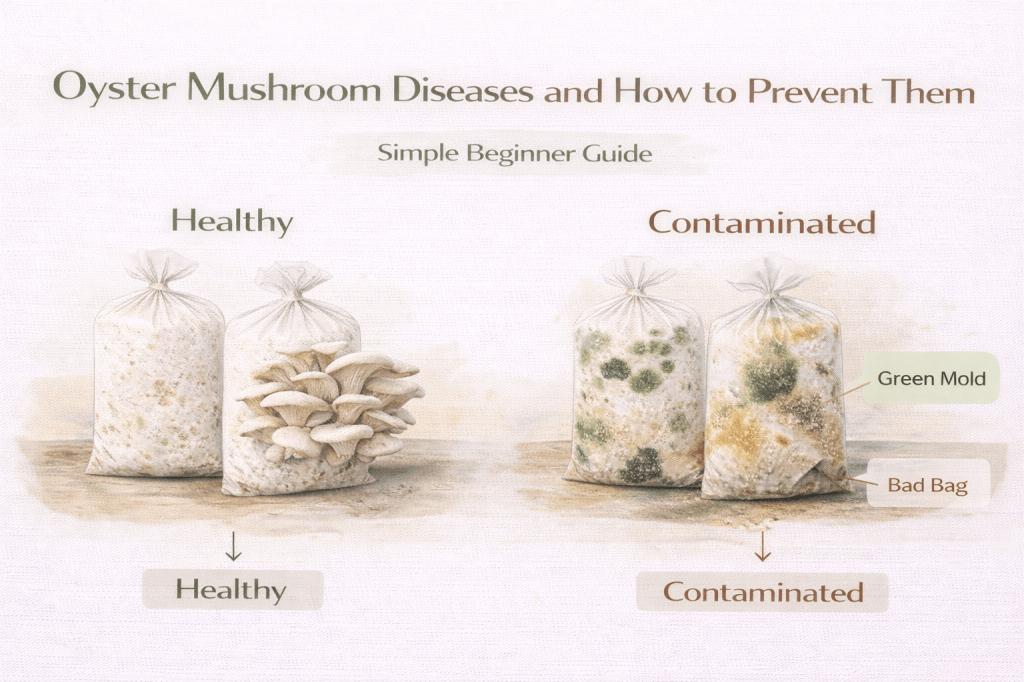
At the early stage, the growth of the pathogen and oyster mushroom mycelium are both white, so it is difficult to distinguish them. At a later stage, green patches appear on the substrate 10 to 15 days after cultivation. In severe cases, the entire bag turns green and no mushrooms grow at all.
What causes it:
The causal agents of green mold contamination are Trichoderma pleuroti, T. harzianum, and T. ghanese. Even after steam pasteurization, Trichoderma can enter through water, air within the growing house, and contaminated cleaning tools.
What to do:
- Remove and destroy contaminated bags immediately. Do not open them inside your growing room; the spores spread fast.
- Disinfect your growing room with a diluted bleach solution (1 part bleach to 10 parts water).
- Check your water source; contaminated water is a major entry point for Trichoderma.
- Clean all tools thoroughly before use.
- Improve your pasteurization process for the next batch.
How to pasteurize mushroom substrates for beginners.
Prevention:
- Pasteurize substrate properly and completely every time.
- Never reuse contaminated bags or substrate.
- Keep your growing room clean and disinfect regularly between cycles.
3. Cobweb Disease
What it looks like:
A thin, grey, cobweb-like growth spreads rapidly across the surface of your bags or substrate. It looks different from healthy white mycelium; it is more grey and wispy, and it spreads much faster than normal mycelium growth.
What causes it:
A fungus called Dactylium dendroides. It thrives in high CO2 conditions and high humidity with poor ventilation.
What to do:
- Increase fresh air exchange in your growing room immediately.
- Reduce humidity slightly.
- Apply a light dusting of salt directly onto the cobweb growth; this slows or stops its spread.
- Remove severely affected bags.
Prevention:
- Keep CO2 levels low with good ventilation; this is your strongest defence.
- Do not let humidity exceed 95%.
- Ensure airflow reaches all bags, not just those near the ventilation source.
4. Bacterial Blotch
What it looks like:
Brown or yellow spots appear directly on the mushroom caps. The spots are wet, slimy, and smell unpleasant. Affected mushrooms deteriorate quickly and cannot be sold.
What causes it:
Bacterial brown blotch is caused by Pseudomonas tolaasii and is present in all countries where mushrooms are cultivated. It spreads through water; particularly when you spray water directly onto mushroom caps during misting.
What to do:
- Remove affected mushrooms immediately.
- Stop spraying directly onto caps. Mist the walls, floor, and air around mushrooms instead.
- Improve ventilation to reduce moisture sitting on caps.
- Disinfect your water sprayer; it can carry bacteria between watering sessions.
Prevention:
- Never spray water directly onto mushroom caps.
- Keep humidity high but ensure good airflow so caps dry slightly between mistings.
- Use clean water from a reliable source. Stagnant or unclean water carries more bacteria.
5. Ink Caps (Coprinus) — The Weed Mushroom
What it looks like:
Small, thin mushrooms with black, inky caps appear alongside your oyster mushrooms. They grow fast, produce black ink as they mature, and stain everything around them.
What causes it:
Coprinus species are competitor fungi that grow on the same substrate as oyster mushrooms. They appear when substrate is not properly pasteurized or when the substrate contains too much nitrogen.
What to do:
- Remove ink caps by hand as soon as you see them; before they release their spores.
- Do not let them mature or they will spread rapidly.
- Reduce nitrogen content in your next substrate mix.
Prevention:
- Proper pasteurization kills most Coprinus spores before they can germinate.
- Avoid over-supplementing your substrate with nitrogen-rich materials.
- Remove ink caps early and consistently; do not let them establish.
6. Soft Rot
What it looks like:
Mushrooms become soft, watery, and collapse quickly after harvest or even before harvest. They smell bad and turn mushy. This is different from normal mushroom deterioration; soft rot is fast and affects mushrooms that should still be healthy.
What causes it:
Bacterial infection combined with high humidity and poor ventilation. Soft rot spreads fast once it starts, especially in warm, humid growing rooms.
What to do:
- Harvest mushrooms promptly. Do not leave mature mushrooms on the bags.
- Remove all affected mushrooms and substrate immediately.
- Reduce humidity and increase ventilation.
- Clean and disinfect the affected area before the next flush.
Prevention:
- Harvest on time; overripe mushrooms are more vulnerable to soft rot.
- Maintain good airflow throughout your growing space.
- Keep your growing room clean and remove all dead plant material promptly.
7. Yellow Blotch
What it looks like:
Yellow or orange discolouration appears on the caps of your oyster mushrooms. Affected areas may be slightly sunken. The mushrooms look unhealthy and are difficult to sell.
What causes it:
A combination of high humidity, poor air circulation, and in some cases bacterial infection. Yellow blotch is more common in warm, poorly ventilated growing rooms.
What to do:
- Increase ventilation immediately.
- Reduce humidity slightly.
- Remove affected mushrooms to prevent spread.
Prevention:
- Keep your growing room well-ventilated at all times.
- Avoid letting water sit on mushroom caps.
- Monitor temperature; excessive heat combined with high humidity creates the conditions for yellow blotch.
8. Dry Bubble Disease
What it looks like:
Mushrooms develop abnormally; caps are deformed, small, or fail to open properly. In severe cases, you see small, dry, brown lumps on the substrate instead of normal mushrooms. Affected mushrooms are unsellable.
What causes it:
A pathogen called Lecanicillium fungicola. It spreads through infected substrate, tools, clothing, and air movement from contaminated areas.
What to do:
- Remove and destroy affected bags immediately.
- Disinfect your growing room, tools, and clothing.
- Do not move people or equipment from an infected growing area to a clean one without thorough cleaning.
Prevention:
- Source spawn and substrate from reputable, clean suppliers.
- Limit access to your growing room; every person who enters is a potential carrier of spores.
- Disinfect footwear and hands before entering the growing space.
9. Pests That Damage Oyster Mushroom Farms
Diseases are not the only threat. These pests cause significant losses too:
| Pest | What It Does | How to Control It |
|---|---|---|
| Fungus gnats | Larvae eat mycelium and spread disease between bags | Use yellow sticky traps. Seal all openings in your growing room. |
| Mites | Feed on mycelium and mushrooms. Spread contamination | Maintain clean growing conditions. Isolate new substrate before use. |
| Springtails | Damage young pins and spread bacteria | Keep humidity controlled. Clean growing room between cycles. |
| Slugs and snails | Eat mushrooms — more common in outdoor or open setups | Use physical barriers. Keep growing area sealed. |
The best pest control is prevention; a clean, well-sealed growing room keeps most pests out before they can establish.
10. The Five Prevention Habits Every Grower Must Have
Most oyster mushroom diseases share the same root causes. Fix these five things and you eliminate the majority of your contamination risk:
1. Pasteurize properly, every time.
This is non-negotiable. Inadequate pasteurization leaves competitor molds and bacteria alive in your substrate. They will beat your oyster mushroom mycelium every time.
2. Keep your growing room clean.
Wipe down walls, floors, and shelves with a diluted bleach solution between every growing cycle. Spores from previous batches survive in dust and debris and infect new bags.
3. Control your water source.
Trichoderma and other contaminants have been detected in water used for misting; even on farms that pasteurize their substrate correctly. Use clean, fresh water. Disinfect your sprayer regularly.
4. Ventilate consistently.
High CO2 and stagnant air are ideal conditions for cobweb disease, yellow blotch, and bacterial infections. Fresh air exchange is one of the cheapest and most effective disease prevention tools you have.
5. Act fast when you see a problem.
Remove contaminated bags the moment you spot them. Do not wait to see if it spreads. In mushroom farming, one contaminated bag left too long can infect your entire growing room.
11. Key Takeaways
- Green mold (Trichoderma) is the most common disease on oyster mushroom farms. It enters through water, air, and dirty tools.
- Most diseases are caused by poor pasteurization, poor hygiene, or poor ventilation; not bad luck.
- Remove contaminated bags immediately. Never open them inside your growing room.
- Never spray water directly onto mushroom caps. This causes bacterial blotch.
- Harvest on time. Overripe mushrooms are more vulnerable to soft rot and bacterial infection.
- A clean growing room prevents more disease than any treatment.
12. FAQ
Why are my oyster mushroom bags turning green?
Green patches on your bags are almost certainly Trichoderma; the most common mold contaminant in oyster mushroom farming. It enters through inadequately pasteurized substrate, contaminated water, or dirty tools. Remove affected bags immediately, disinfect your growing room, and check your water source.
What causes white fluffy growth that is not mycelium on my mushroom bags?
If the growth is grey and spreads unusually fast, it is likely cobweb disease caused by Dactylium dendroides. Increase fresh air exchange and reduce humidity. Healthy mycelium is white and spreads steadily; cobweb growth is wispy, grey, and rapid.
Can I treat contaminated oyster mushroom bags and save them?
In most cases, no. Once Trichoderma or bacterial contamination is established, the bag is lost. Remove and destroy it. Trying to treat it wastes time and risks spreading contamination to healthy bags.
How do I stop bacterial blotch on my mushroom caps?
Stop spraying water directly onto the caps. Mist the air and surfaces around the mushrooms instead. Improve ventilation so caps are not sitting wet for long periods. Remove affected mushrooms to prevent spread.
Is it safe to eat oyster mushrooms that have slight discolouration?
If the discolouration is minor and the mushroom smells normal, it may still be edible. However, mushrooms showing signs of bacterial blotch, soft rot, or significant colour change should not be sold or consumed. When in doubt, discard.
How do I prevent diseases in my oyster mushroom farm long term?
The five habits are: proper pasteurization every cycle, consistent hygiene in your growing room, clean water for misting, good ventilation at all times, and acting fast the moment you spot a problem. Together, these five habits eliminate the majority of disease risk on any oyster mushroom farm.
Published by Kiki’s Agroplace — Digital Marketing for African Agribusinesses.


Leave a Reply