Table of Contents
- Why restaurants and hotels are your best buyers
- What restaurant and hotel buyers actually want
- Step 1 — Get your farm ready for institutional buyers
- Step 2 — Build your target buyer list
- Step 3 — Prepare your pitch
- Step 4 — Make first contact
- Step 5 — Follow up and close the deal
- Step 6 — Deliver consistently and grow the relationship
- How to price your mushrooms for restaurants and hotels
- What to do when you have more mushrooms than buyers
- Key takeaways
- FAQ
Introduction
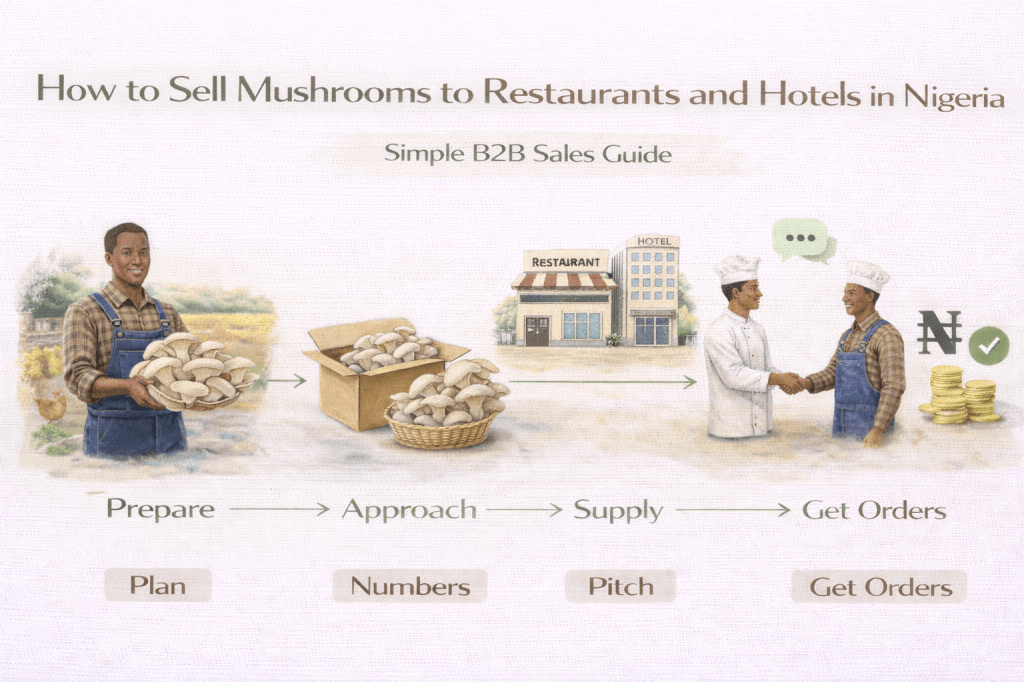
Selling mushrooms to restaurants and hotels in Nigeria is the fastest way to move from occasional sales to consistent monthly income. One hotel buying 10 kg of oyster mushrooms per week is worth more to your business than 50 individual household buyers combined. Restaurants, supermarkets, and health-conscious consumers are looking for fresh mushrooms every day, but very few farmers are meeting this demand consistently. That gap is your opportunity.
This guide walks you through exactly how to find, approach, and secure restaurant and hotel buyers in Nigeria step by step.
How to market mushrooms (beginner’s guide)
1. Why Restaurants and Hotels Are Your Best Buyers
Most mushroom farmers in Nigeria sell at open markets or through middlemen. Both options are fine for moving volume quickly, but they are the least profitable channels available to you.
Here is why restaurants and hotels beat every other buyer type:
| Buyer Type | Price You Get | Consistency | Relationship |
|---|---|---|---|
| Middlemen / market traders | Lowest — 40% to 60% below retail | Irregular | None — they shop around |
| Open market direct sales | Medium | Unpredictable | Minimal |
| Households (WhatsApp/Instagram) | Good | Moderate | Personal but fragmented |
| Restaurants and hotels | High — close to full retail | Weekly or bi-weekly orders | Long-term contracts possible |
Consistency matters more than price for restaurant buyers. A chef who knows you will show up every week with the same quality mushrooms will keep ordering without price shopping. Reliability is your competitive advantage.
Mushroom Farming in Africa: Complete Beginner step-by-step guide
2. What Restaurant and Hotel Buyers Actually Want
Before you approach any buyer, you need to understand what they care about. It is not just the mushrooms, it is the full package.
Restaurant and hotel buyers want:
- Freshness. The quality difference between a mushroom harvested that morning and one that has been sitting in a distributor’s warehouse for a week is immediately noticeable to any chef. Harvest as close to delivery as possible.
- Consistency. Same quality, same weight, same packaging every delivery. Inconsistency kills contracts.
- Reliability. If you say you will deliver every Tuesday, you must deliver every Tuesday. Missing a delivery without notice is the fastest way to lose a restaurant account.
- Clean, professional packaging. Mushrooms arriving loose in a black nylon bag signal an unprofessional supplier. Use clean, labelled packaging; even a simple branded bag makes a difference.
- Correct weight. Restaurants work with recipes and cost formulas. Short-weighting; even by 50g, damages trust fast.
- A point of contact. The buyer wants to reach you quickly when they need extra stock or have a question. Be responsive.
3. Step 1 — Get Your Farm Ready for Institutional Buyers
Before you approach any restaurant or hotel, your farm needs to meet a minimum standard. Buyers will ask questions; sometimes they will even visit.
What to have in place:
- Consistent production schedule. Know exactly how many kilograms you can supply per week and stick to it. Do not promise 20 kg per week if you can only reliably produce 12 kg.
- Clean growing and packaging environment. Your harvesting and packaging area should be clean, covered, and free from contamination. This is about food safety; restaurants take it seriously.
- Professional packaging. Use clean, sealed bags or containers. Label each package with your farm name, product name, weight, and WhatsApp number.
- Basic business registration. CAC registration positions you as a professional supplier rather than a hobbyist, and allows you to supply restaurants and corporate buyers who require proper documentation.
- A simple product sheet. One page with your farm name, what you supply, your weekly capacity, delivery schedule, and pricing. Keep it clean and clear.
How to make more money from mushroom farming with value addition for beginners.
4. Step 2 — Build Your Target Buyer List
Do not approach buyers randomly. Build a focused list of the most likely buyers in your area first.
How to build your list:
- Walk or drive through your nearest urban area. Note every restaurant, hotel, eatery, and food business you pass. Write down the name and address.
- Focus on the buyer types most likely to use mushrooms regularly:
- Continental restaurants
- Chinese, Asian, or Lebanese restaurants
- Pizza and pasta restaurants
- Hotels with in-house restaurants
- Health food cafes and juice bars
- Corporate canteens and workplace cafeterias
- Event caterers and wedding food vendors
- Aim for a list of at least 20 potential buyers. You will not convert all of them; but 20 targets should give you 3 to 5 active accounts within 60 days of consistent outreach.
The rising health consciousness of Nigerian consumers has made mushrooms a popular feature of expensive meals in hotels, bars, restaurants, shopping malls, and top-class eateries. Urban restaurants in Lagos, Abuja, Port Harcourt, and Ibadan are your strongest starting targets.
5. Step 3 — Prepare Your Pitch
Your pitch does not need to be complicated. It needs to be clear, specific, and backed by a sample.
What to prepare before your first visit:
- A 200g to 500g sample pack of your freshest mushrooms, harvested that morning or the day before. Clean, well-packaged, and labelled.
- A one-page product sheet with your farm name, available varieties, weekly supply capacity, price per kg, delivery schedule, and contact details.
- Two or three reference points if you have existing buyers; even household buyers or a small eatery you already supply. Any track record helps.
Your pitch in three sentences:
“I am a local oyster mushroom farmer based in [your area]. I supply fresh mushrooms directly from my farm to restaurants and hotels. I can deliver [X] kg per week, every [day], and I would like to offer you a free sample to try.”
That is it. No long presentations needed. Let the product and the consistency of supply do the selling.
6. Step 4 — Make First Contact
Who to ask for:
At a restaurant, ask for the head chef or purchasing manager. Do not pitch to a waiter or front desk staff, they cannot make buying decisions.
At a hotel, ask for the food and beverage manager or executive chef.
When to visit:
Avoid lunch (12pm to 3pm) and dinner (6pm to 9pm) rush hours. The best times are late morning (10am to 11:30am) or mid-afternoon (3pm to 5pm) when kitchen staff are less busy.
What to say:
Keep it short. Introduce yourself, say you are a local mushroom supplier, hand over your sample and product sheet, and ask for 2 minutes to explain your supply offer.
Then listen more than you talk. Ask:
- “How often do you currently use mushrooms?”
- “What variety works best for your menu?”
- “What is your usual weekly quantity?”
Their answers tell you exactly what to offer.
7. Step 5 — Follow Up and Close the Deal
Most buyers will not say yes on the first visit. They are busy, cautious, and have been let down by unreliable suppliers before. Expect to follow up.
Your follow-up plan:
- Day 3 after first visit: Send a WhatsApp message thanking them for their time and asking if they had a chance to try the sample.
- Day 7: A second WhatsApp or phone call. Ask if they have any questions about supply.
- Day 14: A third follow-up. If they are still undecided, offer a trial delivery at no obligation, supply a small quantity for one week and let the quality speak.
- Day 21: If there is still no decision, move on and keep them on your list for future follow-up in 30 days.
Most serious buyers will convert within 3 to 4 contacts. Those who do not respond after 4 follow-ups are either not the right buyer or are not ready yet. Do not chase indefinitely, focus on active leads.
8. Step 6 — Deliver Consistently and Grow the Relationship
Getting the first order is the beginning, not the finish line. What you do after that first delivery determines whether this becomes a long-term account.
On every delivery:
- Arrive at the agreed time. Not late, not early without notice.
- Deliver exactly the agreed weight, check it yourself before leaving your farm.
- Package cleanly and professionally every time.
- Bring a delivery note with your farm name, date, product, and quantity. Ask them to sign a copy for your records.
After the first month:
- Ask for feedback: “How have the mushrooms been working in your kitchen?”
- Ask if they need more volume as their confidence in your supply grows.
- Offer to add a second variety if your production allows, oyster plus shiitake, for example.
Long-term contracts often secure preferential pricing and priority allocation during supply constraints. Once a restaurant trusts your supply, push gently for a written supply agreement, even a simple WhatsApp message confirming a weekly order quantity and price is a form of commitment that protects both sides.
9. How to Price Your Mushrooms for Restaurants and Hotels
Wholesale pricing for restaurant accounts is typically 50 to 70 percent of retail price. In the Nigerian context, this means:
| Market Channel | Price Range per kg |
|---|---|
| Open market retail | ₦3,000 – ₦6,000 |
| WhatsApp / Instagram direct | ₦3,500 – ₦6,000 |
| Restaurant wholesale | ₦2,500 – ₦4,500 |
| Hotel supply (premium grade) | ₦3,500 – ₦5,500 |
Hotels often pay more than restaurants because they have higher food budgets and their guests expect premium quality. Price your hotel supply at the higher end of the range.
Never go below your cost of production. Calculate your cost per kg first using your actual production costs. Add a minimum 40% margin before accepting any institutional supply contract.
Negotiate volume discounts carefully. A buyer who takes 50 kg per week consistently deserves a better price than one who takes 5 kg. But do not discount so deeply that you eliminate your margin. A 5% to 10% volume discount is reasonable, anything more needs careful calculation.
How to Package and Brand Your Products to sell at Higher Rates
10. What to Do When You Have More Mushrooms Than Buyers
Oyster mushrooms are highly perishable. Fresh mushrooms last 3 to 5 days at room temperature and 7 to 10 days refrigerated. If your buyers cannot absorb everything you produce, here is what to do:
- Dry your surplus. Dried mushrooms have a shelf life of up to 12 months and command 3 to 5 times the price per kg of fresh mushrooms by weight. Invest in a simple food dryer.
- Make mushroom powder. Blend dried mushrooms into powder and sell to food processors, health stores, or household buyers for use in soups and seasoning.
- Sell to households on WhatsApp. Your restaurant accounts should be your anchor buyers, fill your remaining production with household direct sales.
- Expand your buyer list. While your current accounts are settling in, keep approaching new restaurants and hotels. Never rely on just one or two institutional buyers.
11. Key Takeaways
- Restaurants and hotels pay the best prices and give the most consistent orders, they should be every mushroom farmer’s priority buyers.
- What buyers want most is consistency and reliability. Price matters less than showing up every week with the same quality.
- Build a list of 20 target buyers before you start approaching anyone. Quality of outreach matters more than speed.
- Follow up at least 3 to 4 times before writing off a potential buyer.
- Get your farm delivery-ready before the first approach: clean packaging, consistent supply, and basic CAC registration.
- Dry surplus mushrooms rather than dumping them. It protects your income and builds a second revenue stream.
12. FAQ
How do I find restaurants that buy mushrooms in Nigeria?
Start by walking your nearest urban area and listing every continental restaurant, hotel, health food cafe, and corporate canteen you see. Visit during off-peak hours (10am to 11:30am or 3pm to 5pm), ask for the chef or purchasing manager, and offer a free sample. Your first 3 to 5 accounts are likely within 5 km of where you are right now.
How much should I charge restaurants for mushrooms in Nigeria?
Restaurant wholesale pricing in Nigeria typically runs between ₦2,500 and ₦4,500 per kg for oyster mushrooms, and higher for premium varieties. Always calculate your production cost first and add a minimum 40% margin before agreeing to any price.
Do I need a food safety certificate to supply mushrooms to hotels in Nigeria?
Large hotels and international chains may require NAFDAC registration or a food handler’s certificate. Smaller restaurants and local hotels typically do not. CAC registration is the minimum most institutional buyers expect. Ask each buyer what documentation they need before your first delivery.
How often will restaurants want deliveries?
Most restaurant accounts order once or twice per week. Hotels with high occupancy may order 2 to 3 times per week. Agree a fixed delivery schedule from the start, this makes your production planning much easier.
What if a restaurant says my price is too high?
First, check that your production cost allows for negotiation without cutting into your margin. If it does, offer a modest volume discount (5% to 10%) for a minimum weekly commitment. If your price is already at minimum margin, hold firm and explain your quality and consistency advantage. A chef who has been let down by cheap, unreliable suppliers before understands the value of consistency.
Published by Kiki’s Agroplace — Digital Marketing for African Agribusinesses.


Leave a Reply