If you want to know how to start catfish farming, you’re in the right place. Catfish farming is one of the most profitable agribusiness ventures in Nigeria and across Africa. Demand is high, the fish grows fast, and you don’t need millions to get started. This guide walks you through every step: planning, pond setup, feeding, water management, harvesting, and selling with real cost figures to help you plan.
Table of Contents
1. What Is Catfish Farming?
2. Why Catfish Farming Is Profitable
3. How to Start Catfish Farming (Step-by-Step)
4. How Much Does It Cost to Start Catfish Farming?
5. How Long Does Catfish Take to Grow?
6. Common Mistakes Beginners Make
7. Frequently Asked Questions
Have you gotten this catfish farming guide?
What Is Catfish Farming?
Catfish farming is the practice of raising catfish, usually Clarias gariepinus in controlled environments like concrete ponds, tarpaulin ponds, or earthen ponds, for commercial sale. It is a form of aquaculture. You control the environment, feed the fish, manage water quality, and sell at harvest. It works at backyard scale and at full commercial scale.
Why Catfish Farming Is Profitable?
Nigeria has a serious fish supply problem. Total fish production in Nigeria is close to 1 million metric tons per year, yet the country spends over ₦1.3 trillion annually on fish and seafood. That gap is your opportunity.
Nigeria spends nearly $1 billion every year importing fish. Local production cannot keep up with demand. Catfish farmers who plan well and manage their operations properly step directly into that gap.
Here’s why catfish works for beginners:
- Fast growth. Catfish reach 1 kg in about six months using pelletized feed.
- Strong local demand. Catfish is consumed daily across homes, restaurants, and markets in Nigeria.
- Low entry point. You can start with a tarpaulin pond and 300–500 fingerlings.
- Scalable. Start small, reinvest profits, and grow.
Check out the most comprehensive catfish farming guide
A study published in the Nigerian Journal of Agriculture and Agricultural Technology found that catfish farming in Ogun State yielded a net farm income of ₦718,754 per production cycle, with a gross margin of over ₦1.2 million.
How to Start Catfish Farming (Step-by-Step)
To start catfish farming, choose a good location with clean water access, set up your pond (concrete, tarpaulin, or earthen), stock healthy fingerlings at the right density, feed consistently with quality feed, manage water quality, and sell through pre-arranged buyers. The process takes 4–6 months from stocking to first harvest.
Here’s the full breakdown.
Step 1: Planning and Market Research
A lot of beginners skip this step. Don’t.
Before you spend a naira on a pond, answer these questions:
- Who will buy your fish? Households, restaurants, cold rooms, markets, fish processors?
- What quantity do they want? And at what price?
- What is the current price per kg of live catfish in your area?
- How much capital do you have, and what’s your break-even target?
A serious feasibility study tells you whether the business makes sense in your environment, your water source, your land, your proximity to buyers, and your realistic start-up cost.
Where to sell catfish in Nigeria:
- Open markets (Bodija, Mile 12, Oyingbo)
- Restaurants and pepper soup joints
- Supermarkets and cold rooms
- Direct-to-consumer via WhatsApp or social media
- Fish processors who smoke or fry catfish for retail
Pricing insight: Live catfish prices fluctuate. As of when this blog post was updated, live catfish sold at retail between ₦1,800–₦2,500 per kg depending on location and season. Lock in buyers before you stock.
For a full financial plan, read our Catfish farming business plan guide.
Step 2: Choose the Right Location
Your location affects your water supply, running costs, and logistics. Get this wrong and everything else becomes harder.
Key factors to look for:
- Water source — Reliable borehole, river, or municipal supply
- Soil type — Clay-rich soil if building earthen ponds
- Accessibility — Easy road access for feed delivery and fish transport
- Security — Low theft risk; remote sites need guards or fencing
- Proximity to market — Reduces transport cost and fish mortality at harvest
Common mistakes:
- Choosing a site with no water in the dry season
- Building in a flood-prone area
- Renting land you can’t use long enough to recover your pond investment
Step 3: Pond Setup — Types and Costs
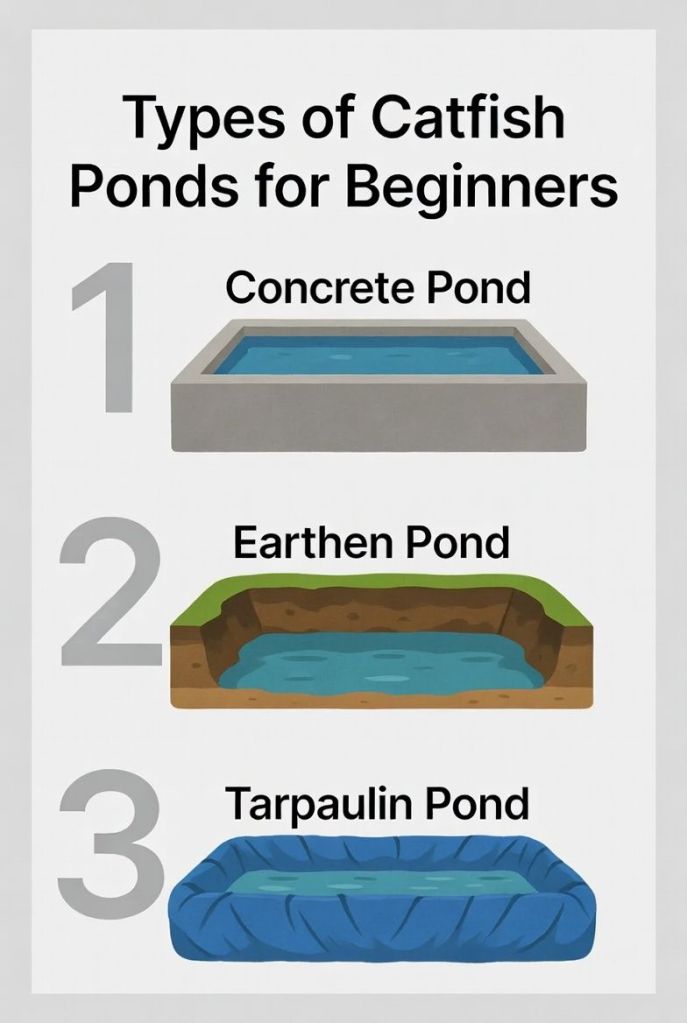
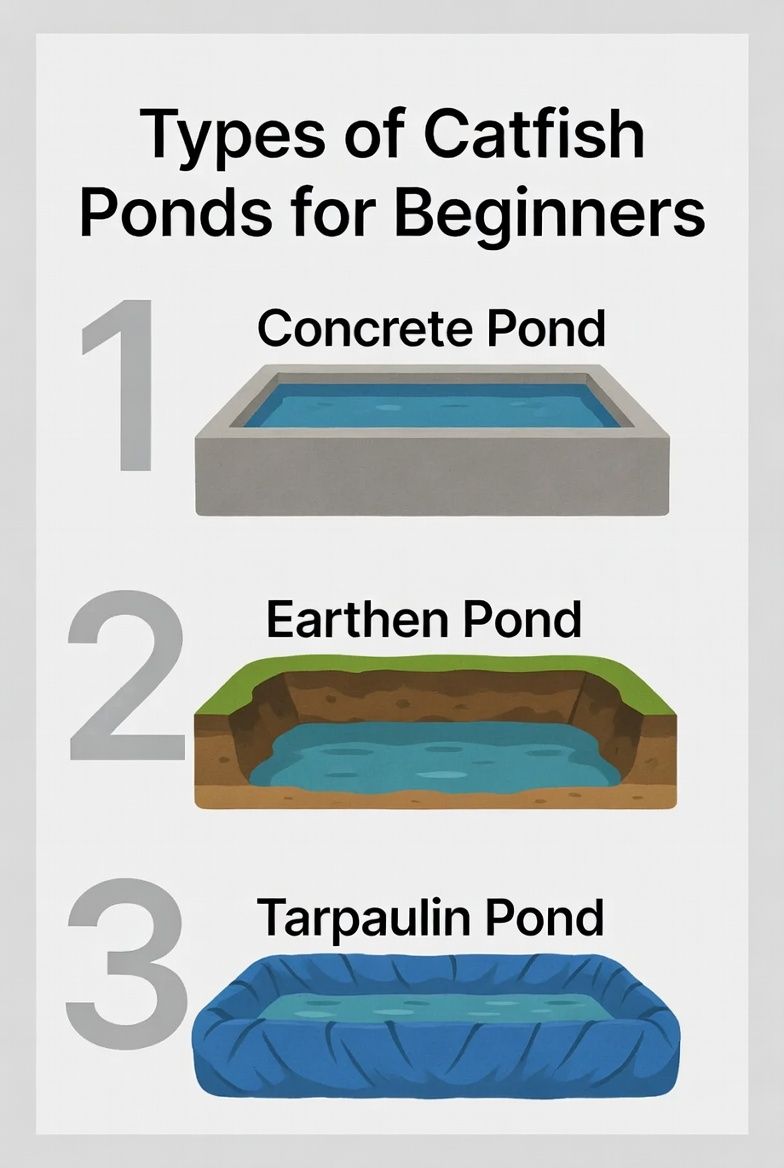
Your pond is your production unit. Choose based on your budget and scale (confirm prices in your environment).
Option 1: Tarpaulin Pond (Best for Beginners)
Tarpaulin ponds are portable, easy to set up, and come in different sizes. Smaller ones hold around 300 fish; larger ones hold 1,000 and above.
- Cost: ₦80,000–₦150,000 per pond depending on size
- Lifespan: 2–3 years with good care
- Best for: Urban or peri-urban setups with limited space
- Limitation: Not suitable for large-scale farming long-term
Option 2: Concrete Pond (Best for Commercial Scale)
A well-constructed concrete pond is leak-proof and can last ten or more years.
- Cost: ₦300,000–₦700,000+ per pond depending on size
- Lifespan: 10+ years
- Best for: Farmers ready to invest in a permanent setup
- Limitation: High upfront cost; mistakes in construction are expensive
Option 3: Earthen Pond (Best for Large Volume)
Fish grow better in earthen ponds compared to other types. Maintenance and construction costs are cheaper, and earthen ponds have a natural capacity to control water pollution.
- Cost: ₦100,000–₦400,000 depending on size and excavation
- Best for: Rural farms with access to clay soil and water
- Limitation: Harder to manage water quality; not suitable for fry or very small fingerlings
Pond preparation checklist before stocking:
1. Remove sediment and old soil
2. Apply lime to neutralise acidity
3. Install inlet and outlet pipes
4. Fill and test for leaks
5. Let pond stabilise for 1 week before stocking
Step 4: Stocking Fingerlings
A fingerling is a catfish between 10–15 cm in size, roughly the length of a finger. It takes about 30–60 days for fry to grow to fingerling size. This is what you stock in your grow-out pond.
Where to buy fingerlings:
- Registered fish hatcheries (most reliable)
- Established catfish farms in your state
- Avoid open markets, quality is inconsistent
How to identify healthy fingerlings:
- Active movement in water
- Uniform size (grading matters, mixed sizes lead to cannibalism)
- No visible sores, lesions, or sluggishness
- Clear eyes
Which species to stock:
Most first-time farmers in Nigeria start with Clarias gariepinus because it is easier to manage and has strong market demand. Hybrid catfish; a cross between Clarias gariepinus and Heterobranchus grow larger, reach market size faster, and survive better under intensive stocking, though they cost slightly more at the fingerling stage.
Stocking density by pond type:
- Tarpaulin pond (3m x 3m): 300–500 fingerlings
- Concrete pond (5m x 3m): 600–1,000 fingerlings
- Earthen pond (10m x 20m): 3,000–5,000 fingerlings
Overstocking ruins your profit. Stick to these figures.
Step 5: Feeding and Growth
Feed is your biggest recurring cost and your biggest lever for profit.
With good quality feed, the feed conversion ratio for catfish ranges from 1.2 to 1.8, with a growth rate of 0.5–1.0g per day. That means a well-fed fish can add up to 30g of weight per month under good conditions.
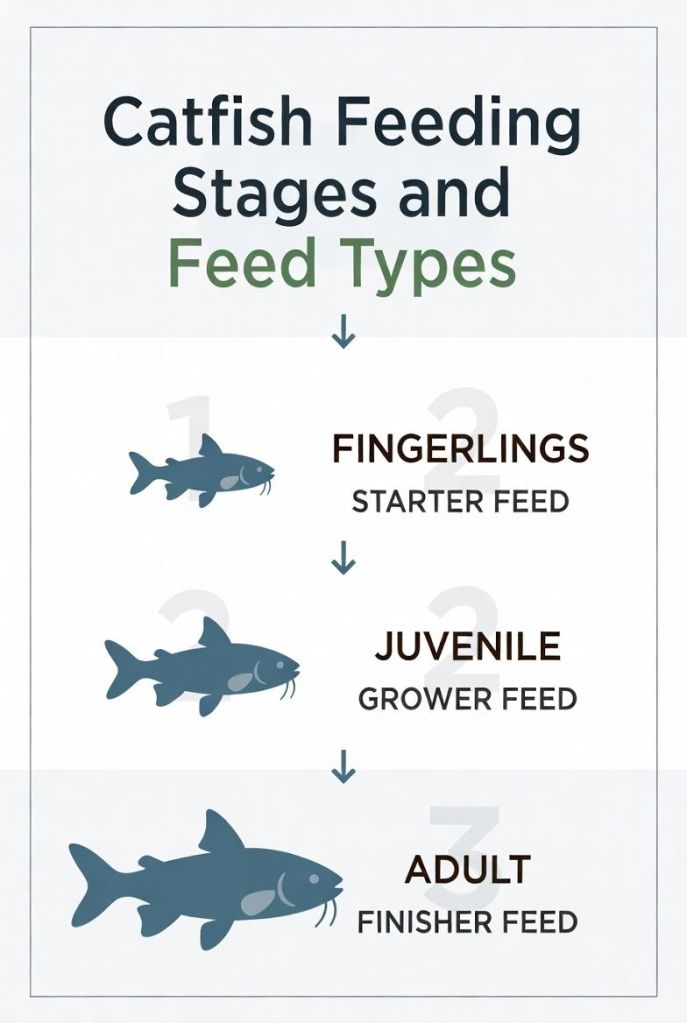
Feeding stages:
- Fry/Fingerling (1–10g): Starter feed; imported brands like Coppens or Aller Aqua 4–5 times daily
- Juvenile (10–100g): Grower pellets; 3 times daily
- Grow-out (100g–1kg): Finisher pellets; local or imported, 2–3 times daily
Imported feed performs best at the fingerling stage due to superior feed conversion ratios. Locally produced feeds are more cost-effective at later stages.
Cost-saving tip: Feed accounts for 60–70% of your total production cost. Learn how to formulate feed or supplement with black soldier fly larvae to cut costs. Read our Feed formulation guide for catfish farmers for a full breakdown.
Step 6: Water and Health Management
Poor water quality is the number one reason catfish farms fail.
Water quality basics:
- Change 20–30% of pond water every 3–5 days
- Watch for oxygen depletion; fish gasping at the surface is a red flag
- Ideal water temperature: 25–30°C
- Ideal pH: 6.5–8.5
Disease prevention:
- Do not overstock
- Quarantine new fish before introducing them to existing stock
- Remove dead fish immediately
- Use salt treatments (1kg per 1,000 litres) to prevent bacterial infections
- Consult a veterinarian or experienced fish farmer at the first sign of disease
Beginner mistakes to avoid:
- Skipping water changes to “save time”
- Adding fingerlings from an unknown source directly into the main pond
- Ignoring early warning signs like reduced feeding response
Step 7: Harvesting and Selling
When to harvest:
Catfish are typically market-ready in 4–6 months. The target weight is 1kg per fish. Weigh a sample at 4 months; if the average is 800g–1kg, you’re ready.
How to harvest:
1. Harvest in the early morning or evening to minimise fish stress
2. Drain 60–70% of pond water first
3. Use drag nets or scoop nets depending on pond type
4. Move fish quickly to aerated transport tanks if selling live
Where to sell:
- Pre-arranged buyers (restaurants, cold rooms, market women), best option
- Roadside sales direct from farm
- Processed as smoked catfish for higher margins
For a complete marketing strategy, read our Catfish marketing guide
Pricing strategy:
- Live catfish: ₦1,800–₦2,500/kg (retail)
- Smoked catfish: 2–3x the price of live fish
- Sell direct where possible; middlemen take 20–30% margin
To learn how to add value through smoking and processing, read our [Catfish Value Addition Guide](Coming soon)
How Much Does It Cost to Start Catfish Farming?
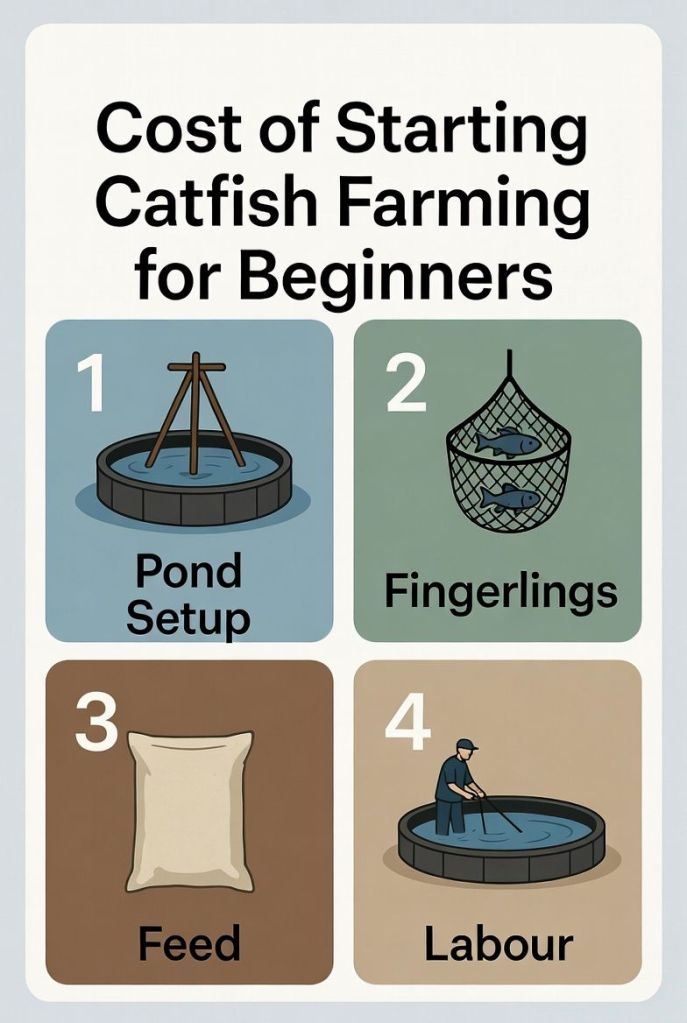
Please confirm the prices in your environment. A beginner catfish farm with 500 fingerlings in a tarpaulin pond costs ₦300,000–₦600,000 to set up and run to harvest. A mid-scale farm with 5 concrete ponds and 5,000 fish can cost ₦2–4 million. A 10,000-capacity operation with 5 earthen ponds may cost ₦5.5–6 million as of when this blog post was updated, including setup, feed, and labour.
Beginner cost breakdown (500 fish, 1 tarpaulin pond):
- Tarpaulin pond (3m x 3m): ₦80,000–₦150,000
- Fingerlings (500 @ ₦50): ₦25,000
- Feed (4–6 months): ₦120,000–₦200,000
- Water supply setup: ₦20,000–₦50,000
- Labour (part-time): ₦30,000–₦60,000
- Medications/treatments: ₦10,000–₦20,000
- ₦285,000–₦480,000
Expected return (500 fish, 80% survival, avg. 1kg):
- 400 fish x ₦2,000/kg = ₦800,000
- Profit after costs: ₦300,000–₦500,000 per cycle
Two cycles per year means ₦600,000–₦1,000,000 net profit from one small pond. That’s real money from a beginner setup.
How Long Does Catfish Take to Grow?
Catfish raised in well-managed ponds with quality feed reach 1kg in 4–6 months. Feed quality, stocking density, water quality, and species type all affect growth speed. Hybrid catfish grow faster than standard Clarias under the same conditions.
Growth timeline:
- Swim fry (Day 7–10): 1–2 cm
- Fingerling (Week 4–8): 10–15 cm
- Juvenile (Week 8–12): 50–150g
- Grow-out (Month 3–5): 300g–800g
- Market size (Month 5–6): 1kg+
Factors that slow growth:
- Poor feed quality or irregular feeding
- Overcrowding; fish compete for oxygen and feed
- Poor water quality; stressed fish don’t grow
- Disease outbreak
Common Mistakes Beginners Make
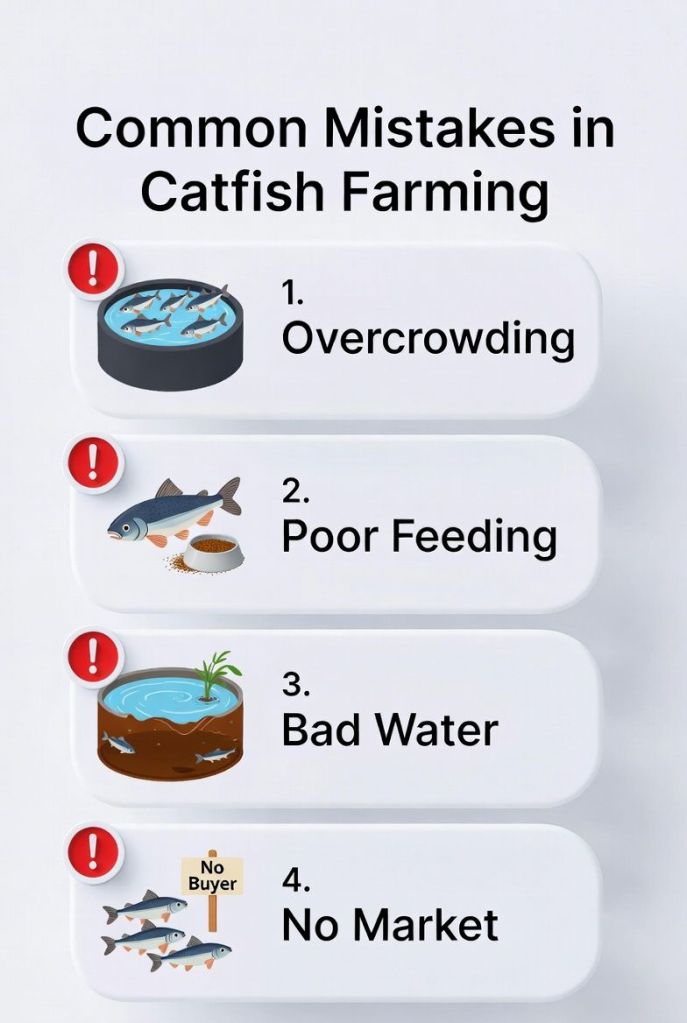
Most catfish farm failures trace back to a handful of avoidable errors.
1. Overcrowding the pond
New farmers often overstock, hoping for higher profits. This leads to stress, disease, and a lower yield than a properly stocked pond. It’s better to raise 800 healthy fish than lose 500 out of 1,500 from overcrowding.
2. Poor feeding habits
Underfeeding stunts growth. Overfeeding pollutes the water and kills fish. Stick to scheduled feeding and measure what you give. Don’t guess.
3. Ignoring water quality
Bad water is the fastest route to a disease outbreak. Set a water change schedule and follow it, even when it feels unnecessary.
4. No market plan before stocking
You can raise 1,000 healthy fish and still lose money if you haven’t arranged buyers. Line up your customers before you stock your first fingerling.
5. Buying cheap, low-quality fingerlings
Starting with low-quality stock is a common and expensive mistake. Always buy healthy, active, and uniform fingerlings from a trusted hatchery.
Frequently Asked Questions
Is catfish farming profitable in Nigeria?
Yes — if you plan well. A well-managed 10,000-capacity catfish farm can yield ₦2–4.8 million in annual profit, depending on survival rate, feed cost, and market price. Smaller farms are proportionally profitable too.
How many fish should a beginner start with?
Start with 300–500 fingerlings in one tarpaulin or concrete pond. This gives you a manageable learning experience without the risk of a large financial loss if something goes wrong.
What is the best feed for catfish?
For fingerlings, imported feeds like Coppens and Aller Aqua give the best results due to their high feed conversion ratios. For grow-out, quality locally produced pellets work well and reduce your feed cost. Read our Feed formulation guide for catfish farmers for homemade feed options.
Can I start catfish farming at home?
Yes. A tarpaulin pond fits in a backyard, a garage, or a paved compound. Many successful Nigerian catfish farmers started in urban homes with one or two ponds. You need a reliable water source and enough space for the pond, feed storage, and fish movement during harvest.

 Kiki's Agroplace
Leave a reply to How to Fertilize Catfish on a Farm – Kiki's Agroplace Cancel reply