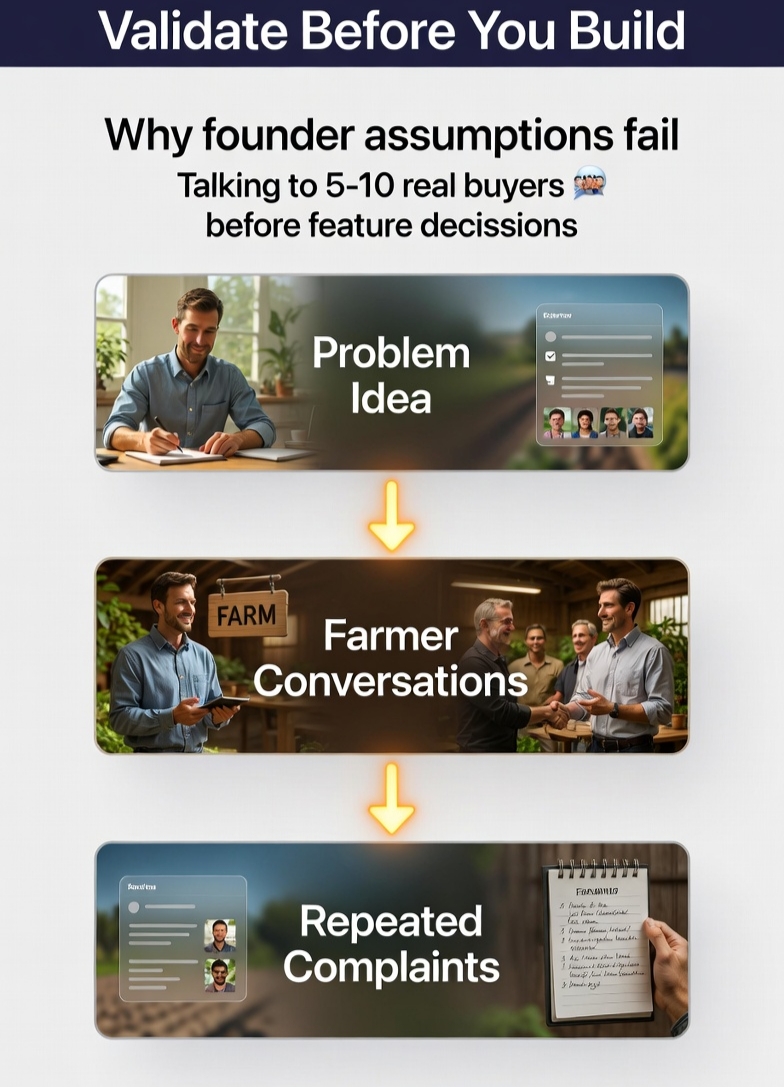
Many agritech founders move straight from an idea to building features. Then they try to market those features.
This is where traction slows down.
Digital marketing for agritech founders works best when the problem is already validated. If the problem is weak, the marketing will struggle no matter how good the campaign looks.
Before adding another feature to your product, you need to confirm that the problem you are solving is real, urgent, and worth paying for.
AI in Marketing for Businesses in Agriculture
What Problem Validation Actually Means
Problem validation means confirming three things:
- The problem exists.
- The problem happens often.
- People are willing to pay to solve it.
If one of these is missing, you may be solving a weak problem.
For example:
- A farmer saying a problem is “annoying” is not enough.
- A farmer saying a problem costs them money every season is stronger.
Your marketing will always perform better when the pain is already clear.
Why Founders Build Features Nobody Asked For
This happens for a few common reasons.
1. Technology excitement
A founder sees what technology can do and starts building possibilities instead of solving specific problems.
2. Investor pressure
Some founders rush to add features because they think complexity makes a startup look impressive.
3. Limited farmer conversations
Many founders speak to only one or two farmers and assume the problem is universal.
This creates a dangerous pattern:
Idea → Feature → Marketing → Silence.
The silence usually means the problem was never validated.
Personal branding for agripreneurs
The 3-Signal Validation Test
Before building a feature, check for these three signals.
Signal 1: Repeated complaints
You hear the same problem from multiple buyers.
Example:
Five poultry farmers independently complain about feed price fluctuations affecting profitability.
Signal 2: Existing workarounds
People are already trying to solve the problem themselves.
Examples:
- Farmers using notebooks to track feed consumption
- WhatsApp groups to find buyers
- Spreadsheets to track crop yields
Workarounds show the problem matters.
Signal 3: Financial impact
The problem affects revenue, cost, or productivity.
Examples:
- Fish dying in ponds
- Fertilizer delays reducing yield
- Crops spoiling before sale
When money is involved, demand is stronger.
How to Validate Problems with Farmers
You do not need complicated research.
Start with structured conversations.
Ask direct questions such as:
- What problem costs you the most money on your farm?
- What is the hardest part of managing this operation?
- Have you tried solving this before?
Pay attention to how people respond.
Strong signals include:
- Detailed explanations
- Emotional frustration
- Stories about failed attempts to fix the issue
Weak signals include:
- Short answers
- Polite agreement without examples
- Problems described as “minor”
Example: Validating a Poultry Farm Problem
Imagine you want to build a poultry management tool.
You interview 10 poultry farmers.
And you hear this:
- 7 farmers complain about feed costs rising unpredictably.
- 5 farmers say they cannot calculate profit accurately.
- 6 farmers track feed with notebooks or rough estimates.
Now you have three signals:
- Repeated complaints
- Existing workarounds
- Financial impact
That is a strong validation signal.
Your product idea becomes clearer:
A simple tool that tracks feed usage and calculates production cost per bird.
Marketing this is much easier because the pain already exists.
Before Building Your Next Feature, Do This Exercise
- Talk to five target users this week.
- Ask what problem costs them the most money.
- Write down the exact words they use.
- Check if at least three people mention the same issue.
If they do, you have a strong signal.
If they don’t, pause development and keep investigating.
When You Validate Problems Before Building Features
- Your product solves real operational issues
- Marketing messages become simple and direct
- Sales conversations become easier
- Buyers understand your value quickly
The biggest difference is this:
Instead of convincing people they need your solution, you show them something that already matches their existing problem, positioning yourself as the obvious choice to solve it.
In a Nutshell
- Problem validation must happen before building features.
- Strong problems show three signals: repetition, workarounds, and financial impact.
- Direct farmer conversations are the fastest validation method.
- Products built around validated problems are easier to market.
- Clear problems lead to clear messaging.
Once you have a validated problem, the next steps are mapping the exact pain points your buyer will pay to fix, then narrowing your marketing to one Ideal Customer Profile, rather than speaking to everyone at once.


Leave a Reply