Table of Contents
- What is oyster mushroom farming?
- Why oyster mushrooms are perfect for African farmers
- What you need to get started
- Step-by-step: How to grow oyster mushrooms
- How much does it cost to start?
- Where to sell your oyster mushrooms in Africa
- Common mistakes beginners make
- Key takeaways
- FAQ
Introduction
Oyster mushroom farming in Africa is one of the fastest-growing agribusiness opportunities for beginners. You do not need a large farm, a lot of money, or years of experience to start. You need a small space, the right materials, and a clear process to follow. This guide gives you exactly that step by step, to help you get started.
Also check out our Mushroom Farming in Africa Complete Beginner step-by-step guide
1. What Is Oyster Mushroom Farming?
Oyster mushrooms (scientific name: Pleurotus ostreatus) are edible mushrooms shaped like the oyster you find in the sea. That is how they got their name.
Farming them means growing them indoors — in bags filled with material like straw or sawdust — and harvesting them to sell or eat.
You do not plant them in soil like maize or tomatoes. They grow on a material called a substrate (think of it as their “food”), inside a warm, humid room or shed. If you’re weighing this against other growing methods, see our compost vs. substrate guide.
2. Why Oyster Mushrooms Are Perfect for African Farmers
Here is why so many beginners across Nigeria, Kenya, Ghana, Uganda, and Zimbabwe are choosing oyster mushrooms:
- Fast harvest. Oyster mushrooms are ready in 3 to 4 weeks from the day you inoculate the substrate with the spawn (the mushroom seed). Compare that to button mushrooms which take 6 to 8 weeks.
- Small space needed. A 10 by 10 foot room — a garage, a shed, or even a mud house — is enough to start.
- Low cost to begin. You can start with materials you likely already have on your farm, like rice straw, wheat straw, or sawdust.
- Strong market demand. Restaurants, hotels, supermarkets, and households across Africa are buying more mushrooms every year. In Kenya alone, annual mushroom demand stands at 1,200 tonnes but local production only covers around 500 tonnes — meaning the market gap is wide open.
- Good income potential. Oyster mushrooms sell for $4 to $6 per kilogram in urban African markets. One kilogram of spawn can produce 4 to 5 kilograms of mushrooms.
3. What You Need to Get Started
Here is your basic shopping list:
| Item | What It Is | Why You Need It |
|---|---|---|
| Mushroom spawn | The “seed” of the mushroom | This is what you plant |
| Substrate | Straw, sawdust, or rice husk | This is what the mushroom eats |
| Polythene bags | Plastic growing bags | You fill these with substrate and spawn |
| A growing room | Shed, garage, or mud house | Keeps mushrooms warm and humid |
| Water sprayer | A hand pump or misting bottle | Maintains humidity |
| Thermometer | Measures room temperature | Keeps conditions right |
Ideal growing conditions for oyster mushrooms:
- Temperature: 20°C to 30°C (68°F to 86°F)
- Humidity: 85% to 95%
- Light: Indirect — avoid direct sunlight during fruiting
- Air: Good ventilation to keep carbon dioxide low
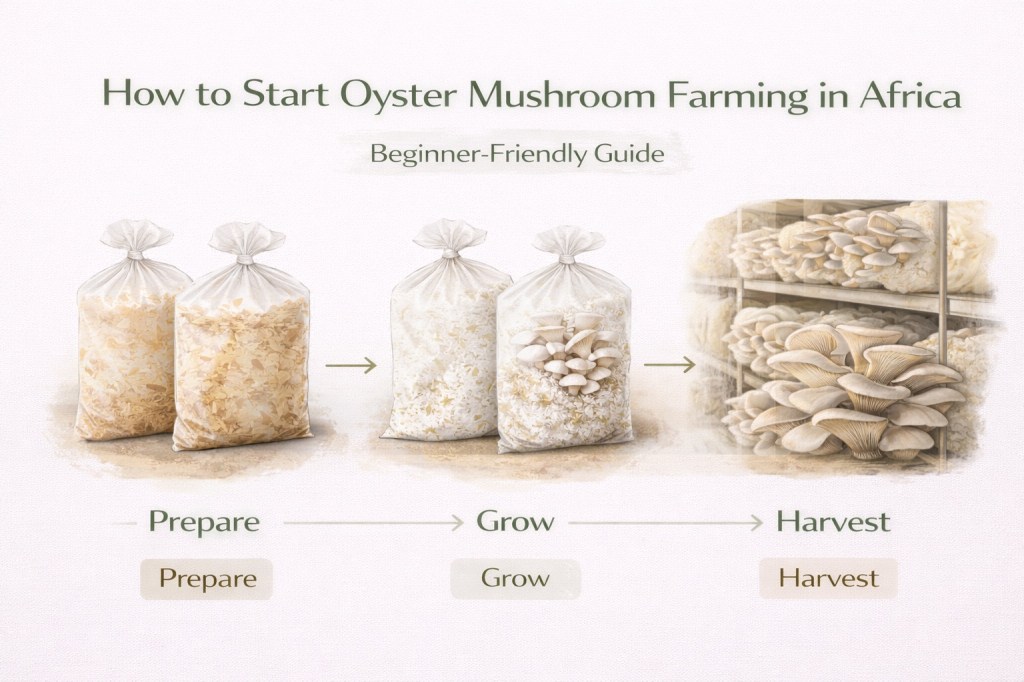
4. Step-by-Step: How to Grow Oyster Mushrooms
Step 1: Prepare your substrate
Use wheat straw, rice straw, or sawdust. Chop it into small pieces (about 5 to 10 cm long). Soak it in clean water for 12 to 16 hours, then drain.
Step 2: Pasteurize the substrate
This kills harmful bacteria and moulds that compete with your mushrooms. Boil the soaked straw for 1 to 2 hours, or soak it in a lime solution (1 tablespoon of lime per litre of water) for 12 hours. Let it cool and drain before use. How to Pasteurize mushroom substrates.
Step 3: Fill your growing bags
Layer your cooled substrate and mushroom spawn alternately in your polythene bags. Start with substrate, then add a layer of spawn, then more substrate, then more spawn. Seal the top of the bag.
Step 4: Incubation
Move your bags to a warm, dark room. Leave them for 2 to 3 weeks. During this time, white threads (called mycelium) spread through the bag — this means it is working.
Step 5: Fruiting
Once the bag is fully white with mycelium, cut small holes or slits in the bag. Move it to a room with indirect light and mist with water 2 to 3 times daily. Mushrooms will start to appear within days.
Step 6: Harvest
Harvest your oyster mushrooms when the caps are fully open but before the edges start to curl up. Twist and pull gently from the base. Do not wait too long — oyster mushrooms are highly perishable and must reach the market quickly after harvest.
Step 7: Second and third flushes
After the first harvest, keep misting the bags. You will get 2 to 3 more rounds of mushrooms (called flushes) from the same bag before the substrate is used up.
5. How Much Does It Cost to Start?
Startup costs vary by country, but here is a rough guide for a small beginner setup:
| Item | Estimated Cost |
|---|---|
| Mushroom spawn (1 to 2 kg) | ₦3,000 – ₦8,000 / KSh 300 – KSh 800 |
| Substrate (straw/sawdust) | Low — often free or cheap locally |
| Polythene bags | ₦1,000 – ₦3,000 / KSh 100 – KSh 300 |
| Basic room setup | Varies — a mud shed works fine |
| Water sprayer | ₦2,000 – ₦5,000 / KSh 200 – KSh 500 |
A small beginner farm can run on less than $50 to $100 in startup costs, depending on your location and what materials you already have access to.
6. Where to Sell Your Oyster Mushrooms in Africa
You have several options:
- Restaurants and hotels — They are consistent buyers, especially in cities.
- Supermarkets and grocery stores — They prefer regular, packaged supply.
- Local markets — Good for quick sales, though prices may be lower.
- Direct to households — Sell via WhatsApp groups, Instagram, or door-to-door in your neighbourhood.
- Dried mushroom powder — If you cannot sell fresh mushrooms fast enough, dry them and sell as powder for soups or porridge flour. This extends shelf life significantly — see our value addition guide for the full process.
Sell directly to end buyers wherever possible. Middlemen typically pay 10% to 15% less than market price. For a full strategy, see our mushroom marketing guide.
7. Common Mistakes Beginners Make
- Skipping pasteurization. This is the most common reason beginner farms fail. Unpasteurized substrate lets competing molds take over your bags before the mushrooms can grow. See our oyster mushroom diseases guide for how to spot and prevent this.
- Poor humidity control. If your bags dry out, mushrooms stop growing. Mist consistently.
- Harvesting too late. Oyster mushrooms deteriorate fast. Harvest at the right time or you lose both quality and price.
- Buying spawn from unreliable sources. Get spawn from a certified supplier or agricultural institution. Bad spawn gives poor yields — our spawn quality guide shows you what to check for before buying.
- No market plan before planting. Know who you will sell to before your first harvest. Mushrooms do not wait.
8. Key Takeaways
- Oyster mushroom farming in Africa is a low-cost, high-return agribusiness for beginners.
- You need a small space, mushroom spawn, substrate, growing bags, and humidity control.
- Mushrooms are ready to harvest in 3 to 4 weeks.
- The demand gap across Africa is wide — supply is far below what the market needs.
- Sell directly to restaurants, hotels, and households to get the best price.
- Pasteurization and humidity control are non-negotiable for a successful farm.
9. FAQ
How much land do I need for oyster mushroom farming?
You do not need farmland. A 10 by 10 foot indoor space — a room, shed, or garage — is enough to start a small profitable farm.
How long does it take to get my first harvest?
Oyster mushrooms take 3 to 4 weeks from planting to first harvest.
What is the best substrate for oyster mushrooms in Africa?
Wheat straw and rice straw are the most common and affordable options across Africa. Sawdust also works well.
Can I do oyster mushroom farming during the dry season?
Yes. Because mushrooms grow indoors, they are less affected by dry weather than outdoor crops. You will need to mist more frequently to maintain humidity.
Is oyster mushroom farming profitable in Africa?
Yes. With consistent production and direct sales to restaurants or households, small-scale oyster mushroom farmers across Nigeria, Kenya, Ghana, and other African countries can earn a steady monthly income from a very small space.
Published by Kiki’s Agroplace — Digital Marketing for African Agribusinesses.


Leave a Reply