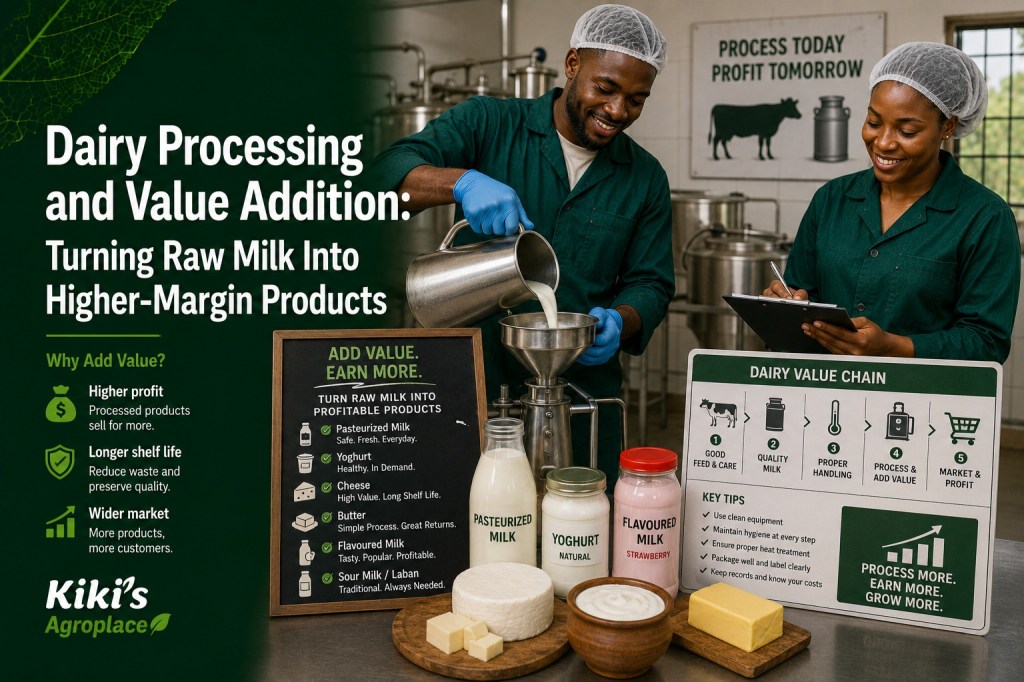
Raw milk is the lowest-margin product you can sell. It spoils within hours without cooling, and buyers know a distressed seller when they see one. Dairy processing and value addition fixes both problems: processed products last longer and sell for more. Here’s how to turn milk into money instead of watching it go to waste.
New to dairy farming? Start with the breed and system guide.
Why raw milk sales leave money on the table
Fresh milk starts losing quality within hours of milking, faster in hot climates without a cold chain. Farmers without cooling access are often forced to sell fast, at a low price, to whoever shows up first. Processing changes that equation. Turning milk into yogurt, ghee, or cheese buys you time and lets you sell into higher-value markets instead of racing the clock.
Across East Africa, this shift is already happening. In parts of Ethiopia, nearly half of household milk production gets processed rather than sold fresh, mostly into butter and a traditional cottage cheese called ayib. That’s not a niche practice; it’s how a large share of smallholder milk actually reaches consumers.
Fermented milk: the simplest starting point
Fermentation is the oldest and cheapest form of dairy value addition. It needs no electricity, no special equipment, and it naturally extends shelf life since the acidity fermented milk develops slows down spoilage bacteria.
- How it works: Warm milk is left to ferment, either naturally or with a starter culture (a small amount of the previous batch), until it thickens and sours.
- Regional variations: Ergo in Ethiopia, mursik in Kenya, amasi in Southern Africa; the technique is common across the continent, even if the name and flavour vary by region.
- Market fit: Fermented milk products are widely trusted by local consumers, since the technique is familiar and doesn’t require them to trust an unfamiliar processing method.
If you’re processing milk for the first time, start here. It’s low-risk, low-cost, and gives you a product you can sell fresh from day one.
Yogurt: bigger margins, more consistency needed
Yogurt is fermentation’s more disciplined cousin. It needs a controlled starter culture and consistent temperature to turn out right every time, but it commands a stronger price in urban markets and has room to grow into flavoured or drinking yogurt lines as your business scales.
- Basic process: Heat milk to kill unwanted bacteria, cool it to a warm temperature suited to the culture, add a starter culture, then hold it warm until it sets.
- Equipment needed: A thermometer and a way to hold the milk at a steady warm temperature; a simple insulated box or flask works at small scale.
- Where the demand is: Urban and peri-urban markets increasingly want yogurt in plain, flavoured, and drinkable forms, and this demand is growing faster than most other dairy product categories.
Ghee and butter: your best answer to spoilage
If cold storage and fast transport aren’t reliable where you farm, ghee is worth prioritising. Properly made ghee doesn’t need refrigeration and stores for months, which makes it one of the few dairy products that solves the cold chain problem instead of depending on it.
- How it’s made: Cream is separated from milk, churned into butter, then the butter is simmered slowly to remove water and milk solids, leaving pure clarified butterfat.
- Why it matters for smallholders: A milk processing survey of dairies in semi-arid Kenya found that ghee and cheese were consistently more profitable than moving raw milk over the same distances, given the high cost of transport for a perishable product.
- Selling point: Ghee is already a kitchen staple in many African cuisines, so you’re not introducing an unfamiliar product; you’re offering a better, more traceable version of something people already buy.
Cheese: higher effort, higher reward
Cheese takes more skill and equipment than fermented milk or ghee, but urban demand for cheese is rising across the continent, and it holds some of the highest margins in the dairy value chain.
- Start simple: Fresh cottage-style cheeses, similar to Ethiopia’s ayib, need basic equipment and short processing times, making them a realistic entry point for a smallholder.
- Scale up carefully: Harder, aged cheeses need consistent refrigeration and longer production cycles. Don’t move into these until your cold storage and cash flow can support the wait time between production and sale.
- Local varieties travel well: Regional cheeses, like Uganda’s waragi cheese, show there’s room for distinct local products, not just imitations of European styles.
The cooperative model: how smallholders solve the cold chain problem together
Individual smallholders rarely have the volume or capital to justify a chiller or processing equipment on their own. This is exactly the gap dairy cooperatives were built to close.
Kenya’s dairy cooperative model, often called a dairy hub or bulking centre, works by pooling milk from many small farmers at a collection point with shared chilling and, in some cases, processing equipment. Muthiru Dairy Farmers Cooperative in Tharaka Nithi county is a working example: over 4,000 members deliver to 25 collection points, and the pooled milk, roughly 16,000 litres a day, gets access to chilling and processing that no individual farmer could afford alone.
Research on Kenyan dairy cooperatives found that farmers who sold through a cooperative earned meaningfully higher incomes than those selling independently, driven by better prices, reduced spoilage losses, and access to loans against future milk payments.
- If you’re a solo farmer: Look for an existing cooperative or bulking centre near you before investing in your own processing equipment. Shared infrastructure gets you to market faster and cheaper.
- If you’re organising farmers: Milk bulking and chilling should come first; processing capacity can follow once volume and cash flow justify it.
- Watch the hygiene chain: Studies of milk collection in Kenya found real gaps in hygienic handling between the farm and the collection point. A cooperative model only pays off if the milk arriving at the chiller is still good enough to process.
Extending shelf life without industrial equipment
You don’t need a factory to slow spoilage. A few low-cost steps make a real difference before milk ever reaches a processor or a cooperative chiller:
- Cool it fast, even without electricity. Placing milk containers in cold water or a shaded, ventilated area right after milking slows bacterial growth compared to leaving milk at ambient temperature.
- Use clean containers. Aluminium containers are easier to clean fully than plastic, which can retain milk residue and harbour bacteria between uses.
- Boil before selling as fresh milk. Boiling doesn’t match proper pasteurisation, but it does kill many spoilage organisms and is widely practiced by smallholders without cooling access.
- Move quickly to fermentation or ghee. If you can’t chill or sell milk within a few hours, converting it into a shelf-stable product beats risking a total loss.
Mistakes that cut into value-addition profits
- Jumping straight to hard cheese. It needs the most skill, equipment, and patience. Build up through fermented milk and ghee first.
- Ignoring hygiene at the collection stage. A processed product is only as good as the raw milk that went into it. Dirty containers or slow cooling undo the value addition before it starts.
- Underpricing traditional products. Fermented milk and ghee are often sold cheaply out of habit, even though they took real time and skill to make. Price for the value added, not just the raw milk cost.
- Going at it alone when a cooperative exists nearby. Shared chilling and bulking almost always beats the cost of solo investment in equipment you can’t yet justify by volume.
Key takeaways
- Processing turns a fast-spoiling product into something that holds value, whether that’s a few extra days or several months.
- Fermented milk is the easiest entry point; yogurt, ghee, and cheese follow as your skill and equipment grow.
- Ghee is your strongest option where cold chain access is limited, since it stores without refrigeration.
- Dairy cooperatives solve the volume and capital problem that keeps individual smallholders from accessing chilling and processing equipment.
- Hygiene at the point of milking and collection determines whether any of this pays off.
FAQ
Which dairy product is most profitable for a smallholder?
Ghee and cheese typically carry the highest margins, but they need more skill and, for hard cheese, reliable cold storage. Fermented milk and yogurt offer a lower-risk starting point while you build up capacity.
Do I need refrigeration to process milk at home?
Not for every product. Fermented milk, yogurt, and ghee can all be made without refrigeration, though yogurt needs a steady warm temperature during fermentation. Hard, aged cheeses are the main product that genuinely needs consistent cold storage.
How does a dairy cooperative help a smallholder farmer?
A cooperative pools milk from many farmers, giving access to chilling and processing equipment that no single smallholder could afford. Research on Kenyan cooperatives found members earned meaningfully more than farmers selling independently, largely through better prices and reduced spoilage.
Is boiling milk the same as pasteurisation?
No. Boiling kills many spoilage organisms and is a reasonable stopgap without cooling access, but proper pasteurisation uses controlled temperature and time to kill pathogens more reliably without affecting the milk as much. If you’re selling processed products commercially, follow proper pasteurisation standards rather than relying on boiling alone.
What equipment do I need to start making yogurt at small scale?
A thermometer, a heat source, clean containers, a starter culture, and a way to hold the milk at a steady warm temperature during fermentation; an insulated box or flask works at small scale. You can grow into more specialised equipment as demand increases.
Kiki’s Agroplace: Bridging the knowledge gap in agriculture.


Leave a Reply