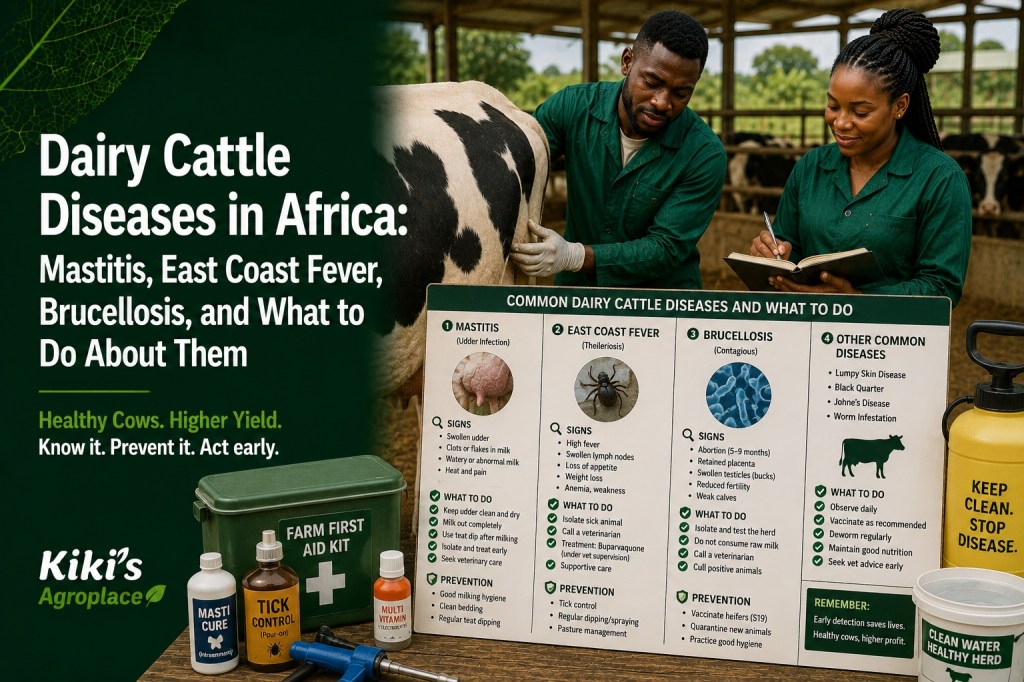
A sick cow doesn’t just cost you a vet bill. She stops producing milk, sometimes for good. Disease is one of the biggest reasons smallholder dairy farmers lose their investment, and the diseases that matter most shift depending on where you farm. Here’s what actually threatens dairy cattle in Africa, how to spot it early, and what you can do before it costs you the cow.
Start with the breed and system guide if you’re still setting up.
Mastitis: the disease hiding in plain sight
Mastitis is an infection of the udder, and it’s more common than most farmers realise. A study of smallholder dairy cows in Embu and Kajiado counties in Kenya found 80% of cows tested positive for mastitis, and most of those cases were subclinical; meaning the cow showed no obvious signs, but her milk yield and quality were already dropping.
This matters because subclinical mastitis is easy to miss. You won’t see swelling or clots in the milk. You’ll just see slowly falling yield and blame it on feed or weather.
- Clinical signs: Swollen, hot, or painful udder; clots or watery discharge in the milk; fever in severe cases.
- Subclinical signs: None visible. Catch it with the California Mastitis Test (CMT), a simple cow-side test using a paddle and reagent that any farmer can learn to run.
- Main causes: Bacteria entering through the teat canal, usually from dirty milking hands, unclean equipment, or a wet, manure-covered stall floor.
- Prevention: Clean the udder before every milking, dip teats after milking, milk infected cows last, and keep stall floors dry.
Farms that consistently follow basic hygiene steps see meaningfully fewer subclinical cases than farms that don’t. This is one of the few dairy diseases where the fix costs almost nothing; it just needs to happen every single milking.
East Coast Fever: the tick-borne killer in East and Southern Africa
East Coast Fever (ECF) is caused by a parasite called Theileria parva, spread by the brown ear tick. It’s one of the leading causes of cattle death across East and Southern Africa, particularly dangerous for young calves and exotic or crossbred cattle with no natural resistance.
- Symptoms: High fever, swollen lymph nodes (especially near the ear where the tick attaches), laboured breathing, and rapid decline. Death can follow within two to three weeks if untreated.
- Treatment: Drugs called Buparvaquone or Parvaquone work if given early, alongside long-acting oxytetracycline. Waiting past the first signs sharply lowers the odds of recovery.
- Prevention: Tick control through regular acaricide spraying or dipping is the frontline defence, though ticks can develop resistance over time and acaricides get expensive fast.
- Vaccination: The Infection and Treatment Method (ITM), using what’s known as the Muguga cocktail, gives lasting protection against ECF. It’s a live vaccine, so it needs a trained technician to administer, and uptake is still low in many pastoralist areas due to cost and limited awareness.
If you farm in Kenya, Tanzania, Uganda, or nearby countries with brown ear tick populations, ECF should sit near the top of your disease watchlist, especially for calves and any exotic or crossbred cow you’ve just brought onto the farm.
Trypanosomiasis: the West African tsetse-belt threat
Farmers in the West African tsetse belt face a different parasite problem. Trypanosomiasis, spread by the tsetse fly, causes anaemia, weight loss, and falling milk yield, and it’s a major reason dairy farming struggles to take hold in large parts of West and Central Africa.
- Symptoms: Progressive weight loss, pale gums and eyes from anaemia, rough coat, swollen lymph nodes, and a steady decline in milk production.
- Breed matters here: N’Dama and West African Shorthorn cattle carry natural trypanotolerance, built up over thousands of years of exposure. They can stay productive under infection pressure that would kill or cripple an exotic or zebu breed.
- Treatment: Trypanocidal drugs exist, but resistance is a growing problem in parts of the region, and there’s no vaccine.
- Prevention: Tsetse trap and target programs, clearing bush near watering points, and choosing trypanotolerant breeds where dairy crossbreeding is being considered in tsetse zones.
This is the one place where the “crossbreed for higher yield” advice needs a serious caveat. In a heavy tsetse zone, a trypanotolerant local breed may out-earn a high-yielding crossbred cow that keeps getting sick.
Brucellosis: the disease that can make you sick too
Brucellosis deserves its own warning because it’s zoonotic, meaning it can pass from cattle to people, usually through handling an infected placenta or drinking unpasteurised milk. Studies across East Africa have found the disease circulating in a meaningful share of smallholder dairy herds, particularly where cattle mix freely with other herds at shared grazing or watering points.
- Signs in cattle: Late-term abortion, retained placenta, reduced fertility, and lower milk yield. Bulls can show swelling in the testicles.
- Signs in people: Recurring fever that can be mistaken for malaria, joint pain, and fatigue. This makes it easy to miss in areas without good lab access.
- Prevention: Always boil or pasteurise milk before drinking it, handle aborted foetuses and placentas with gloves, and isolate cows that abort until you know the cause.
- Testing: Ask your local vet about herd screening, especially if you buy in new cattle regularly or notice unexplained abortions.
Foot and Mouth Disease: the trade-stopper
Foot and Mouth Disease (FMD) is a highly contagious viral disease that spreads fast through direct contact, shared water, or even the wind over short distances. It rarely kills adult cattle outright, but it crashes milk production and can shut down livestock movement and trade in an affected area for weeks.
- Symptoms: Blisters on the mouth, tongue, and feet, drooling, lameness, and a sharp drop in milk yield.
- Prevention: Vaccination, usually needed every six months in endemic areas, plus strict control over new animals entering the herd and limiting contact with untested cattle at markets or shared grazing.
- If you suspect it: Report to your local veterinary authority immediately. FMD outbreaks trigger movement restrictions, and reporting early protects your neighbours’ herds as much as your own.
Building a basic herd health routine
You don’t need a full-time vet on payroll to keep a healthy herd. A basic routine covers most of your risk:
- Daily: Check for changes in appetite, milk yield, or behaviour. A cow that goes off her feed is telling you something early.
- Every milking: Clean udder, clean hands, teat dip after milking.
- Weekly: Tick checks, especially around the ears and under the tail, if you’re in an ECF-risk area.
- Every six months: FMD vaccination in endemic zones, deworming, and a general health check with your local vet or extension officer.
- Whenever you buy a new cow: Quarantine and observe before mixing with the rest of the herd, and ask about the animal’s vaccination and disease history.
Key takeaways
- Mastitis is widespread and often invisible; hygiene at every milking is your cheapest and most effective prevention.
- East Coast Fever threatens East and Southern Africa through tick bites; tick control and the ITM vaccine are your main defences.
- Trypanosomiasis threatens the West African tsetse belt; trypanotolerant breeds like N’Dama matter more here than crossbreeding for yield.
- Brucellosis can pass to people; always boil or pasteurise milk and handle abortions with care.
- FMD spreads fast and stops trade; vaccinate on schedule and report suspected cases immediately.
FAQ
What is the most common disease in dairy cattle?
Mastitis is the most common disease across smallholder dairy herds, and most cases are subclinical, meaning you won’t see obvious symptoms without testing. Regular milking hygiene is the most effective way to keep it under control.
How do I know if my cow has East Coast Fever?
Watch for high fever, swollen lymph nodes near the ears, and laboured breathing. If you’re in a tick-heavy area and see these signs, contact a vet immediately, since treatment works best when started early.
Can humans catch diseases from dairy cattle?
Yes. Brucellosis is the main concern, and it can pass to people through unpasteurised milk or contact with an infected placenta. Always boil or pasteurise milk before drinking it, and use gloves when handling any abortion material.
Which cattle breed resists tsetse fly disease best?
N’Dama and West African Shorthorn cattle carry natural trypanotolerance built up over thousands of years in tsetse-infested areas. They stay productive under infection pressure that would seriously harm exotic or zebu breeds.
How often should dairy cattle be vaccinated?
This depends on the disease and your region. Foot and Mouth Disease vaccination is typically needed every six months in endemic zones. East Coast Fever’s ITM vaccine gives longer-lasting protection but needs a trained technician to administer. Ask your local vet for a schedule specific to your area.
What is the California Mastitis Test?
It’s a simple, low-cost cow-side test that mixes a reagent with a milk sample to detect subclinical mastitis. A change in the mixture’s texture signals infection, letting you catch mastitis before it becomes visible or costly.
Kiki’s Agroplace: Bridging the knowledge gap in agriculture.


Leave a Reply