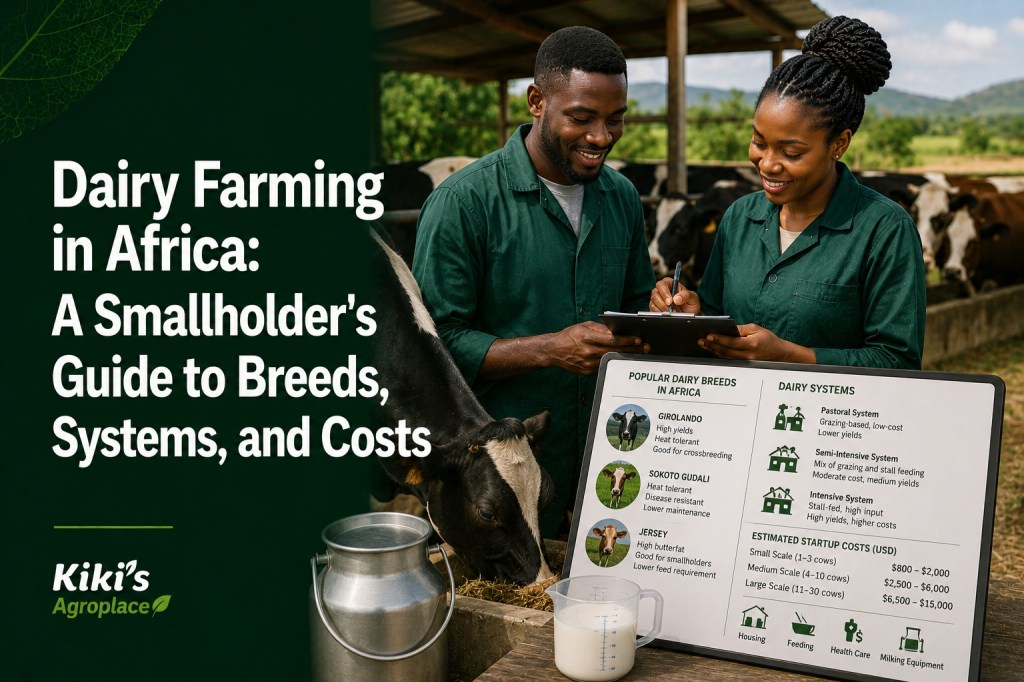
Africa holds a fifth of the world’s cattle but produces only 5% of the world’s milk. That gap is not a large-farm problem to solve someday; it’s a smallholder opportunity right now. If you’re considering dairy farming in Africa, the numbers say you don’t need a large commercial operation to make it work. You need the right cow, the right system, and a realistic budget. Here’s how to get all three right.
Dairy farming in Africa already runs on smallholders, not big farms
Here’s something most people get backwards: dairy in Africa isn’t dominated by large commercial operations waiting to be disrupted by small farmers. It’s the opposite. More than 80% of the milk produced in sub-Saharan Africa already comes from small-scale producers, most of them keeping just one to five cows. In Kenya, smallholders produce roughly 80% of the country’s milk. In Ethiopia, smallholder mixed farms account for about 65% of milking cows and 72% of national milk output.
So why does the continent still import so much dairy? The problem isn’t farm size. It’s productivity per cow. In Senegal, local breeds top out around 4 liters of milk a day, compared to roughly 20 liters for improved or crossbred cows. In Ethiopia, home to Africa’s largest cattle herd, average output is just 1.5 liters per cow per day. Nigeria’s 20 million-strong cattle population produces around 600 million liters of milk a year against a demand of roughly 1.3 billion liters; a gap the country fills by spending an estimated $1.5 billion a year on imports.
Add population growth and urbanization on top of that, and Africa’s dairy imports keep climbing; the continent spent roughly $7.5 billion on dairy imports in 2023 alone. This is the real opportunity: the demand already exists, and the biggest lever for closing the gap is which cow you put in your shed, not how many hectares you own.
How to turn your farm into a tourist destination.
The breed decision matters more than farm size
This is where most new dairy farmers get it wrong. They either buy a purebred exotic cow they can’t feed properly, or they stick with an indigenous breed that’s hardy but barely profitable. The better answer for most smallholders sits in between.
| Breed type | Examples | Milk yield | Best for |
|---|---|---|---|
| Indigenous zebu | Boran, East African Shorthorn Zebu, White Fulani (Bunaji) | Low — often under 5 liters/day | Harsh climates, low-input systems, farmers prioritizing survival over yield |
| Trypanotolerant breeds | N’Dama | Very low — around 2–3 liters/day | Tsetse fly zones in West and Central Africa; kept mainly for meat, not dairy |
| Crossbreeds | Friesian-Sahiwal, Friesian-Boran crosses | Moderate to high, with better heat and disease tolerance than purebred exotics | Most smallholders — the practical middle ground |
| Exotic purebred | Holstein-Friesian, Jersey, Ayrshire | High — 20–40+ liters/day under good conditions | Farmers with reliable feed, water, and veterinary access |
Crossbreeding is the practical choice for most beginners. It combines the higher milk yield of exotic breeds like the Holstein-Friesian with the heat tolerance and disease resistance of local breeds like the Sahiwal or Boran. A crossbred cow won’t out-produce a purebred Friesian, but it’s far less likely to die or stop producing the first time your feed quality dips or the rains fail.
Straight exotic breeds are a real option, but only if you can guarantee consistent, quality feed and have access to a veterinarian. Without that, survival rates for pure exotic cattle drop fast. This isn’t a small caveat; it’s the single biggest reason new dairy farmers lose their investment in the first year.
25 profitable agribusiness ideas.
Zero-grazing vs open grazing — which system fits your land
Your system matters as much as your breed. Two options dominate smallholder dairy farming in Africa.
- Zero-grazing (cut-and-carry): Your cow stays in a stall, and you bring feed to her; usually Napier grass, cut fresh daily and supplemented with dairy meal. This suits farmers with limited land, since it needs roughly 0.75 to 1 acre of Napier grass per cow rather than open pasture. It also gives you tighter control over feeding, breeding, and disease, which matters most if you’ve invested in a crossbred or exotic cow.
- Open grazing: Your cow roams and feeds on natural pasture. Lower daily labour, lower feed cost, but lower and less consistent milk yield. This system works best with hardier indigenous breeds that don’t need concentrated feed to stay productive.
Zero-grazing is labour-intensive; someone needs to cut and carry grass to the cow every day, twice a day if you want to keep it fresh. But it’s the system that makes a crossbred or exotic cow’s higher yield actually achievable on a small plot. If you’re going to invest in a better breed, plan to invest in the labour and land for proper feeding too. One without the other is how farmers end up with an expensive cow producing disappointing milk.
How to write a farm business plan that actually gets you funded.
What it costs to get started
Costs vary a lot by country and breed, so treat these as a starting reference, not a fixed budget.
- Cow purchase: In Kenya, a young crossbred heifer runs roughly 70,000–120,000 KES, a pregnant in-calf heifer 120,000–180,000 KES, and an already-lactating cow 150,000–250,000 KES. Indigenous breeds cost less; purebred exotic cattle cost more.
- Housing: A basic zero-grazing stall can be built with local materials and expanded over time; start with the essentials (stall, feeding trough, milking area) and add a store or better drainage as funds allow.
- Fodder: Budget for Napier grass establishment if you’re zero-grazing, plus dairy meal and mineral supplements to keep milk yield consistent.
- Veterinary care: Vaccinations, deworming, and a relationship with a local vet or extension officer, especially important if you’re keeping a crossbred or exotic cow.
Feed is your largest recurring cost in any system, and it directly drives your milk yield. Underfeeding a good cow is one of the most common ways smallholders sabotage their own investment.
Mistakes that hold smallholder dairy farmers back
- Buying a breed that doesn’t match your feed and water reality. A purebred Friesian on inconsistent feed will underperform a well-fed crossbred cow every time.
- Skipping the milk market plan. Most milk in Africa moves through informal channels; know who’s buying, at what price, and how often before you commit to a cow.
- Underinvesting in feed to save money upfront. Feed costs are the largest share of your ongoing budget for a reason; cutting corners here shows up directly in reduced milk yield.
- Ignoring artificial insemination and breeding records. Uncoordinated breeding leads to inbreeding and slow genetic improvement over generations, especially in areas with limited AI service access.
- Starting with too many cows. One or two well-managed cows that are properly fed and housed will outperform a larger herd you can’t maintain.
Key takeaways
- Smallholders already produce more than 80% of sub-Saharan Africa’s milk; this is a smallholder-driven sector, not a large-farm one.
- The real gap is productivity per cow, not farm size. Crossbred cows can produce roughly four to five times more milk than unimproved local breeds.
- Crossbreeding (exotic x indigenous) is the practical middle ground for most beginners; better yield than local breeds, better resilience than pure exotics.
- Zero-grazing suits limited land and higher-yield breeds; open grazing suits hardier indigenous cattle and lower labour budgets.
- Feed is your biggest ongoing cost and the main driver of whether your breed choice actually pays off.
FAQ
Which part of Africa produces the most milk?
East Africa is the continent’s dairy hub. The region accounted for 48% of Africa’s total milk production in 2023, and it also had the fastest growth of any region over the past decade. Kenya, Ethiopia, Sudan, Tanzania, and South Sudan are the main producers in the region.
What are the top milk-producing countries in Africa?
Egypt, Kenya, Ethiopia, Sudan, and South Africa consistently rank among the continent’s largest milk producers, together accounting for roughly half of Africa’s total output. Ethiopia has the largest cattle herd of any African country, while South Africa gets the most milk per cow thanks to its more commercial, intensive systems.
Which county in Kenya is best for dairy farming?
Kiambu County consistently leads Kenya in milk production, helped by its proximity to Nairobi’s market and strong cooperative infrastructure. Meru, Nyeri, Nakuru, and Uasin Gishu round out the top-producing counties, all benefiting from favorable climate and established dairy cooperatives.
How much space do I need for 10 cows?
Under a zero-grazing system, budget roughly 0.75 to 1 acre of Napier grass per cow, which works out to about 7.5 to 10 acres of fodder land for 10 cows, plus space for stalls and a milking area. Open grazing needs considerably more land per cow, since the cattle rely on natural pasture rather than cut-and-carry feed.
Is dairy farming profitable in Africa?
It can be, and most of the continent’s milk already comes from exactly this kind of farmer. Profitability depends heavily on breed choice, feed quality, and having a reliable buyer lined up before you start; not on farm size.
How much money do I need to start a dairy farm?
In Kenya, a single crossbred cow costs roughly 70,000 to 250,000 KES depending on age and whether it’s already lactating, on top of housing, fodder, and veterinary costs. Costs vary a lot by country, so use this as a starting reference rather than a fixed budget for your own market.
What is the best cattle breed for a beginner dairy farmer?
A crossbred cow; combining an exotic breed like Friesian with an indigenous breed like Sahiwal or Boran, is the most practical starting point. It produces meaningfully more milk than a purebred indigenous cow while handling heat, disease, and inconsistent feed better than a purebred exotic.
How many liters of milk does a dairy cow produce per day?
It depends almost entirely on breed and feeding. Unimproved local breeds can produce as little as 1.5 to 4 liters a day. Crossbred cows typically do much better, and well-fed purebred exotic cows like Holstein-Friesians can produce 20 to 40 liters a day or more.
What’s the difference between zero-grazing and open grazing?
Zero-grazing keeps the cow in a stall and brings cut fodder to her daily, giving tighter control over feed and health at the cost of more labour. Open grazing lets the cow roam pasture, which is less labour-intensive but generally produces lower, less consistent milk yield.
Kiki’s Agroplace: Bridging the knowledge gap in agriculture.


Leave a comment