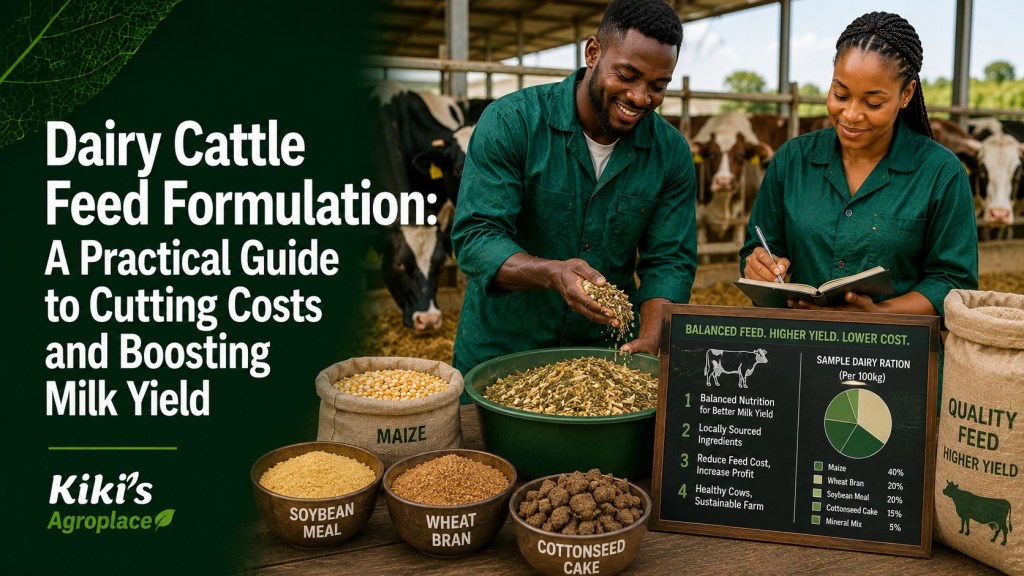
Feed makes up 60 to 80% of your dairy farming costs. Get the ration wrong, and even a good crossbred cow will underperform. Get it right, and you cut costs while your cow produces more milk. Here’s how to build a balanced dairy cattle feed formulation using ingredients you can actually find, with a step-by-step method to work out the numbers yourself.
Why your feed mix decides if your breed choice pays off
A crossbred or exotic cow only produces more milk if she gets more energy and protein than a local breed needs. Buy a good cow and feed her like a local one, and you get local-breed milk yield from an expensive animal. Feed formulation is the tool that closes this gap. It means working out the right mix of forage and concentrate so your cow gets what she needs, without paying for more than that.
Read the full guide to breeds, systems, and startup costs.
Forage and concentrate: the two halves of the ration
Every dairy ration has two parts. Forage gives your cow bulk, fibre, and some energy. Concentrate gives her the extra energy and protein she needs to turn feed into milk instead of just body weight.
- Forage (roughage): Napier grass, maize silage, hay, or crop residues. This should make up roughly 60 to 70% of the diet by weight for a lactating cow.
- Concentrate: A mix of energy and protein feeds, making up the remaining 30 to 40%. This is where feed formulation matters most, since concentrate is the part you build yourself and the part that costs the most per kilogram.
These ratios shift with your system. Zero-grazing cows eating cut Napier grass need more concentrate to hit their energy needs than cows on rich natural pasture. Treat 60:40 as a starting point, not a fixed rule.
Local ingredients by country
You don’t need imported feed to formulate a balanced ration. Most African dairy regions have local energy and protein sources already. Here’s what farmers commonly use, with approximate crude protein (CP) levels.
| Ingredient | Type | Approx. CP% | Common in |
|---|---|---|---|
| Maize bran / maize germ | Energy | 9–11% | Kenya, Tanzania |
| Wheat bran / pollard / offal | Energy | 14–17% | Kenya, Nigeria |
| Cottonseed cake | Protein | 36–41% | Kenya, Nigeria, Tanzania |
| Sunflower cake / meal | Protein | 28–34% | Kenya, Tanzania |
| Groundnut cake | Protein | 42–48% | Nigeria |
| Dried brewers grains | Protein | 24–28% | Nigeria, Kenya |
| Molasses | Energy / palatability | — | Nigeria (Northern states) |
Prices and availability shift by season and region, so check with your local agrovet or cooperative before you commit to a mix. Cottonseed cake and groundnut cake are usually the priciest ingredients here, since they compete with human food and export markets.
How to work out your own ration: the Pearson Square method
You don’t need software or a nutritionist to build a two-ingredient concentrate mix. The Pearson Square method gets you there with basic maths. Here’s a worked example using two common Kenyan ingredients: maize bran (9% CP) and cottonseed cake (41% CP), targeting a 16% CP concentrate for a lactating cow.
- Write your target in the middle. Your target CP (16%) must sit between your two ingredients’ CP values (9% and 41%). If it doesn’t, pick different ingredients.
- Subtract diagonally. Parts of maize bran = 41 − 16 = 25. Parts of cottonseed cake = 16 − 9 = 7.
- Add the parts. 25 + 7 = 32 total parts.
- Convert to percentages. Maize bran = 25 ÷ 32 = 78% of the mix. Cottonseed cake = 7 ÷ 32 = 22% of the mix.
- Check your work. (0.78 × 9) + (0.22 × 41) = 7.0 + 9.0 = 16% CP. That matches your target.
So for every 100kg of concentrate, you’d mix roughly 78kg maize bran with 22kg cottonseed cake. Add a mineral premix at 1 to 2% of the total, as plain maize bran and cottonseed cake won’t cover your cow’s mineral needs on their own.
The same method works with any two ingredients from the table above; wheat offal and groundnut cake for a Nigerian farm, or maize bran and sunflower cake for a Tanzanian one. Swap in your local CP values and run the same five steps.
See the full livestock feed formulation guide for more worked examples and cost tables.
Closing the dry-season feed gap
Milk yield drops hard in the dry season because pasture and Napier grass thin out. This is where most smallholder dairy farmers lose the gains they made during the rains. A few fixes work well across the continent:
- Maize silage: Store surplus maize forage from the wet season by ensiling it. This holds nutrient value far better than dry hay.
- Hay from Rhodes grass or Boma Rhodes: A cheaper option than silage if you lack storage pits, though it holds less energy per kilogram.
- Crop residues: Maize stover (consists of the leaves, stalks, and cobs of corn left in a field after harvest), sorghum stalks, and groundnut haulms (leftover stems, leaves, and vines of the groundnut plant after the groundnuts are harvested) fill gaps but need a protein supplement alongside them, since residues alone run low on protein.
- Leguminous tree fodder: Calliandra calothyrsus and Leucaena leaves are high in protein and grow well as a hedge or boundary planting. Farmers in Tanzania have used Calliandra leaf meal mixed with maize bran to hold milk yield through the dry season.
The storage risk most farmers miss: mycotoxins
Feed formulation doesn’t stop once you’ve mixed the ration. How you store it matters just as much. Maize bran, cottonseed cake, and other feed ingredients can grow mold in damp storage, producing mycotoxins; toxic compounds that cut milk yield, damage your cow’s liver, and can pass into the milk itself.
Studies of smallholder dairy feed in South Africa found mycotoxins in the large majority of samples tested, with many samples carrying more than one type at once. This isn’t a rare problem limited to one country; damp storage conditions are common across the region.
Protect your feed by keeping it dry, off the ground, and in a well-ventilated store. Buy only what you’ll use within a few weeks rather than stockpiling, and check bagged feed for a musty smell or visible mold before you use it.
Mistakes that waste money on feed
- Feeding a flat ration year-round. A lactating cow needs more protein and energy than a dry cow. Feeding both the same mix wastes money on the dry cow and underfeeds the lactating one.
- Skipping minerals. Energy and protein feeds alone don’t cover mineral needs. A missing premix shows up as poor fertility and weak bones before it shows up in milk yield.
- Buying concentrate you can’t verify. Commercial dairy meal quality varies. Ask your supplier for the CP percentage on the label, and mix your own when the maths favours it.
- Ignoring dry-season planning until the dry season hits. Silage and hay need to be made during the rains, not after the grass has already thinned out.
Key takeaways
- Forage should make up 60 to 70% of a lactating cow’s diet, with concentrate covering the rest.
- The Pearson Square method lets you formulate a two-ingredient concentrate mix with basic maths and no software.
- Local ingredients like maize bran, cottonseed cake, wheat offal, and groundnut cake can replace costly commercial dairy meal.
- Dry-season feed gaps need planning during the rains, through silage, hay, or leguminous fodder trees.
- Feed storage matters as much as feed formulation. Damp, moldy feed can undo a well-balanced ration.
FAQ
What is the ideal crude protein percentage for a dairy cow?
A lactating dairy cow typically needs a concentrate mix of around 14 to 18% crude protein, with higher-producing cows needing the upper end of that range. Dry cows need less, usually around 10 to 12%.
Can I formulate dairy feed without a nutritionist?
Yes, for a simple two-ingredient concentrate mix. The Pearson Square method covers most smallholder needs using local ingredients and basic maths. More complex, multi-ingredient rations benefit from a nutritionist or extension officer’s input.
How much does homemade dairy meal save compared to commercial feed?
Farmers who mix their own dairy meal from local ingredients commonly report meaningful savings per kilogram compared to buying commercial feed, though the exact figure depends on local ingredient prices and shifts with the season.
What happens if I feed my cow moldy feed?
Moldy feed can carry mycotoxins that lower milk yield, damage your cow’s liver, and in some cases pass into the milk. Discard any feed with a musty smell or visible mould rather than feeding it, even in small amounts.
What is the cheapest way to feed dairy cows in the dry season?
Maize silage made during the rains is usually the most cost-effective option, since it holds nutrient value well and uses forage you already grew. Crop residues like maize stover are cheaper still, but need a protein supplement alongside them to stay effective.
Kiki’s Agroplace: Bridging the knowledge gap in agriculture.


Leave a Reply