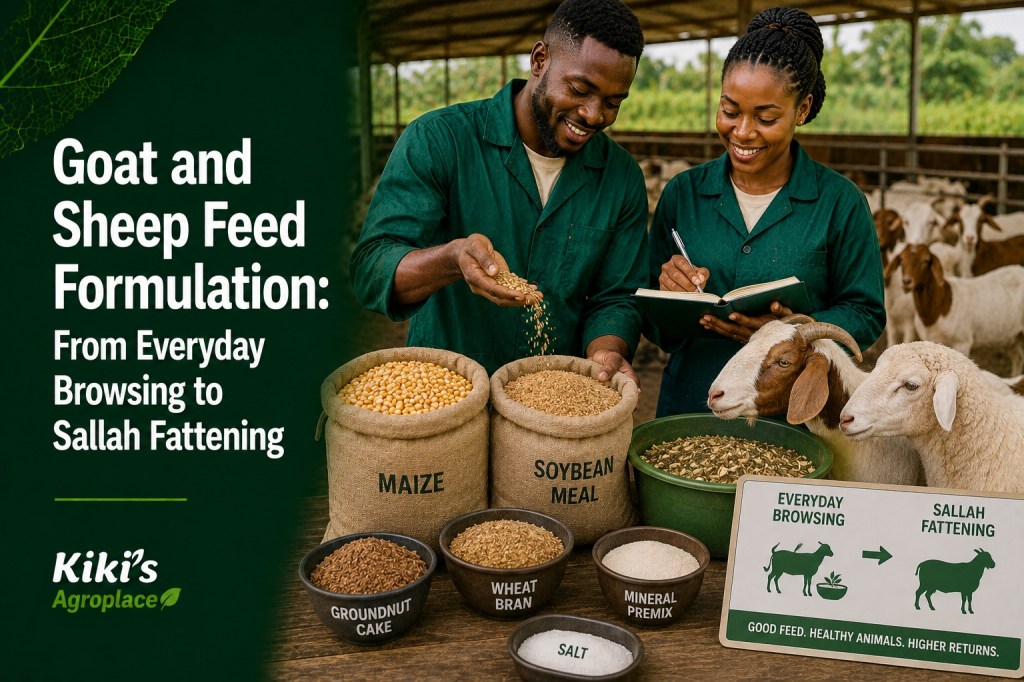
Goats and sheep don’t need the feed budget a dairy cow does. Most of their diet can come from browsing, cut-and-carry forage, and crop residues most smallholders already have access to. But if you’re fattening for a specific market, especially Sallah, feeding by guesswork costs you real money. Here’s how to handle goat and sheep feed formulation for both everyday maintenance and festival-timed fattening.
Start with the breed and market timing guide if you haven’t already.
Everyday feeding: browse and forage do most of the work
Unlike cattle, goats and sheep are selective feeders. Left to browse, they naturally pick the most nutritious leaves and shoots available, which is part of why they survive on land that wouldn’t support a cow. For maintenance, most smallholders rely on:
- Natural browse and grazing: Shrubs, leaves, and grass gathered during the day. This covers most of a goat’s nutritional needs outside the dry season.
- Cut-and-carry forage: Napier grass, Rhodes grass, or fodder trees cut and brought to a confined or semi-confined animal. Common in zero-grazing systems where land is limited.
- Fodder trees and legumes: Gliricidia, Calliandra, Leucaena, and Moringa are widely used across the continent as a high-protein supplement, especially valuable when dry-season grass thins out. Moringa in particular has been shown to speed up goat growth while cutting feed costs compared to relying on commercial feed alone.
For a doe or ewe on maintenance, browse and forage alone often cover her needs. Concentrate only becomes necessary during late pregnancy, lactation, or when you’re deliberately fattening an animal for sale.
When to add concentrate
- Late pregnancy and lactation: A doe or ewe raising twins, common in breeds like Galla, needs more energy and protein than browse alone reliably provides.
- Dry season gaps: When browse quality drops, a concentrate supplement prevents the weight loss that otherwise follows every dry season.
- Fattening for market: Whether you’re targeting Sallah or a general meat market, concentrate is what compresses your finishing period from many months down to a manageable few.
A simple dairy goat ration in Kenya, for example, commonly pairs 8 to 10kg of fresh Napier grass a day with around 300g of concentrate; enough to lift output without the cost of a fully concentrate-heavy diet.
Formulating a Sallah fattening ration
If you’re fattening for Sallah, you’re working against a fixed date, not an open-ended growing season. Farmers typically fatten young animals over a two to three month period, feeding a higher concentrate ratio than a maintenance diet needs. Research on mutton sheep finishing recommends a concentrate-to-forage ratio in the range of 70:30 to 80:20 for the fattening period specifically, a sharp shift from the mostly-forage maintenance diet.
Here’s a worked example using the Pearson Square method (covered in more depth in our dairy feed formulation guide) to build a 16% crude protein (CP) concentrate mix using maize offal (9% CP) and groundnut cake (45% CP), two ingredients common across Northern Nigeria’s fattening operations.
- Target sits between your two ingredients. 16% CP falls between maize offal (9%) and groundnut cake (45%), so the method works.
- Subtract diagonally. Parts of maize offal = 45 − 16 = 29. Parts of groundnut cake = 16 − 9 = 7.
- Add the parts. 29 + 7 = 36 total parts.
- Convert to percentages. Maize offal = 29 ÷ 36 = 81% of the concentrate. Groundnut cake = 7 ÷ 36 = 19%.
- Check your work. (0.81 × 9%) + (0.19 × 45%) = 7.3 + 8.6 = 15.9%, close enough to the 16% target.
So for every 100kg of concentrate, mix roughly 81kg maize offal with 19kg groundnut cake, then feed this alongside forage at your target concentrate-to-forage ratio for the fattening period.
Local ingredients by region
| Ingredient | Type | Notes | Common in |
|---|---|---|---|
| Maize offal / bran | Energy | Base of most fattening concentrates; often blended with other milling by-products into a mix known as “Dusa” | Northern Nigeria |
| Groundnut haulm | Protein forage | Trials in the West African Sahel show sheep on bush hay alone lost weight, while those supplemented with groundnut haulm gained steadily | Nigeria, Niger, Sahel countries |
| Cowpea husk | Protein supplement | Combined with maize offal (roughly 50:50), shown to significantly improve weight gain over grazing alone | Nigeria (sub-humid zone) |
| Groundnut cake | Protein concentrate | High-protein supplement for finishing rations | Nigeria, wider West Africa |
| Napier / Rhodes grass | Forage | Base forage for cut-and-carry systems | Kenya, East Africa |
| Lucerne / Desmodium | Protein forage | High-quality legume forage for dairy and meat goats | Kenya |
| Moringa | Protein supplement | Grown on-farm; shown to speed weight gain and cut reliance on commercial feed | Kenya, widely across the continent |
Closing the dry-season gap
Dry-season feed shortages hit small ruminants the same way they hit dairy cattle: less browse, thinner animals, slower growth right when you may be trying to hit a Sallah deadline. A few fixes carry real evidence behind them:
- Crop residue supplementation. Cowpea husk and groundnut haulm both showed measurable weight gains over grazing alone in controlled Nigerian trials, particularly valuable during the dry season when forage quality drops.
- Fodder tree browse. Gliricidia, Calliandra, and Moringa keep producing usable leaf even when grass has dried out, and they can be planted as a boundary hedge without taking up separate cropland.
- Alternative grasses. Napier grass and Brachiaria have both shown reliable performance as dry-season feed for confined goats, giving you options if one grass type is scarce.
Mistakes that waste money on small ruminant feed
- Starting the fattening ration too late. A two to three month finishing window doesn’t stretch. Work backward from the Sallah date and start your concentrate feeding on schedule, not when you remember to.
- Feeding a fattening ratio year-round. A 70:30 concentrate-to-forage mix is expensive overkill for an animal that isn’t actively finishing. Save it for the fattening period.
- Ignoring crop residues you already have. Groundnut haulm and cowpea husk are often treated as waste when they’re a proven, low-cost protein source sitting on your own farm.
- Skipping minerals and salt. A small amount of salt added to water or feed measurably improves intake and appetite, and it costs next to nothing.
Key takeaways
- Everyday maintenance for goats and sheep runs mostly on browse, cut-and-carry forage, and fodder trees; concentrate is the exception, not the rule.
- A Sallah fattening ration needs a concentrate-to-forage ratio of roughly 70:30 to 80:20, a sharp jump from maintenance feeding.
- The Pearson Square method works the same way for goats and sheep as it does for dairy cattle; just swap in your local ingredients and target CP.
- Crop residues like groundnut haulm and cowpea husk are proven, low-cost protein sources, especially during the dry season.
- Start your fattening ration early enough to hit market weight before the Sallah date, not after.
FAQ
How long does it take to fatten a goat or sheep for Sallah?
Most smallholder fattening operations in Nigeria run two to three months on a concentrate-heavy ration. Work backward from the Sallah date each year, since it shifts earlier by roughly 10 to 11 days annually on the Gregorian calendar.
Do goats and sheep need commercial concentrate feed?
Not for everyday maintenance. Browse, cut-and-carry forage, and fodder trees cover most nutritional needs outside of late pregnancy, lactation, or active fattening. You can also mix your own concentrate from local ingredients using the Pearson Square method rather than buying commercial feed.
What is Dusa and is it good feed for sheep?
Dusa is a milling by-product common in Northern Nigeria, made from maize, guinea corn, millet, sorghum, and rice residues. It’s a widely used, affordable energy source for sheep fattening, and works best paired with a protein supplement like groundnut cake or cottonseed cake, rather than fed alone.
Can crop residues replace commercial feed for fattening?
Partially. Trials in the West African Sahel found sheep fed only bush hay lost weight, while those supplemented with groundnut haulm gained steadily. Crop residues work best as a supplement to a basal forage diet, not as a complete standalone ration for fattening.
What should I feed a lactating dairy goat?
A common Kenyan ration pairs 8 to 10kg of fresh Napier grass a day with roughly 300g of dairy concentrate, adjusted for the goat’s size and milk output. Legume forages like Lucerne or Desmodium can supplement or partly replace the concentrate portion.
Kiki’s Agroplace: Bridging the knowledge gap in agriculture.


Leave a Reply