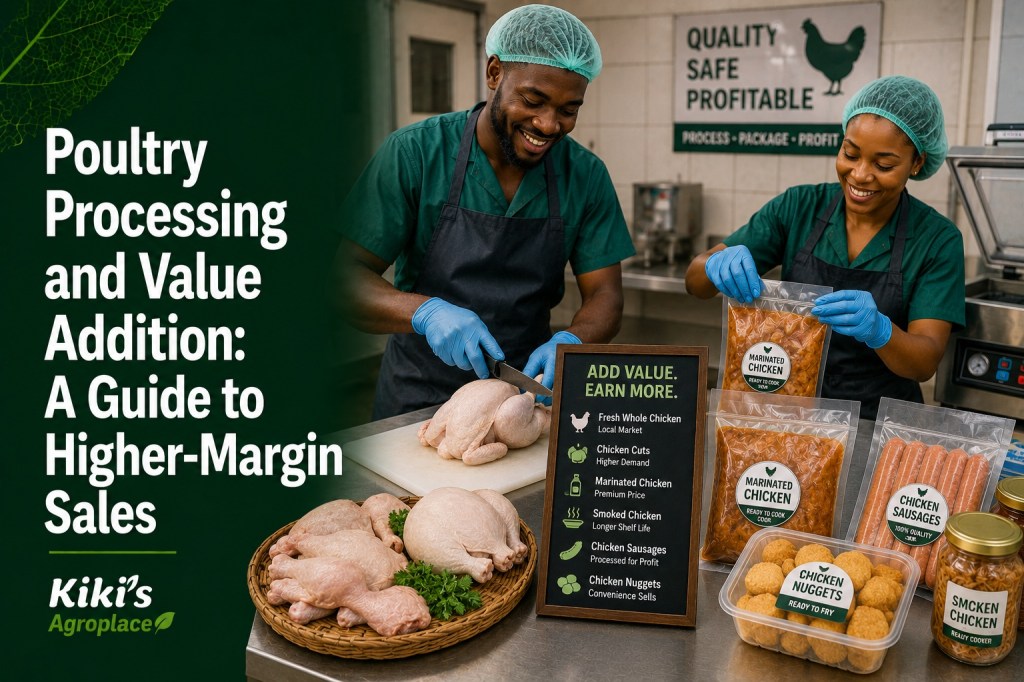
Less than 30% of chicken meat across African countries gets processed into clean, cut, chilled, or preserved products. Most is still sold live and slaughtered on-site, which caps what farmers can earn per bird. Poultry processing and value addition is where the real margin sits, and the gap between what’s possible and what’s actually happening is wide open across the continent.
The value addition gap across Africa
In Kenya, roughly 80% of chickens produced and consumed come from indigenous or backyard flocks, and about 95% of them are sold through live bird markets. Only around 10% of chicken meat and less than 6% of eggs get processed at all. Nigeria, the continent’s second-largest chicken producer after South Africa, sees poultry contribute roughly 37% of the country’s total protein intake, with the livestock sub-sector growing faster than agriculture overall. Despite that scale, most of the value chain still runs through live sales rather than processed product.
The barriers are consistent across the region: limited consumer preference for frozen product, weak cold chain infrastructure, disorganized marketing, and the upfront cost of processing equipment. None of these are unsolvable at small scale, and farmers who work through them capture margin that live-bird sellers never see.
Broiler Vs Layer: which one makes more money?
Basic dressing and processing steps
- Withdraw feed 8 to 12 hours before slaughter. This reduces gut contents and lowers the risk of fecal contamination during processing. Provide water only during this window, and use the time to check each bird’s health and suitability for slaughter.
- Slaughter and allow full bleeding. Roughly two minutes of bleeding time extends the meat’s usable shelf life.
- Scald and pluck. Hot water scalding loosens feathers, making plucking faster and cleaner.
- Eviscerate carefully. Remove internal organs promptly and cleanly to reduce contamination risk.
- Chill rapidly. Get the carcass down to 4°C within two hours of slaughter, using forced air, water immersion, spray, or vacuum chilling, whichever you have access to. This single step does more for food safety and shelf life than almost anything else in the process.
Hygiene matters more than most farmers realize
A study of informal poultry slaughter operations in Nigeria found serious, widespread gaps: no protective equipment used in any of the operations surveyed, slaughtering carried out on unsanitary surfaces in every case, and improper evisceration technique in 75% of operations. These aren’t minor details, they’re the difference between a safe product and a real contamination risk, both to your customers and to you.
If you’re moving from selling live birds into processing them yourself, treat hygiene as a core part of the business, not an afterthought: clean surfaces, clean water, basic protective equipment, and careful evisceration. This is also where a lot of your competitive advantage lives, a visibly clean, well-handled product stands out in a market where informal slaughter is the norm.
Higher-margin value-added products
Once you’ve got clean, properly dressed birds, several paths add real margin beyond selling whole carcasses.
- Cut-up and portioned parts. Wings, legs, breasts, and deboned cuts sell to different customers at different price points than a whole bird, and let you match your product to what specific buyers actually want.
- Cured and smoked chicken. Brine-curing dressed chicken or cuts for 48 hours at 4°C, then smoking for about 4 hours at 45°C, produces a distinctive pink color and smoky flavour with meaningfully longer shelf life, up to 4 days at ambient temperature in vacuum packaging, or 10 days refrigerated. This process also reduces microbial load, improving both safety and shelf life at once, and commands a real price premium over fresh dressed chicken.
- Chicken sausages and further-processed products. These sit at the premium end of processing. Industry data suggests sausages and similar further-processed products can sell for four to five times the price per kilogram of equivalent raw meat, making this one of the highest-margin categories available to a poultry producer willing to invest in the equipment and process.
Small electric processing equipment, slicers, deboners, grinders, commonly costs between $500 and $1,000, an entry point for a small-scale operation looking to move beyond whole-bird sales without committing to industrial-scale machinery.
Where to sell processed product
In Nigeria’s broiler value chain, processors sell the large majority of their output, roughly 88%, to fast food outlets, hotels, restaurants, and supermarkets, with only about 12% going directly to household consumers. If you’re building a processing business rather than just supplying your own household or local market, these institutional buyers are worth targeting directly rather than waiting for individual customers to find you.
For breed and feed guidance to pair with your processing plans, see our guides on best poultry breeds for Nigerian farmers and poultry feed formulation for layers.
Key takeaways
- Less than 30% of chicken meat across Africa is processed; in Kenya, only about 10% of chicken meat and 6% of eggs are processed at all, leaving substantial margin unclaimed.
- Rapid chilling to 4°C within two hours of slaughter is one of the most important steps for both food safety and shelf life.
- Hygiene gaps are widespread in informal slaughter, clean handling is both a safety issue and a real competitive advantage.
- Cured and smoked chicken adds shelf life and commands a price premium; further-processed products like sausages can sell for 4 to 5 times the price of raw meat.
- Institutional buyers, hotels, restaurants, supermarkets, absorb the majority of processed poultry sales in Nigeria’s value chain, and are worth targeting directly.
FAQ
How much of Africa’s chicken meat is actually processed?
Less than 30% across African countries generally. In Kenya specifically, only about 10% of chicken meat and less than 6% of eggs are processed, with most poultry still sold live through informal markets.
How soon after slaughter should chicken be chilled?
Within two hours, down to 4°C. This is one of the most important steps for both food safety and extending shelf life, and can be achieved through forced air, water immersion, spray, or vacuum chilling depending on what equipment you have access to.
How much more does smoked chicken sell for compared to fresh?
Cured and smoked chicken commands a real price premium over fresh dressed chicken, along with a significantly longer shelf life, up to 4 days at ambient temperature in vacuum packaging, or 10 days refrigerated. Further-processed products like sausages can sell for 4 to 5 times the price per kilogram of raw meat.
How much does small-scale poultry processing equipment cost?
Small electric equipment like slicers, deboners, and grinders commonly costs $500 to $1,000, a realistic starting investment for moving beyond whole-bird sales without committing to industrial-scale machinery.
Who buys processed poultry products?
In Nigeria’s broiler value chain, roughly 88% of processed poultry meat goes to fast food outlets, hotels, restaurants, and supermarkets, with only about 12% sold directly to households. Institutional buyers are a significant, underexplored channel for many small-scale processors.
Kiki’s Agroplace: Bridging the knowledge gap in agriculture.


Leave a Reply