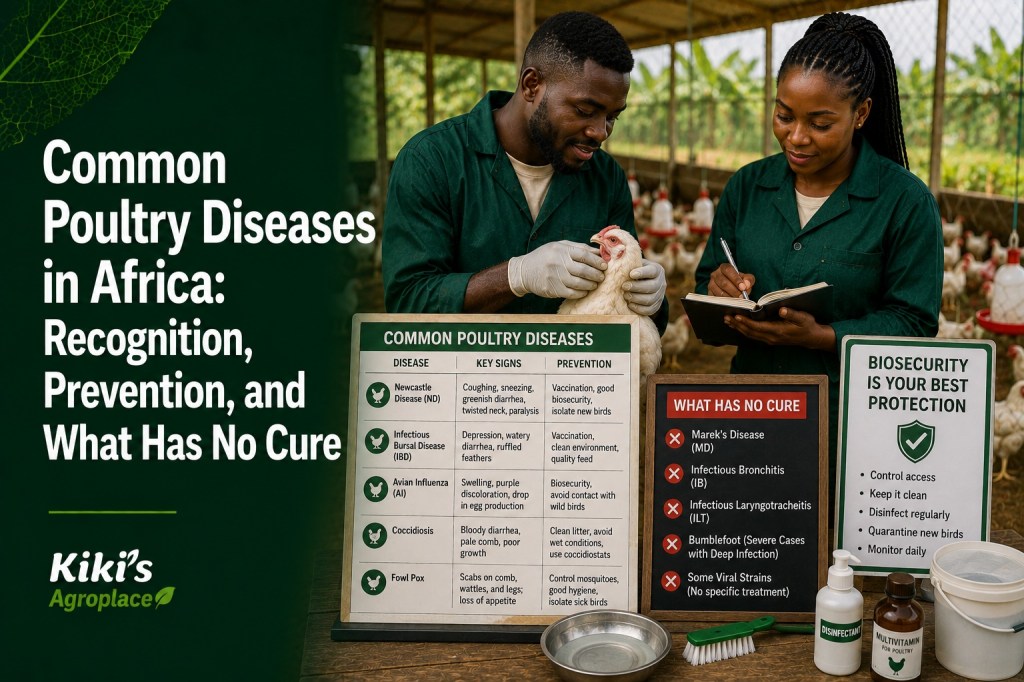
Newcastle disease alone accounts for roughly 80% of infections in rural Kenyan flocks, with unvaccinated birds facing mortality rates as high as 100%. In Nigeria, a decade of veterinary clinic records found Newcastle disease behind nearly a third of all poultry cases seen. Poultry diseases are the single biggest threat to profitability across African poultry farming, but most of them are recognizable and preventable once you know what you’re looking at.
The three types of poultry diseases
Poultry diseases fall into three categories, and knowing which type you’re dealing with changes how you treat and prevent it.
| Type | Caused by | Examples | Treatable? |
|---|---|---|---|
| Viral | Viruses | Newcastle disease, Gumboro (infectious bursal disease), Marek’s disease, fowl pox, avian influenza | No direct treatment; prevention through vaccination is the only real defense |
| Bacterial | Bacteria | Fowl typhoid, fowl cholera, colibacillosis (E. coli), chronic respiratory disease (mycoplasmosis) | Often treatable with antibiotics under veterinary guidance |
| Parasitic | Protozoa, worms, or external parasites | Coccidiosis (protozoal), helminths (worms), lice and mites | Treatable with appropriate antiparasitic medication |
A common point of confusion: coccidiosis and E. coli infections often show up together, but they’re not the same thing. Coccidiosis is caused by a protozoan parasite (Eimeria), while E. coli infection is bacterial. They just happen to affect the same weakened birds at the same time, which is why they’re often mentioned in the same breath.
Newcastle disease: the continent’s number one killer
Newcastle disease is a highly contagious viral infection, and it’s consistently the most devastating poultry disease across African farms. It spreads through the air, contaminated feed, water, and equipment, causing twisted necks, difficulty breathing, greenish diarrhea, and sudden death. In unvaccinated flocks, mortality can reach 100%.
The scale of the problem is well documented in more than one country. A ten-year study of poultry disease cases at a Nigerian veterinary teaching hospital found Newcastle disease responsible for 31.2% of all cases seen. In rural Kenya, Newcastle disease has been found to cause roughly 80% of chicken infections, and it’s considered endemic in the country. There’s genuinely good news here too: routine vaccination has been shown in controlled trials to meaningfully increase flock size in smallholder farms by reducing Newcastle-driven mortality. Vaccination is the single most effective step you can take against this disease.
Marek’s disease: no cure, but preventable
Marek’s disease is a viral tumor disease caused by a herpesvirus, and it has no cure. Once a bird is infected, there’s no treatment, only management. The virus attacks a chicken’s tumor-suppressing genes and antibody-producing cells, weakening the immune system so severely that infected birds become far more vulnerable to secondary problems like coccidiosis and E. coli infection.
The one genuinely reassuring fact: Marek’s disease is not zoonotic. It cannot spread to humans, and eggs and meat from infected birds remain safe to eat. It’s also not typically contagious to other poultry species besides chickens, though rare cases have been reported in quail and turkeys housed close to infected flocks.
While there’s no cure, vaccination is highly effective at preventing the tumors that cause the disease’s worst effects, even though it doesn’t fully stop an infected bird from carrying and shedding the virus. This is why vaccinating day-old chicks against Marek’s is standard practice on well-run commercial farms.
Other diseases to watch for
| Disease | Type | Key signs | Prevention |
|---|---|---|---|
| Gumboro (infectious bursal disease) | Viral | Depression, ruffled feathers, watery diarrhea; hits birds 3-7 weeks old hardest | Vaccination; strict hygiene since the virus survives long in the environment and resists most disinfectants |
| Coccidiosis | Parasitic (protozoal) | Bloody diarrhea, weight loss, huddling; most common in birds under 7 weeks | Dry litter management, coccidiostats in feed, good sanitation |
| Fowl typhoid | Bacterial | Pale comb, diarrhea, high mortality in severe outbreaks | Biosecurity, sourcing chicks from disease-free hatcheries |
| Fowl cholera | Bacterial | Sudden death, swollen wattles, respiratory distress | Good sanitation, rodent control, vaccination in high-risk areas |
| Fowl pox | Viral | Wart-like lesions on unfeathered skin, or lesions in the mouth and throat | Vaccination; mosquito control, since it can spread through insect bites |
For the biosecurity practices that reduce your exposure to all of these diseases, see our guide on biosecurity in poultry farming.
Key takeaways
- Poultry diseases fall into three types: viral (vaccination is the main defense), bacterial (often treatable with antibiotics), and parasitic (treatable with antiparasitics).
- Newcastle disease is consistently the biggest killer across African poultry farms, confirmed independently in both Nigeria (31.2% of clinic cases) and Kenya (80% of rural infections).
- Marek’s disease has no cure, but it’s preventable through vaccination and is not zoonotic, it cannot spread to humans.
- Coccidiosis and E. coli are different types of pathogens (parasitic vs. bacterial) that commonly appear together, especially in birds with weakened immunity.
- Vaccination remains the single most effective tool against the viral diseases responsible for most poultry losses.
FAQ
What are the three types of poultry diseases?
Viral, bacterial, and parasitic. Viral diseases like Newcastle disease and Marek’s disease have no direct treatment and rely on vaccination for prevention. Bacterial diseases like fowl typhoid are often treatable with antibiotics, and parasitic diseases like coccidiosis are treatable with antiparasitic medication.
What is the number one killer of chickens?
Newcastle disease. It’s consistently identified as the most devastating poultry disease across African farms, causing up to 100% mortality in unvaccinated flocks, and accounts for a large share of poultry disease cases in both Nigeria and Kenya.
Which poultry disease has no cure?
Marek’s disease has no cure once a bird is infected. However, vaccination is highly effective at preventing the tumors that cause its worst effects, which is why vaccinating day-old chicks against it is standard practice.
Can humans get Marek’s disease from chickens?
No. Marek’s disease is not zoonotic and cannot spread to humans. Eggs and meat from infected birds remain safe to eat.
Is E. coli the same as coccidiosis in chickens?
No. E. coli infection is bacterial, while coccidiosis is caused by a protozoan parasite. They’re often seen together because both tend to affect birds with weakened immune systems, but they’re different types of pathogens requiring different treatment approaches.
Does baking soda help chicken health?
Adding a small amount of baking soda (sodium bicarbonate), typically 0.1 to 0.5% of feed, has been shown to help chickens manage heat stress, support digestion, and improve eggshell strength in laying hens. It’s not a disease treatment, but it can support overall flock resilience when used in moderation.
Kiki’s Agroplace: Bridging the knowledge gap in agriculture.


Leave a Reply