Expanding a poultry farm sounds straightforward. You have birds in the pen, they are selling well, and you want to grow. So you double your flock, take on more overhead, and wait for bigger profits.
Then the feed bill arrives. A disease outbreak hits. Your main buyer slows their orders. And suddenly, expansion feels like a mistake.
This guide is not just a list of tips. It is a decision-making framework, designed to help you assess whether you are actually ready to expand, understand what the real risks are, and scale your poultry business without the mistakes that turn growth into losses. New to poultry? Start with our guide on choosing the right poultry breed and our broiler feed formulation guide before you plan an expansion.
How Do You Expand a Poultry Farming Business?
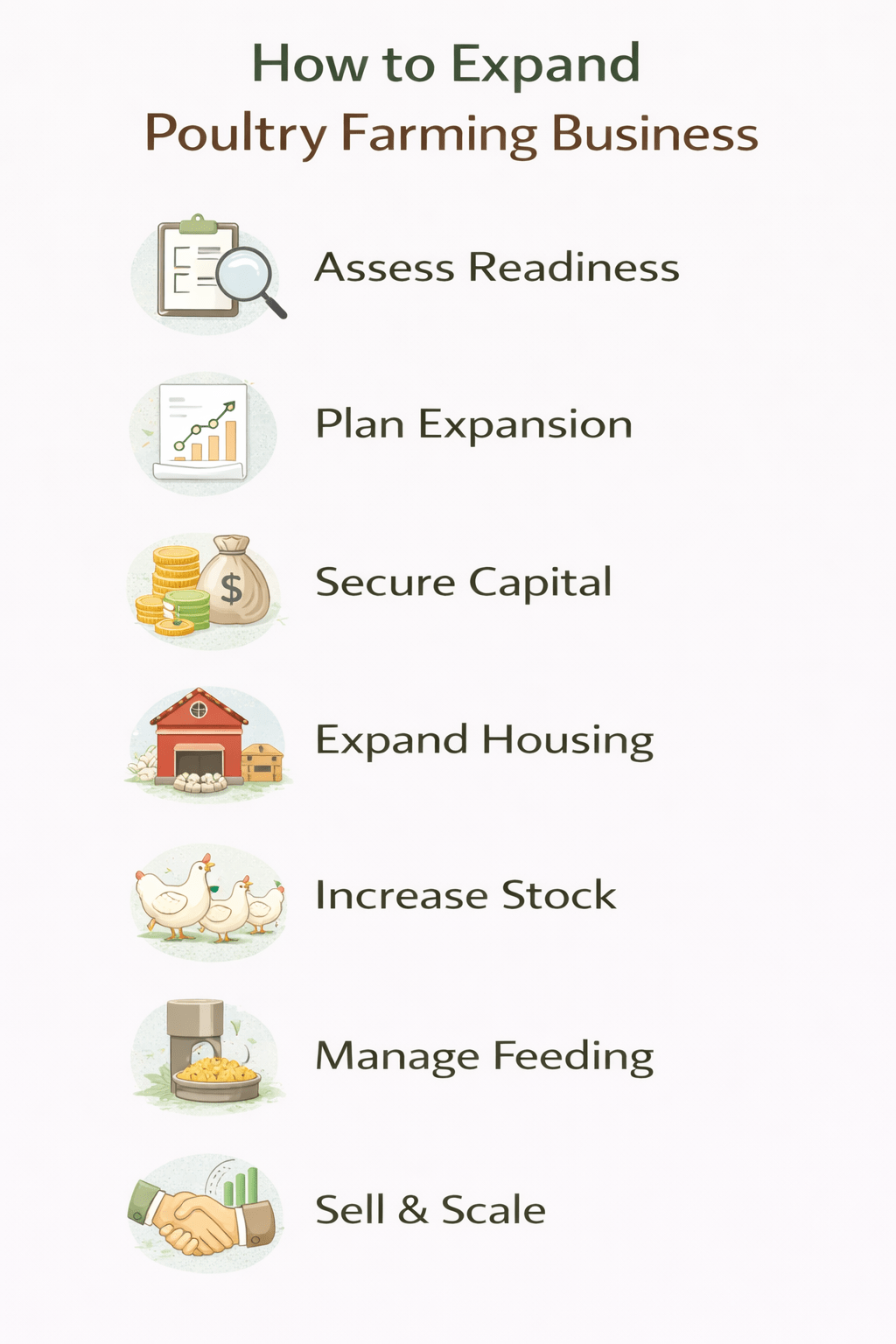
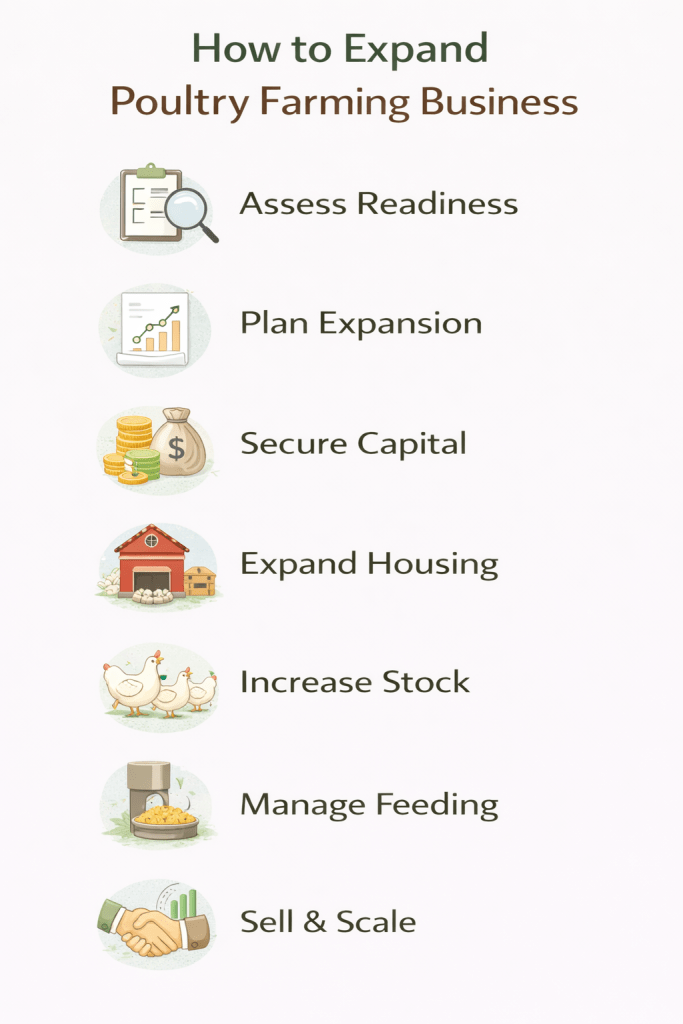
To expand a poultry farming business, confirm you have consistent buyers and stable cash flow before adding birds. Assess your housing capacity, feed supply chain, labour, and biosecurity systems. Expand in stages; not all at once. Understand your current cost per bird produced, then project how that changes at scale. Plan your sales channel before you increase production.
When Should You Expand Your Poultry Farm?
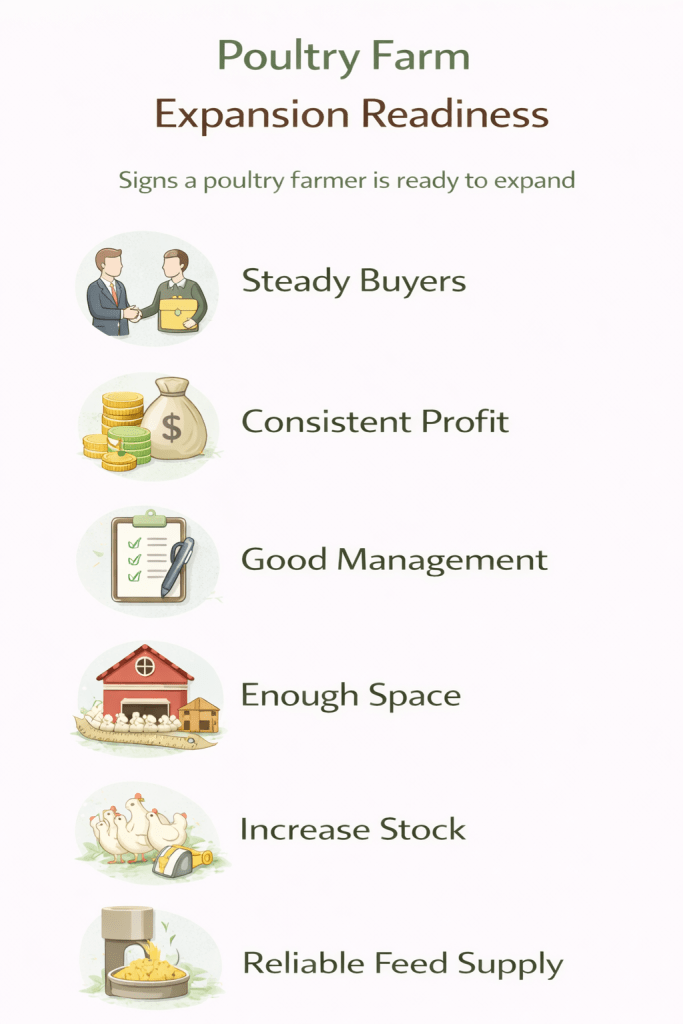
Expand your poultry farm when three conditions are consistently true: you have more buyer demand than your current production can fill, your cash flow covers at least two to three months of operating costs without income, and you can manage your current flock reliably without daily crises. Expanding before these conditions are met turns a growth decision into a risk.
Here is what each condition actually means in practice:
Consistent, proven buyer demand. You should be turning away orders, not just expecting that buyers will appear when you produce more. If you currently sell everything you grow with ease, and buyers are asking for more than you can supply, that is a signal worth acting on. If you are currently selling 70–80% of your production and holding the rest, scaling production will make that unsold portion larger.
Stable cash flow. Poultry farming has a gap between when you spend money (day-old chicks, feed, medications) and when you receive it (at sale, 6–8 weeks later for broilers). At small scale this gap is manageable. At larger scale, it becomes a cash flow problem if you have not planned for it. Expanding while your cash flow is already tight is the most common reason farms fail during growth.
Operational control. If your current operation requires constant crisis management; disease problems, feed shortages, inconsistent mortality rates, unreliable labour, scaling will multiply those problems, not fix them. Expansion works best when you are scaling something that already runs well.
Why Many Poultry Farm Expansions Fail
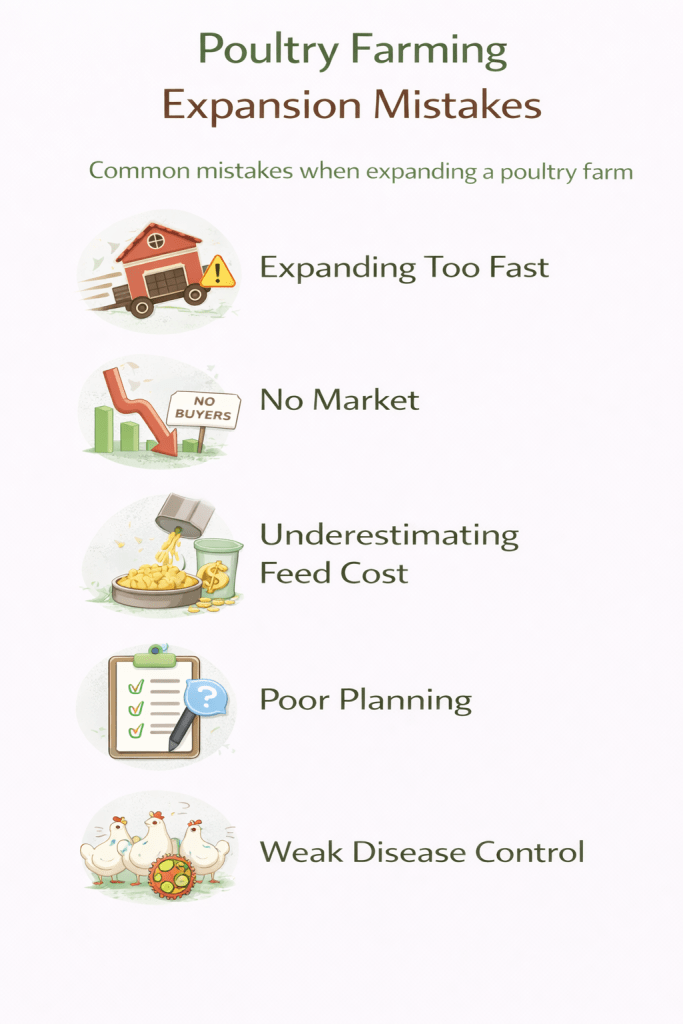
The honest reason most small-scale poultry farm expansions in Nigeria underperform or fail is not bad luck. It is one of three predictable problems:
Poor planning. Adding birds without calculating the full cost increase; including feed for an additional 6–8 weeks, additional labour, additional medications, and the additional housing cost, means running out of money before the first expanded batch reaches market.
Underestimating cost. Feed accounts for 60–70% of broiler production cost. Doubling your flock does not just double your feed bill, it also amplifies every management mistake. One feeding error affects twice as many birds. One disease exposure spreads through twice the population.
No confirmed market for the increased output. Producing 1,000 birds per batch is very different from selling 1,000 birds per batch. The production side can be planned precisely. The sales side depends on relationships, timing, and market access that take time to build. Many farmers grow their production faster than they grow their market.
10 Important Things to Consider Before Expanding Your Poultry Farming Business
1. Market Demand
What it is: The actual, verified buying capacity of your target market for the volume you plan to produce.
Why it matters: Every additional bird you grow needs a buyer. Unsold birds sitting past market weight continue eating feed without generating revenue. They also lose value; a broiler held past 6–8 weeks gains minimal additional weight but consumes significant additional feed.
What goes wrong if ignored: You produce 1,000 birds per batch but your buyers can only absorb 600. You sell 600 at full price and 400 at a discount to clear stock. Your margin collapses.
What to do: Before expanding, confirm actual orders from at least two buyer categories, for example, one restaurant and one market seller or household buyer base. Pre-selling or taking pre-orders before scaling is the most reliable protection against this problem.
2. Feed Cost and Supply
What it is: Your ability to source sufficient feed at a reliable price for a larger flock throughout the full production cycle.
Why it matters: Feed is 60–70% of your total production cost. At larger scale, a disruption in your feed supply or a spike in feed prices mid-cycle has a significantly larger impact on your bottom line than it did when you were operating small.
What goes wrong if ignored: Your feed supplier runs out of stock or raises prices during the cycle. You scramble to find alternatives, accept a higher price under pressure, and your margin shrinks or disappears entirely.
What to do: Before expanding, secure a reliable feed supply agreement with at least one primary and one backup supplier. Understand the market price of feed per 25kg bag in your area across different seasons. Buy in bulk during low-price periods if you have storage capacity. Track your feed conversion ratio (FCR) at current scale, if it is already high (meaning poor conversion), fix it before you expand, because the same inefficiency costs much more at larger scale. Our broiler feed formulation guide covers how to build a cost-effective ration from local ingredients.
3. Housing and Space
What it is: The physical infrastructure needed to house more birds at the right stocking density.
Why it matters: Overcrowding is one of the most direct causes of poor performance and disease in poultry. Overcrowded birds are stressed, which suppresses their immune systems, reduces feed conversion efficiency, and creates the conditions for disease to spread rapidly through the flock.
What goes wrong if ignored: You add 500 more birds to a pen built for 300. Mortality rises. Feed conversion worsens. A respiratory disease moves through the entire flock at once.
What to do: Calculate your current stocking density. Standard recommended density for broilers is approximately 30–35kg of live weight per square metre of floor space roughly 10–12 birds per square metre at harvest weight. Before adding birds, either expand your housing first or stagger your batch cycles to maintain correct density.
4. Capital and Cash Flow
What it is: The actual money available to fund an expansion, including all costs from day-old chick purchase through to the first sale of the expanded batch.
Why it matters: Expansion requires upfront capital that will not return for 6–10 weeks. If your cash flow is already stretched at current scale, adding more birds adds more financial pressure without adding immediate revenue.
What goes wrong if ignored: You spend your working capital on day-old chicks and run short on feed funds in week four. You underfeed a portion of your flock trying to stretch the budget. Growth slows. You sell underweight birds at a lower price per kg.
What to do: Before expanding, calculate your full cost for the additional batch from day one to sale day. Ensure you have that amount available as working capital, separate from your current operational funds.
5. Labour and Management
What it is: The human capacity to manage a larger operation effectively on a daily basis.
Why it matters: Poultry management requires consistent daily attention; feeding, water checks, health observation, mortality removal, litter management, and ventilation control. What one person can manage well at 500 birds may require two people at 2,000 birds.
What goes wrong if ignored: You add birds without adding management capacity. Daily tasks are rushed or skipped. Small health problems are not caught early. Mortality rises. Performance drops.
What to do: Honestly assess whether your current labour can handle the additional workload. If not, factor in the cost of hiring before you calculate your expected profit margin. A hired worker who reduces your mortality rate by 5% can pay for themselves many times over.
6. Disease Control
What it is: Your biosecurity systems and health management protocols at the scale you are planning to operate.
Why it matters: Disease risk does not just grow proportionally with flock size, it amplifies. A larger flock provides more opportunities for pathogens to spread, more stress factors that suppress immunity, and higher economic losses when an outbreak occurs.
What goes wrong if ignored: Newcastle disease, infectious bronchitis, or Gumboro hits a flock of 2,000 birds with inadequate biosecurity. A 20% mortality at that scale is 400 birds, compared to 100 birds at current scale. The loss is four times larger from the same proportional incident.
What to do: Before expanding, review and strengthen your biosecurity protocols. This includes: all-in-all-out stocking (not mixing birds of different ages), strict visitor access control, proper disposal of dead birds, clean footwear protocols for entering the pen, and a comprehensive vaccination schedule confirmed with a vet for your specific area and the diseases common in your region. See our guide on common poultry diseases and our poultry biosecurity guide for the full protocols.
7. Water and Power Supply
What it is: The reliability of your water supply and electricity for the larger operation.
Why it matters: Poultry are highly sensitive to water deprivation. Broilers deprived of water for even a few hours during hot weather experience severe stress, reduced feed intake, and can die. Power failures affect ventilation and lighting, which directly impacts growth performance and mortality.
What goes wrong if ignored: Your borehole breaks down during a hot week. Your generator fails during a power outage. You lose birds to heat stress or dehydration before you can resolve the problem.
What to do: Before expanding, assess whether your water and power infrastructure can reliably serve the larger flock. Budget for backup systems; a generator, a water storage tank, or a backup borehole pump, as part of your expansion cost, not as an afterthought.
8. Record Keeping
What it is: Systematic tracking of your farm’s inputs, outputs, and performance metrics at every production cycle.
Why it matters: Without records, you cannot calculate your actual cost per bird produced, your actual FCR, your true mortality rate, or your real profit per batch. Farmers who do not keep records consistently overestimate their margins and underestimate their problems, especially as scale increases.
What goes wrong if ignored: You expand based on a rough estimate that “this batch was profitable” without knowing exactly how profitable or why. At larger scale, the same vagueness means larger errors and harder-to-diagnose problems.
What to do: Keep a simple farm notebook or spreadsheet tracking, at minimum: number of birds stocked, feed quantities and costs per week, mortality count and cause where identifiable, medication costs, harvest weight, selling price per kg, and total revenue per batch. Review these numbers before every expansion decision.
9. Marketing and Sales Strategy
What it is: A clear, pre-existing plan for how you will sell the additional volume you intend to produce.
Why it matters: Producing birds and selling birds are two different skills. At small scale, informal word-of-mouth and spot sales may work. At larger scale, you need confirmed channels, agreed pricing, and a distribution system that can handle higher volume without last-minute scrambling.
What goes wrong if ignored: You produce 1,500 birds. Your usual informal buyers take 600. You have 900 birds to move urgently. You sell to a middleman at a heavily discounted price. Your margin disappears.
What to do: Before expanding, map out exactly how the additional volume will be sold by channel, by approximate volume per channel, and at what price. Then contact those buyers and confirm interest before you stock the expanded batch. This is the same advance-marketing principle that applies across all livestock businesses.
10. Risk Management
What it is: Identifying the specific risks your expanded operation faces and having a concrete plan for each one.
Why it matters: At small scale, a disease outbreak, a feed price spike, or a buyer cancelling an order is a setback. At larger scale, the same event is a serious financial crisis. Scaling up without scaling your risk management is one of the most common causes of farm failure.
What goes wrong if ignored: An unexpected event; Newcastle outbreak, 40% feed price increase, your main buyer reducing orders, hits your expanded farm with no backup plan. You cannot absorb the loss.
What to do: Before expanding, identify your top three risks and write down what you will do if each one happens. This could include: livestock insurance coverage (increasingly available in Nigeria through NIRSAL and agricultural insurance providers), a feed reserve that can cover 2–3 weeks at expanded volume, and a secondary buyer list for emergency stock clearance.
Are You Ready to Expand Your Poultry Farm? (Checklist)
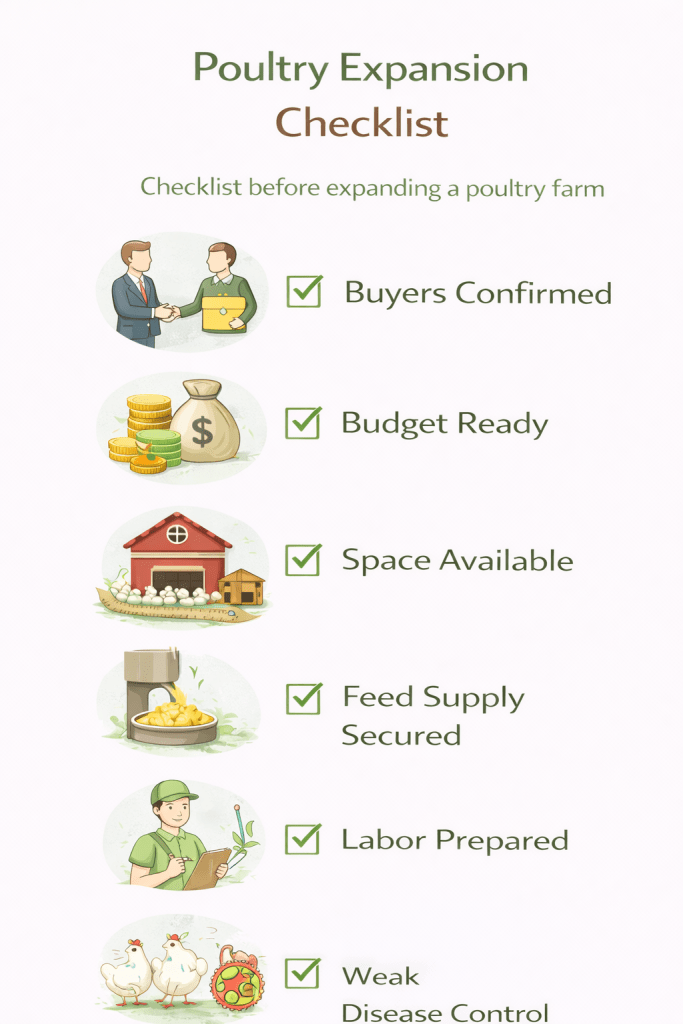
Use this before you make any expansion decision.
- Do you have confirmed buyers for the additional birds you plan to produce?
- Can you afford full feed costs for 2–3 months without income from the new batch?
- Is your housing adequate for the new stocking density without overcrowding?
- Do you have reliable water and power for a larger flock?
- Is your current mortality rate under control and consistently below 5%?
- Do you have labour capacity to manage more birds without cutting corners?
- Is your FCR (feed conversion ratio) at an acceptable level at current scale?
- Do you have a backup plan if your main buyer reduces or cancels orders?
- Have you kept records from at least two previous batches that show you are actually profitable?
- Are you expanding because demand is pulling you forward or because you are hoping bigger scale will fix a profitability problem?
If you answered no to three or more of these, your expansion plan needs work before it is funded.
What Happens When You Expand Too Fast
Here is a scenario that plays out regularly among small-scale Nigerian poultry farmers:
A farmer runs 300 broilers per batch from a backyard operation in Ogun State. Two batches go well. The birds sell quickly. He decides to scale to 1,500 birds for his third batch.
He builds a second pen quickly at a lower standard than his first, stocks 1,500 day-old chicks, and starts the cycle. Weeks two and three go smoothly.
Then feed prices rise 25% mid-cycle. He budgeted based on the previous price. He does not have enough working capital to cover the increase for 1,500 birds. He reduces feed rations slightly in weeks five and six to manage costs.
The birds are underweight at harvest. His usual buyers pay per kilogram. He receives less per bird than he expected. Meanwhile, he cannot sell all 1,500 birds in one week, his buyer network only absorbs about 600 birds at his normal price. He sells the remaining 900 to a middleman at ₦200–₦300 below his target price.
The batch makes a small technical profit. But when he calculates the full costs, including the second pen construction, he has actually lost ground compared to running two smaller batches at his proven scale.
The birds were fine. The farming was competent. The expansion plan was not.
Conclusion
Expanding a poultry farm is not a shortcut to higher income, it is a multiplication of everything your current operation is already doing. If your current operation is profitable, well-managed, and demand-driven, expansion can significantly increase your earnings. If it has unsolved problems, expansion will make those problems more expensive.
Use the checklist in this guide before you commit capital. Fix what is broken at current scale first. Expand in stages. Build your buyer base before you build your flock.


Leave a Reply