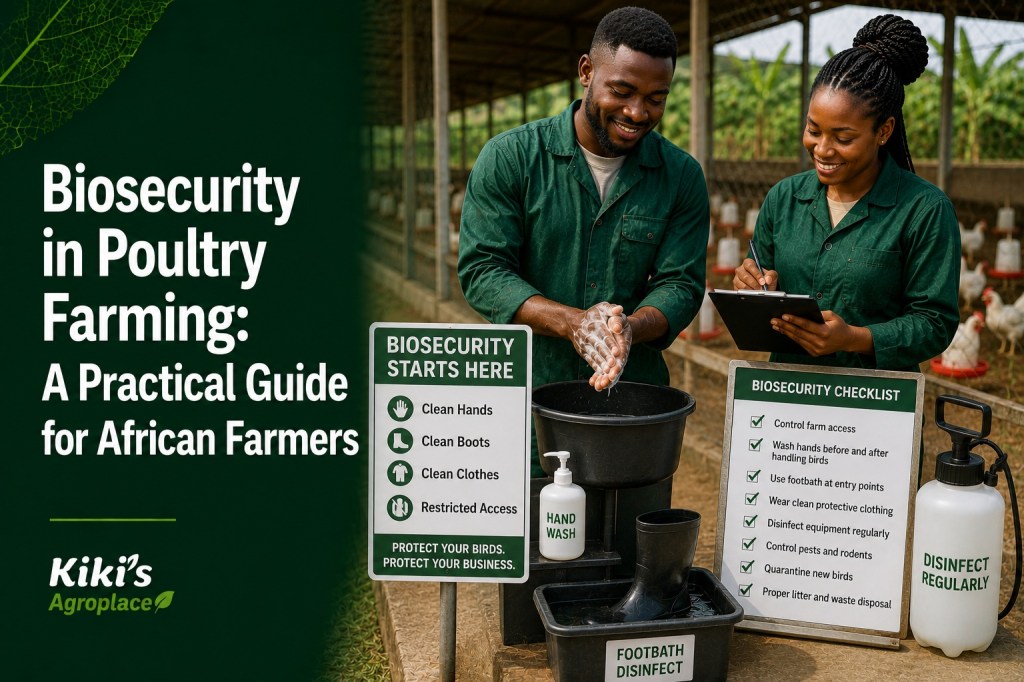
Nigeria recorded Africa’s first highly pathogenic avian influenza outbreak in January 2006, and South Africa lost 6.82 million birds, roughly 20% of its entire egg-laying flock, to a single 2023 outbreak. Biosecurity in poultry farming is the actual defense against this, not luck, and not distance from other farms alone. Here’s how to build it properly, using a framework recognized across the poultry industry worldwide, with examples of what’s at stake from two of the continent’s largest poultry-producing countries.
Broiler Vs Layer Farming: which one makes more money.
Why this matters right now
Nigeria: The country’s first HPAI (Highly Pathogenic Avian Influenza) outbreak destroyed over 46,000 birds at a commercial farm in Kaduna State, and by mid-January 2007, Nigeria had lost nearly 946,000 birds nationwide. The disease has returned in waves since, with fresh outbreaks confirmed across Kano, Plateau, and the Federal Capital Territory as recently as 2025. Survey data shows roughly 40% of poultry owners in Nigeria are still unaware of avian flu, with even less understanding of how it spreads or how to prevent it. Live bird markets have been identified as a major reservoir for spreading the disease between farms, since they concentrate birds from multiple sources with limited biosecurity oversight.
How to expand your poultry farming business.
South Africa: In 2023, South Africa faced two separate HPAI (highly pathogenic Avian Influenza) crises at once. An H7N6 strain, the first of its kind ever detected on the African continent, emerged near Delmas in Mpumalanga Province, likely starting in a smallholder flock before spreading to commercial farms. By the time it was contained, 6.82 million birds had died or been culled, about 20% of the country’s egg-laying flock and nearly 30% of its broiler breeder flock. A separate H5N1 outbreak that same year caused 29 more poultry outbreaks across six provinces. A new H5N1 outbreak was detected again in June 2025 in Mpumalanga. South Africa’s official response follows a strict stamp-out policy: any infected flock is destroyed entirely and the housing sterilized at significant cost to the farmer, which makes prevention far cheaper than the alternative.
This isn’t a distant, theoretical risk in either country. It’s an active, recurring threat to African poultry farms, and biosecurity is the single most effective tool you have against it.
How to hire the best workers for your farm.
The three levels of biosecurity
Poultry biosecurity is built on three recognized levels, and this framework applies regardless of which country you’re farming in. Understanding the difference helps you know where to focus your limited time and budget.
| Level | What it covers | Examples |
|---|---|---|
| Conceptual | Where and how your farm is planned and located | Choosing a site away from other poultry operations and major roads used to transport birds; keeping distance between brooder and layer housing |
| Structural | The physical features built into your farm | Perimeter fencing, water source testing, safe feed storage separated from bird housing, facilities for proper disposal of dead birds |
| Operational (procedural) | The daily practices and routines your farm follows | Footbaths, visitor logs, disinfecting vehicles and equipment, changing into farm-specific clothing, controlling access to essential personnel only |
Most established biosecurity programs describe these three levels as working together, and also point to three guiding principles that run through all of them: isolation, traffic control, and sanitation. If you’re building a program from scratch, use those three principles as a quick mental checklist, am I isolating my birds enough, controlling who and what moves in and out, and keeping things clean, before diving into the detailed measures below.
Practical measures for your farm
- Restrict farm access. Only essential personnel and authorized visitors should enter, and every visit should be logged.
- Use footbaths and provide farm-specific clothing. Disinfect footwear at every entrance, and don’t let outside clothing or shoes into bird housing areas.
- Disinfect vehicles and equipment before entry. Anything coming onto the farm from outside is a potential carrier.
- Control rodents and wild birds. These are common routes for introducing disease into an otherwise well-managed flock; South Africa’s 2023 and 2025 outbreaks were both linked to wild bird movement patterns.
- Dispose of dead birds properly. Bury dead birds in deep ditches well away from the flock, or use another safe, scientific disposal method. In one Nigerian survey, 97% of smallholder commercial farmers practiced this, compared to very few backyard flock keepers, a gap worth closing if you’re running a smaller operation.
- Test your water source periodically. Check for bacteria, minerals, and pathogen load, since water is often overlooked as a disease pathway.
- Limit contact with live bird markets. If you must source or sell through them, minimize direct contact between your farm equipment, clothing, and vehicles and the market environment.
- Keep multi-age flocks separated. Mixing different ages and species of birds on the same site raises disease risk considerably, one of the key risk factors identified in Nigerian biosecurity surveys.
- Vaccinate and monitor for disease consistently. Don’t rely on visual inspection alone; work with a veterinarian on a monitoring schedule appropriate for your flock and your country’s regulations.
For breed and feeding guidance to pair with your biosecurity plan, see our guides on best poultry breeds for Nigerian farmers and poultry feed formulation for layers.
Key takeaways
- Nigeria has faced recurring avian influenza outbreaks since 2006; South Africa lost 6.82 million birds, about 20% of its egg-laying flock, to a single 2023 outbreak, with another detected in 2025.
- Biosecurity operates on three levels: conceptual (site planning), structural (physical farm features), and operational (daily practices), this framework applies regardless of country.
- Isolation, traffic control, and sanitation are the three guiding principles that cut across all three levels.
- Live bird markets are a documented major risk factor for spreading disease between farms; limit direct contact where possible.
- South Africa’s stamp-out policy destroys entire infected flocks at the farmer’s cost, making prevention dramatically cheaper than an outbreak.
FAQ
What are the three types of biosecurity?
Conceptual biosecurity covers farm location and layout, structural biosecurity covers physical features like fencing and waste disposal facilities, and operational (or procedural) biosecurity covers daily practices like disinfection, visitor control, and vaccination. This framework is used internationally, not specific to any one country.
What are some basic biosecurity measures for a poultry farm?
Restricting access to essential personnel, using footbaths and farm-specific clothing, disinfecting vehicles and equipment, controlling rodents and wild birds, and properly disposing of dead birds are all foundational measures every poultry farm should have in place.
Why is biosecurity important in poultry production?
Biosecurity is what prevents disease outbreaks like avian influenza from entering or spreading through your flock. Both Nigeria and South Africa have lost large numbers of birds to HPAI outbreaks in recent years, and weak biosecurity practices have been directly linked to how fast the disease spreads once it reaches a farm.
Are live bird markets a biosecurity risk?
Yes. Live bird markets concentrate birds from multiple sources with limited biosecurity oversight, and have been identified as a major reservoir for spreading avian influenza to commercial poultry farms, particularly documented in Nigeria.
What happens if avian influenza is confirmed on a farm in South Africa?
South Africa follows a stamp-out policy: the entire infected flock is destroyed and the housing is cleaned and sterilized, all at significant cost to the farmer. This is a major reason prevention through strong biosecurity is far cheaper than dealing with an actual outbreak.
Do small or backyard poultry farms need biosecurity too?
Yes, and surveys show this is where gaps are widest. Practices like proper dead-bird disposal and regular disinfection are far less common among backyard flock keepers than commercial farmers, which makes smaller operations a real weak point in overall disease control. South Africa’s 2023 H7N6 outbreak is believed to have started in a smallholder flock before reaching commercial farms.
Kiki’s Agroplace: Bridging the knowledge gap in agriculture.


Leave a Reply