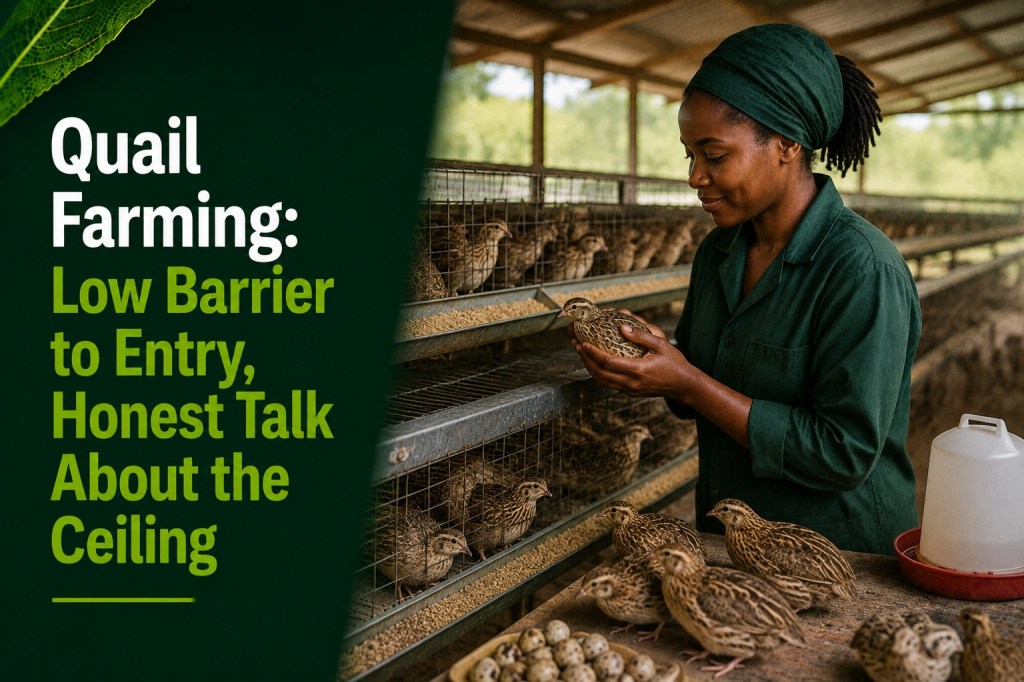
Twenty quails fit comfortably in the cage space two chickens would need, and one report cites a working small-scale start-up budget as low as ₦18,000, covering 6 males and 24 females. Quail farming lowers the barrier to entry that keeps a lot of people out of poultry altogether. What’s worth knowing upfront, though, is that research on Nigeria’s quail sector found small-scale farmers earning less per unit invested than large-scale producers, for reasons that have more to do with policy and market access than the birds themselves.
Why quail fits small spaces and small budgets
- Space efficiency: You can comfortably rear around 20 quails in the same cage space that would tightly fit just 2 chickens, making quail viable for backyard and urban farming where land is limited.
- Fast maturity: Quails reach sexual maturity and begin laying at around 6 weeks, compared to layer chickens, which can take up to 5 months to start laying. This is one of the fastest returns to production of any poultry species.
- Strong egg output: A female quail can lay an egg daily, adding up to roughly 250 to 300 eggs a year depending on the study and management conditions.
- Low feed consumption: Quails eat considerably less than chickens per bird, which keeps ongoing feed costs down even as flock size grows.
Breeds worth knowing
- Coturnix quail: The dominant commercial choice, valued for rapid growth, high egg production, and a larger body size than other quail breeds. If you’re farming for eggs or meat commercially, this is almost certainly your starting breed.
- Button quail: Smaller and primarily kept for ornamental purposes, though its eggs and meat still carry some market demand. A niche option rather than a commercial default.
Basic setup: housing and incubation
- Housing: Battery cages are the standard housing method across most commercial quail operations, kept in a well-ventilated space with controlled temperature and humidity.
- Incubation matters more than with chicken. Quails don’t reliably incubate their own eggs, so you’ll need an incubator set to 37.5 to 38°C with 60 to 70% humidity, hatching eggs over 16 to 18 days with regular turning.
- Brooding newly hatched chicks: Chicks need a warm, secure brooder environment, with a heat source maintaining 35 to 37°C for the first week.
- Disease management: Quails are generally hardy and more disease-resistant than many other poultry species, but they’re still susceptible to respiratory infections and coccidiosis. A clean environment and balanced diet remain the frontline defence.
The feeding mistake almost everyone makes
A study of quail farmers in Southwest Nigeria found that 100% of surveyed farmers were feeding their quails feed formulated for laying hens or broilers, rather than a ration formulated specifically for quail nutritional needs. Quail have different protein and nutrient requirements than chicken, and feeding a chicken-formulated ration isn’t optimal, even though the birds tolerate it well enough to survive and produce. If you can source or formulate quail-specific feed, it’s a genuine, currently underused opportunity to improve on what most of the market is already doing.
The profitability picture
This is the part most quail farming content skips. Research on Nigeria’s quail sector found small-scale farmers achieving a benefit-cost ratio of 1.09, compared to 1.24 for large-scale producers; both profitable, but the gap is real and worth understanding before you scale your expectations.
- Policy exclusion is a documented issue. The same research describes quail farming as socially profitable but privately constrained, citing exclusion from national agricultural policy support that larger livestock sectors receive.
- Credit access is uneven. Farmers report limited access to formal credit, with gender disparities in loan access specifically flagged as a persistent problem.
- Middlemen capture value. Farmers describe frustration with exploitative middlemen in the sales chain, a pattern that reduces the share of final sale value reaching the actual producer.
- Rising feed costs squeeze margins. As with most poultry farming, feed cost increases directly affect profitability, and quail’s lower per-bird feed need doesn’t fully insulate a farm from broader feed price inflation.
None of this means quail farming isn’t worth doing; the same research still finds it profitable at both scales. It does mean going in with realistic expectations about market access and support structures, rather than assuming the low startup cost translates directly into effortless returns.
Mistakes that cost quail farmers the most
- Feeding a chicken ration by default. Nearly every surveyed farmer does this; sourcing or formulating quail-specific feed is a genuine point of differentiation.
- Assuming quails will incubate their own eggs. They generally don’t reliably do this; budget for an incubator from the start rather than discovering the gap after your first breeding attempt.
- Selling only through middlemen. Documented frustration with exploitative middlemen suggests direct sales relationships, where you can build them, capture more value than relying entirely on intermediaries.
- Expecting large-scale returns from a small-scale operation. The profitability gap between scales is real; plan your growth path deliberately rather than assuming small-scale quail farming matches large-scale margins.
Key takeaways
- Quail farming offers a low barrier to entry: minimal space, low feed costs, and a 6-week path to egg production.
- Coturnix is the standard commercial breed; Button quail serves a smaller ornamental niche.
- Nearly all surveyed farmers feed quails a chicken-formulated ration rather than quail-specific feed, a widespread gap worth addressing on your own farm.
- Small-scale quail farming is profitable but shows a real benefit-cost ratio gap compared to large-scale operations, driven by policy exclusion, credit access, and middlemen rather than the birds themselves.
- Realistic expectations about scale and market access matter as much as good bird husbandry for actual profitability.
FAQ
How much space do quails need compared to chickens?
You can comfortably rear around 20 quails in the cage space that would tightly fit just 2 chickens, making quail farming a realistic option for small backyard or urban spaces.
How long does it take for quails to start laying eggs?
Quails typically reach sexual maturity and begin laying around 6 weeks of age, compared to up to 5 months for layer chickens, giving you a much faster return to production.
Do quails need an incubator to hatch eggs?
Generally, yes. Quails don’t reliably incubate their own eggs, so a proper incubator set to 37.5 to 38°C with 60 to 70% humidity is needed to hatch eggs successfully over 16 to 18 days.
Is quail farming actually profitable in Nigeria?
Research shows it’s profitable at both small and large scale, though small-scale farmers achieve a lower benefit-cost ratio (1.09) than large-scale producers (1.24). This gap is linked to policy exclusion, limited credit access, and exploitative middlemen rather than the birds themselves being unprofitable.
What feed should I give my quails?
Quail-specific feed, formulated for their particular protein and nutrient needs, is ideal, though research found that nearly all surveyed Nigerian quail farmers were instead using feed formulated for laying hens or broilers. Sourcing or formulating a proper quail ration is a genuine opportunity to improve on common practice.
Kiki’s Agroplace: Bridging the knowledge gap in agriculture.


Leave a Reply