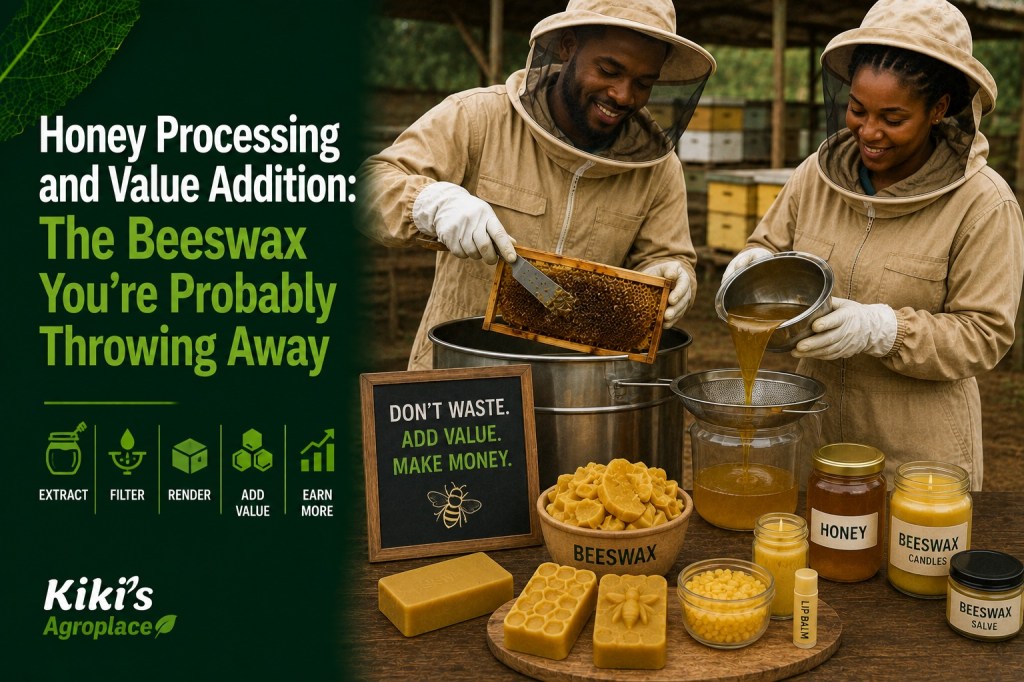
Beeswax fetches more money per kilogram than honey does. And yet across African honey houses, it’s routinely scraped off and thrown away as waste. Honey processing and value addition starts with getting the honey itself right, but the actual missed income often sits in what beekeepers discard afterward.
Start with the beekeeping setup guide if you’re just getting going.
Extraction: the method you choose affects the honey you get to sell
A survey of honey handling practices in Uganda tested the common extraction methods smallholders use, pressing, boiling, and straining, against measured quality parameters. The honey press came out ahead. Boiling, while common and simple, degrades honey quality by raising HMF (a heat-damage marker explained below) and destroying the natural enzymes that indicate freshness.
- Pressing: Comb is crushed or pressed to release honey, then strained to remove wax and debris. Works without electricity and preserves honey quality better than heating.
- Centrifuge extraction: Frames are spun in an extractor, pulling honey out while leaving the comb structure largely intact for reuse. Faster at scale, but needs equipment investment.
- Boiling: Avoid this where possible. It’s the fastest method for someone without a press or extractor, but it noticeably damages honey quality and can push your product outside export-grade standards.
The honey quality standard most farmers have never heard of
If you’re selling into a formal or export market, one number matters more than most beekeepers realise: HMF (hydroxymethylfurfural), a compound that forms as honey is heated or ages. High HMF signals overheated, poorly stored, or old honey.
Here’s the detail that trips up a lot of African producers: the international Codex Alimentarius standard sets a general HMF limit of 40mg per kilogram, but recognises that honey from countries with tropical ambient temperatures naturally develops HMF faster, and allows a limit of 80mg per kilogram for honey of declared tropical origin. If a buyer is holding you to the 40mg limit without accounting for this exception, that’s worth raising, since it’s the internationally recognised standard for exactly your situation.
- Keep HMF low regardless: Avoid boiling, minimise heat exposure during extraction, and store honey away from direct sun and high ambient heat.
- Moisture content: Honey should generally sit below 20% moisture. Harvesting immature honey (capped too early) pushes moisture too high and increases the risk of fermentation.
- Contamination: The same Ugandan study found contamination by extraneous material, wax fragments, dead bees, debris, was a common quality problem, almost always tied to basic straining and filtering steps being skipped or rushed.
Beeswax: the second product hiding in your honey house waste
Beeswax genuinely fetches more per kilogram than honey on international markets, split between cosmetics, pharmaceuticals, and candle-making, and it’s described by industry analysts as the most under-exploited near-term opportunity in African apiculture. There’s a reason African beekeepers are well placed here too: because most colonies aren’t treated with chemical acaricides (a point covered in our bee health and pests guide), the resulting wax is naturally closer to the residue-free, organic-grade product that’s genuinely scarce on world markets.
- Basic rendering: Melt cappings and comb scraps in water, strain out debris while still liquid, then let it cool and solidify into blocks.
- Checking for purity: Pure beeswax has a good aroma and shows a grainy surface when broken. If it feels greasy or overly transparent, it may be mixed with paraffin or another adulterant, something international buyers actively screen for.
- Where the demand is: Cosmetics, pharmaceuticals, and candle-making all draw on beeswax; roughly a fifth of global beeswax trade goes into candle-making alone.
- Don’t overheat it: Overheated beeswax loses quality just like overheated honey does. Melt gently and avoid prolonged high heat.
Propolis, pollen, and the higher-skill products
Beyond honey and wax, a small tier of bee products climbs steeply in value but demands technical skill and, in some cases, cold storage:
- Propolis: The resin bees use to seal and protect the hive. Requires clean collection methods and careful storage, but already sells in urban East African markets as tinctures and supplements.
- Pollen: Collected using pollen traps at the hive entrance. Needs careful drying and storage to avoid mold, but has a growing supplement market.
- Royal jelly: The most technically demanding of the group. It’s secreted only for queen larvae, so harvesting requires active queen-rearing management, and the product needs refrigeration almost immediately after collection. Not a starting point for a new beekeeper, but worth knowing about as you scale.
These aren’t theoretical markets. Kenyan firms are already turning honey, wax, propolis, and pollen into KEBS-certified retail products, and even bee venom now has a formal marketplace in Kenya, trading at prices that make it, gram for gram, the most valuable product to come out of a hive; though it sits firmly in advanced, specialist territory rather than a next step for most farmers.
Mistakes that cost you at the processing stage
- Boiling honey out of habit. It’s fast, but it measurably damages quality and can push honey outside the standards that formal buyers check for.
- Throwing away cappings and comb scraps. This is beeswax, and it’s worth rendering and selling rather than discarding as waste.
- Harvesting honey too early. Uncapped or immature honey carries excess moisture, raising the risk of fermentation and spoilage before it even reaches a buyer.
- Skipping straining and filtering. Contamination from debris and wax fragments is one of the most common, and most avoidable, quality problems documented in African honey handling studies.
- Accepting a buyer’s quality standard without checking it. If you’re being held to a 40mg/kg HMF limit as a tropical producer, the internationally recognised standard allows for 80mg/kg; know the actual rule before assuming your honey has failed.
Key takeaways
- Pressing preserves honey quality better than boiling; boiling raises HMF and can push honey outside export standards.
- Codex allows an 80mg/kg HMF limit for tropical-origin honey, double the standard 40mg/kg limit; know this before assuming a rejected batch is genuinely poor quality.
- Beeswax fetches more per kilogram than honey and is routinely discarded; rendering and selling it is close to free money for most beekeepers.
- Low chemical treatment use in African beekeeping is a genuine advantage for supplying organic-grade beeswax to a market that’s short on it.
- Propolis, pollen, and royal jelly offer real income potential but need more technical skill and, for royal jelly, cold storage most smallholders don’t yet have.
FAQ
What is the best way to extract honey without electricity?
A honey press, which crushes comb to release honey before straining, works well without power and preserves quality better than boiling, which was found to be the most quality-damaging common method in a Ugandan study of smallholder practices.
What is HMF and why does it matter for selling honey?
HMF (hydroxymethylfurfural) is a compound that increases as honey is heated or ages, and it’s used internationally as a freshness and quality marker. Standard limits sit at 40mg/kg, but Codex allows 80mg/kg for honey of declared tropical origin, recognising that heat naturally raises HMF faster in tropical climates.
How can I tell if beeswax has been adulterated?
Pure beeswax shows a grainy surface when broken and has a distinct natural aroma. If it feels greasy, looks unusually transparent, or lacks the typical smell, it may be mixed with paraffin or another additive, something international buyers routinely test for.
Is beeswax really worth more than honey?
Per kilogram, yes, beeswax generally commands a higher price than honey, split across cosmetics, pharmaceuticals, and candle-making demand. It’s widely considered one of the most under-exploited income sources in African beekeeping, since it’s often discarded rather than rendered and sold.
What bee products can a beginner realistically process and sell?
Honey and beeswax are the realistic starting point for most beekeepers; both need relatively simple equipment and processing knowledge. Propolis and pollen are reasonable next steps as your skills grow. Royal jelly and bee venom require specialist technical skill and infrastructure, and are best approached only once you’ve built experience with the more accessible products.
Kiki’s Agroplace: Bridging the knowledge gap in agriculture.


Leave a Reply