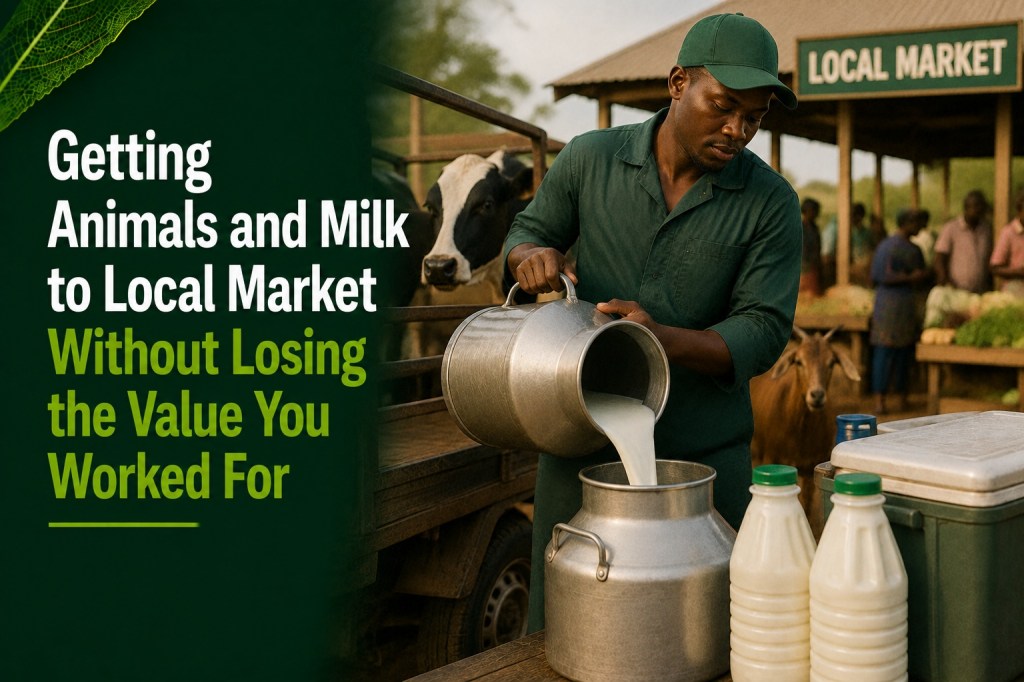
Most cold chain advice online is written for exporters shipping produce overseas. This isn’t that. Livestock transport and cold chain from your farm to your nearest local market is a shorter trip, but it still costs you money when it’s done badly. One documented camel milk route in Kenya lost 25% of its milk to spoilage before it even reached market, purely from heat exposure on a standard local delivery route. A solar-cooled van fixed it. Most farmers can apply the same principle at a much smaller scale.
See our export cold chain guide if you’re shipping internationally instead.
Moving live animals without losing weight you already paid to put on
Every animal loses some weight in transit; this is normal and is called shrink. The problem is when it goes beyond normal. A weight loss of 8 to 10% of body weight during transport is generally considered a red flag, usually signalling dehydration rather than simple, expected shrink. Research also shows cull and feeder cattle shrink faster than well-finished cattle, meaning younger or leaner animals need extra care during a move.
- Withhold roughage before loading. Grain, alfalfa, and clover hay have a laxative effect; withholding these for at least 12 hours before transport reduces this particular source of weight loss.
- Don’t skip water. Animals should have full access to food and, especially, water right up until loading, and again as soon as they arrive.
- Build in recovery stops on longer routes. Commercial operators build in rest stops for journeys over 500km; if you’re moving animals that far, plan for the same.
- Avoid mixing unfamiliar animals. Strange animals loaded together will fight to establish a new hierarchy, and fighting is a leading cause of injury, stress, and lower-quality meat at slaughter.
- Fix loading facilities before you fix trucks. Transporters across the region consistently cite poor or nonexistent loading facilities as one of the biggest, most avoidable sources of stress and injury during loading.
The reality of getting animals to market across the continent
Live animal transport in Africa often looks nothing like a single truck trip. In parts of Kenya, cattle are trekked for 14 to 30 days from primary to secondary markets before ever being loaded onto a truck for the final leg to Nairobi. In Ghana, cattle moving along the main north-south corridor travel an average of 528km over roughly 18 hours. In Nigeria, over 1,800 truckloads of livestock move from north to south every month.
This matters because trekking on foot, still common across much of the region due to limited trucking infrastructure, causes considerable weight loss, physical injury, and illness compared to trucking. If trucking is available and affordable on your route, it’s worth the cost difference more often than farmers assume, particularly for higher-value animals.
Milk and perishable products: the local cold chain gap
Live animals aren’t the only thing losing value in transit. Across Kenya’s informal dairy sector, milk commonly moves from farm to market by bicycle, motorcycle (boda-boda), or shared minibus (matatu), often without any refrigeration at all. Most vendors report modest weekly spoilage, but a meaningful share still cite spoilage as a significant, ongoing business cost, and even vendors with refrigeration remain vulnerable when power cuts hit.
The camel milk trade in Wajir, Kenya, shows just how bad this gap can get, and how directly fixable it is. Before intervention, milk was carried by motorcycle from herding areas, then boiled for hours to preserve it (destroying flavour and nutrients in the process), then transported roughly 50 miles by public bus in dangerous heat. As much as 25% of the milk was lost before it even reached the market, and what did arrive needed boiling again.
The fix was a solar-paneled refrigerated van replacing the bus and boiling steps entirely, paired with solar-powered milk dispensers (informally called milk “ATMs”) at the market end. Traders reported selling more milk at higher quality and, in turn, earning meaningfully more from the same production.
Low-cost fixes that don’t require a refrigerated van
Most smallholders won’t have access to a solar-cooled vehicle, but the underlying principles scale down:
- Move fast, in the coolest part of the day. Early morning transport, before ambient temperature rises, is a simple, free step that meaningfully slows spoilage.
- Use insulated containers rather than open jerry cans. Even a basic insulated cooler box slows temperature rise significantly compared to an uninsulated container.
- Bulk at a collection point before the final leg. Aggregating milk at a shared collection point, the same model behind dairy cooperatives, concentrates volume enough to justify better transport or shared cooling that no individual farmer could afford alone. This is the same logic covered in our dairy processing and value addition guide.
- Clean containers matter as much as speed. Aluminium containers are easier to fully clean than plastic, which can retain residue and harbour bacteria that accelerate spoilage regardless of how fast you move.
- Know your route’s weak points. Power cuts affecting refrigerated vendors, unreliable road conditions, and predictable heat windows are all identifiable risks; planning around known weak points beats reacting to spoilage after the fact.
Mistakes that cost value between farm and market
- Trekking animals long distances when trucking is available. Trekking causes more weight loss and injury than trucking; the cost difference is often smaller than the value lost.
- Loading animals without water access beforehand. This directly worsens the dehydration-driven weight loss that pushes shrink past the normal range.
- Transporting milk in open containers during the hottest part of the day. Both factors are free or low-cost to fix and meaningfully reduce spoilage risk.
- Assuming individual farmers can’t access better cold chain infrastructure. Bulking at a shared collection point is exactly how smaller farmers access chilling and transport options that would be unaffordable alone.
Key takeaways
- An 8 to 10% weight loss during animal transport is a red flag for dehydration, not just normal shrink; water access before and after transport is the biggest lever you control.
- Trekking remains common across the continent but causes more weight loss and injury than trucking where trucking is genuinely available.
- Informal milk transport by bicycle, motorcycle, or minibus, without refrigeration, is standard across much of the region, and spoilage is an ongoing cost for a meaningful share of vendors.
- A documented Kenyan camel milk route lost 25% of its product to spoilage before a solar-cooled van and milk dispensers fixed the problem, showing how directly fixable local cold chain gaps can be.
- Bulking at a shared collection point gives individual smallholders access to cooling and transport infrastructure they couldn’t justify alone.
FAQ
How much weight loss is normal when transporting cattle?
Some weight loss (shrink) is expected on any transport. A loss of 8 to 10% of body weight is generally considered a red flag, usually pointing to dehydration rather than normal shrink, and warrants investigating water access and transport conditions.
Is trekking or trucking better for moving livestock to market?
Trucking generally causes less weight loss, injury, and illness than trekking, according to research across the region. Trekking remains common due to limited trucking infrastructure and cost, but trucking is worth the expense more often than farmers typically assume, particularly for higher-value animals.
How can I keep milk from spoiling during transport without refrigeration?
Move milk during the coolest part of the day, use insulated rather than open containers, keep containers clean (aluminium is easier to fully clean than plastic), and where possible, bulk with other farmers at a shared collection point to access better cooling than you could afford individually.
Why do informal milk traders in Kenya still lose money to spoilage?
Limited access to refrigeration, unreliable power for vendors who do have it, and long, hot transport routes on bicycles, motorcycles, or minibuses all contribute. A meaningful share of vendors cite spoilage as a significant ongoing business cost even though most report relatively low weekly losses.
What is a milk collection point and how does it help smallholders?
A milk collection point bulks milk from multiple smallholder farmers before onward transport or chilling, giving the group access to cooling and transport infrastructure that no individual farmer could justify buying alone. This is the same underlying model as dairy cooperatives more broadly.
Kiki’s Agroplace: Bridging the knowledge gap in agriculture.


Leave a Reply