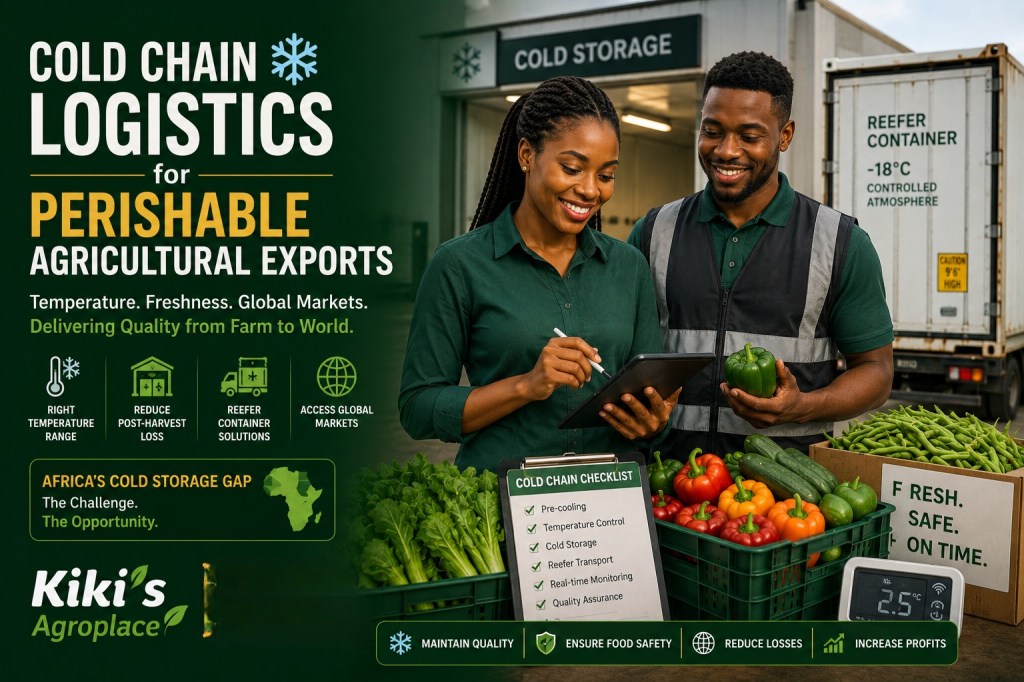
Cold chain logistics decides whether your perishable export arrives fresh or arrives as waste. Get the temperature wrong at any single point: farm, storage, truck, port, or ship and the whole shipment suffers. Here’s how the cold chain actually works, where it breaks in Africa, and what’s fixing it.
Why cold chain breaks cost you real money
Post-harvest loss in Africa is high, and weak cold chain is the main reason. Industry reports show total food production losses reaching 40% in some markets, with fruits and vegetables alone losing up to 70% when there’s no proper temperature-controlled storage. In East Africa specifically, 30% to 50% of food is lost after harvest, largely because of missing cold storage and logistics infrastructure.
This isn’t a farming problem. It’s a storage and transport problem. Good produce leaves the farm in good condition and arrives unsellable because nothing along the route kept it cold enough, consistently enough.
How to reduce post harvest loss on your farm
The cold chain, link by link
| Stage | What needs to happen |
| Harvest | Pick at the right ripeness and get produce out of the sun fast |
| Pre-cooling | Bring produce down to target temperature before it enters storage or transport |
| Local storage | Hold at the correct temperature until transport is ready |
| Transport to port/airport | Refrigerated truck, maintaining the same temperature set at pre-cooling |
| Port or airport handling | Cold storage facility bridges the gap between truck and ship or plane |
| Sea or air transport | Reefer container or cargo hold, temperature-controlled for the full journey |
| Destination handling | Buyer’s cold storage picks up where the reefer container leaves off |
One weak link breaks the whole chain. A truck without working refrigeration between the farm and the port undoes everything done correctly before it.
Getting the temperature right
Different products need different temperatures. Set it wrong, and you either freeze produce that should stay cool, or leave it warm enough to spoil.
| Product | Typical reefer temperature |
| Avocados | +2°C to +5°C |
| Citrus fruits (oranges, etc.) | +3°C to +8°C |
| Bananas | +13°C to +18°C |
| Cut flowers | Around 0°C to +1°C, with high humidity |
| Fresh fish, meat, dairy | Below +4°C |
| Frozen meat, fish, seafood | -18°C to -25°C |
These are starting points, not fixed rules. Exact settings shift with variety, ripeness, and how long the journey takes. Always confirm final settings with your buyer or shipping line before loading, a reefer container holds a temperature, it doesn’t fix produce that was already too warm when it went in.
Africa’s cold chain gap, in numbers
Sub-Saharan Africa’s total refrigerated warehouse capacity sits at under 5% of India’s, despite both regions producing comparable volumes of agricultural output. That gap is the core reason so much produce spoils before reaching a buyer.
South Africa holds the largest share of the continent’s cold chain capacity, thanks to established retail and export networks. Most other countries are working from a much smaller base, which is part of why fresh produce trade concentrates around a handful of export-ready regions; Kenya, Ethiopia, Senegal, and Morocco lead in horticulture exports to Europe, largely because their cold chain infrastructure matured earliest.
What’s actually working right now
The gap is real, but so is the progress. A few models are proving cold chain doesn’t need massive upfront investment to work.
ColdHubs, Nigeria. Solar-powered walk-in cold rooms, installed in major markets across 22 Nigerian states. Farmers and traders rent crate space by the day instead of buying their own refrigeration. The result: shelf life for produce extends from about 2 days to 21 days, and spoilage drops by up to 80% for users. Over 5,000 smallholder farmers and traders now rely on this system.
Shared-use cold storage hubs. Instead of one farmer or exporter paying for a whole facility, the cost is spread across multiple farmer groups and traders using the same hub. This makes cold storage viable at a much smaller scale than traditional private cold stores required.
East African cold storage expansion. New temperature-controlled facilities are under construction in Kampala, Dar es Salaam, Mombasa, and Kigali, aimed at supporting the region’s growing exports of flowers, French beans, avocados, and specialty coffee.
What buyers now expect
European and UK supermarkets increasingly require proof of proper cold chain handling, not just a fresh-looking product on arrival. This usually means:
- Documented temperature records for the full journey, not just at loading
- Compliance with Good Distribution Practice (GDP) standards, a recognized set of rules for storing and moving temperature-sensitive goods correctly
- Traceability: proof of exactly where and how the product was handled at each stage
If you’re new to exporting fresh produce, expect your buyer to ask for these records before they’ll commit to repeat orders.
An insurance certificate is worth adding for temperature-sensitive cargo too — see our export documentation basics guide for the full list of certificates your shipment may need alongside cold chain records.
Steps to protect your shipment
- Pre-cool before loading. Don’t rely on the reefer container to cool warm produce; it’s built to hold a temperature, not drop one quickly.
- Use a temperature logger. A simple, inexpensive device that records the actual temperature throughout the journey gives you proof if something goes wrong, and proof of good handling if it goes right.
- Check your cold storage gap points. Map out every stage where your product changes hands or vehicles. Each handover is a risk point.
- Ask your freight forwarder about reefer container availability early. Reefer capacity gets booked up, especially in peak export seasons.
- Get insurance for temperature-sensitive cargo. If a breakdown happens outside your control, insurance is what protects your income.
Common mistakes
- Loading warm produce into a reefer container and expecting it to cool down in transit.
- Using an unrefrigerated truck for the short trip between the farm and the first cold storage point.
- Assuming one temperature setting works for every product in a mixed shipment.
- Skipping temperature monitoring, then having no proof when a buyer disputes quality on arrival.
FAQ
Can a reefer container cool down warm produce during shipping?
No. Reefer containers hold a set temperature, they’re not designed to rapidly cool cargo that’s loaded warm. Produce needs to be pre-cooled to the target temperature before it goes in.
What’s the single biggest cause of cold chain failure in Africa?
Infrastructure gaps at the farm and rural level. Losses often happen before produce ever reaches a port, because of missing local cold storage and poor refrigerated transport options over long distances.
Do I need my own cold storage facility to export perishables?
No. Shared-use, pay-per-use cold storage hubs, like ColdHubs in Nigeria, let you rent space by the day. This makes cold chain access possible without a large upfront investment.
What is a temperature logger, and do I really need one?
It’s a small device that records temperature throughout your shipment’s journey. It’s not always mandatory, but many buyers now expect the record as proof of proper handling, especially for European and UK markets.
Why do bananas need a warmer temperature than avocados?
Different produce reacts differently to cold. Bananas suffer chilling injuries below a certain temperature, so they’re shipped warmer, around 13°C to 18°C, while avocados tolerate cooler conditions, around 2°C to 5°C.
What does GDP compliance mean for a small exporter?
It means showing your buyer that your product was stored and transported correctly at every stage, usually through temperature records. It’s becoming a standard request, not just a large-exporter requirement.
Key takeaways
- Post-harvest losses in Africa reach up to 70% for fruits and vegetables without proper cold storage.
- Sub-Saharan Africa’s refrigerated warehouse capacity sits under 5% of India’s, despite similar agricultural output.
- Different products need different reefer temperatures; there’s no single correct setting.
- Shared-use cold storage models like ColdHubs prove smallholders can access cold chain without owning their own facility.
- Buyers increasingly expect documented proof of proper handling, not just a fresh-looking product on arrival.
Not sure where your cold chain has the weakest link? Get in touch for a free export readiness chat.


Leave a comment