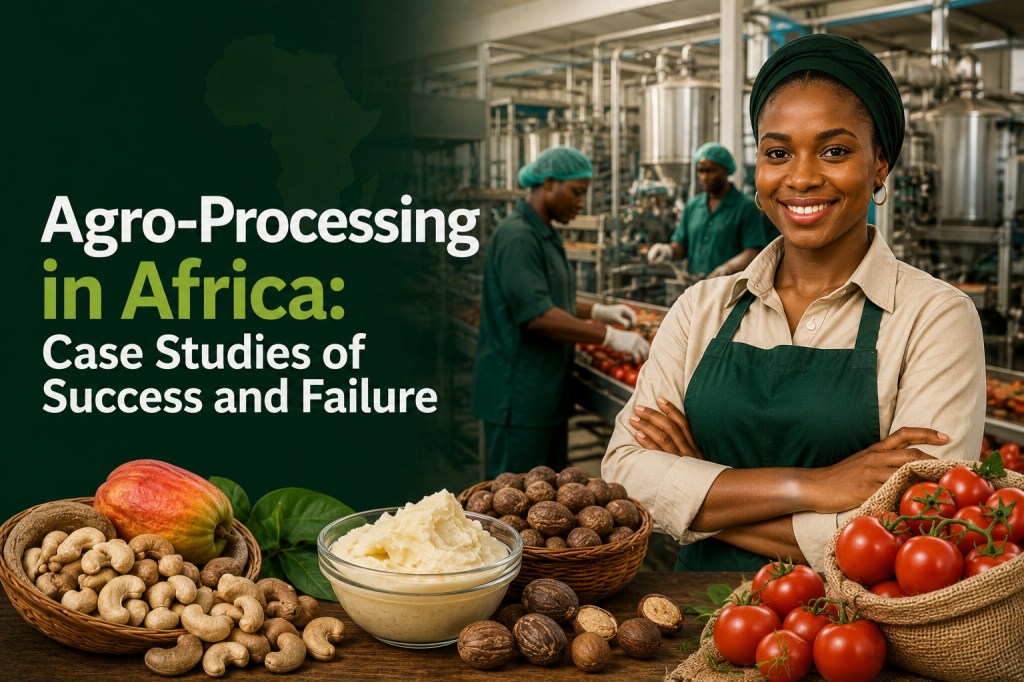
Agro-processing turns raw crops into products that sell for more. Cocoa beans become chocolate. Raw cashew nuts become roasted kernels. Shea nuts become butter. Africa produces huge volumes of raw commodities, but most of the profit from processing happens outside the continent. Value addition is the effort to change that. This article covers what’s working, what’s failed, and why.
Case study 1: Cashew processing in Côte d’Ivoire — a real success
Côte d’Ivoire produces about 40% of the world’s raw cashew nuts. For years, almost none of it was processed locally; nuts left the country raw, and Asian factories captured the processing profit. As recently as the mid-2010s, less than 7% of Ivorian cashews were processed at home.
That’s changing fast. Local processing capacity grew from about 68,500 tons in 2015 to 345,000 tons in 2024. The government’s target is to process more than 50% of the harvest locally by 2030. To push things along, the country now reserves an exclusive early buying window each season for local processors, before exporters can buy raw nuts.
The results are measurable. Cashew kernel export revenue jumped from about $65 million in 2020 to over $440 million in 2024. More than 30 processing plants opened in 2024 alone, creating over 15,000 direct jobs; 70% held by women. One cooperative chairman in the Worodougou region reported going from zero permanent processing jobs to around 50 stable positions, 60% held by women.
Neighboring countries are following the same path. Benin has stopped raw cashew exports outright to force local processing. Ghana’s president has announced plans to do the same. Nigeria is debating it.
How to reduce post harvest losses.
Case study 2: Shea butter — closing a massive value gap
Shea butter shows the value gap in its clearest form. Around 16 million women across Africa work in the shea value chain, and over 80% of shea labour is done by women. A 200-gram jar of shea body butter can sell for $25 to $30 in a London or Tokyo store. The woman who did the processing work behind that jar might have earned $1.50 or less.
West African governments are now moving to close that gap. Burkina Faso and Nigeria have already banned raw shea nut exports. Ghana plans to follow in 2026. The combined shea sector across these countries could generate over $1.1 billion in the short term, with projections reaching $4 billion if full processing and market access are achieved.
Cooperative models are proving this works at the ground level. Ghana’s Star Shea Network links over 5,000 women across the country’s north, training them in sustainable harvesting, quality grading, and hygienic butter production. Cooperatives like this let women capture more of the value themselves, instead of selling raw nuts to middlemen at the lowest point in the chain.
Crops to grow during dry season in Nigeria
Case study 3: Dangote’s tomato factory — what went wrong
Not every value addition story ends well. In 2016, Aliko Dangote; Africa’s richest man, invested $20 million in a tomato processing factory in Kadawa, Kano State. The plant was built to process 1,200 tonnes of fresh tomatoes a day into paste, cutting Nigeria’s reliance on imported tomato paste.
It shut down within eighteen months. The core problem: the factory needed 40 truckloads of fresh tomatoes daily, and Nigeria’s supply chain couldn’t reliably deliver that. An invasive pest, Tuta absoluta, hit Kano’s tomato farms the same year the factory launched. Farmers abandoned tomato cultivation when the rainy season made other crops more reliable. High energy costs made local paste more expensive than cheap, often substandard imports from China. The factory has restarted and shut down multiple times since, and as of 2026 it stands largely idle.
Nigeria still spends over $400 million a year importing tomato paste, despite growing enough tomatoes to supply it domestically. The gap isn’t production. It’s everything around production; storage, transport, and a steady supply agreement that survives a bad season.
25 agribusiness ideas you can start in Africa
Comparing the three
| Case | Outcome | Key factor |
| Cashew, Côte d’Ivoire | Success — processing more than quintupled in under a decade | Government policy secured raw material access for local processors first |
| Shea butter, Ghana/Burkina Faso | Improving — cooperatives capturing more value directly | Training and direct market access, not just raw material bans |
| Tomato, Nigeria | Failed repeatedly | Raw material supply couldn’t match factory capacity, no fallback plan |
What separates success from failure
- Secure raw material supply first. Côte d’Ivoire’s cashew policy locked in nut supply for processors before building more capacity. Dangote built capacity before securing a reliable, weather-proof supply.
- Match your factory size to what your supply chain can actually deliver. A 1,200-tonne-a-day factory needs a 1,200-tonne-a-day supply chain, every day, including bad seasons.
- Build in cooperatives or direct producer relationships. Both the cashew and shea successes involved cooperatives, not just a factory buying on the open market.
- Plan for pests, weather, and price competition from imports. Dangote’s factory got hit by an invasive pest, a rainy season crop switch, and cheap imports; all at once. None of these were unpredictable risks; they just weren’t planned for.
Before you invest in processing
- Map your raw material supply for a full year, not just peak season. What happens to your factory in the low season?
- Lock in supply agreements with farmers or cooperatives before committing capital to processing equipment.
- Check what’s already competing with you. Cheap imports undercut Nigeria’s tomato paste industry for years, know your competition’s price point before you set yours.
- Start smaller than you think you need to. A smaller plant running at full capacity beats a large plant running at 20%.
- Build relationships with cooperatives, not just individual farmers. Cooperatives spread risk and make supply more predictable.
Once you have a processed product ready to sell, the next problem is finding buyers for it abroad — see our guide to finding buyers and distributors abroad. Our Africa Agriculture Trade Monitor breakdown also has the trade data behind why processed goods are already close to half of regional agricultural trade.
FAQ
Why does raw commodity export earn less than processed export?
Processing adds labor, technology, and branding to a raw product, and buyers pay for that added value. A raw cashew nut sells for far less than the roasted, packaged kernel it becomes.
Why did the Dangote tomato factory fail if Nigeria grows plenty of tomatoes?
Growing tomatoes and reliably supplying a large factory every day of the year are different problems. Seasonal farming patterns, pest outbreaks, and farmers switching to other crops all broke the supply chain the factory depended on.
Can small cooperatives compete with large processing companies?
Yes, especially in shea butter, where cooperatives capture more value by processing and selling directly, instead of selling raw nuts to middlemen at the lowest price point in the chain.
What’s the biggest risk in agro-processing investment?
Raw material supply. A processing facility is only as reliable as the crops feeding it, and weather, pests, and farmer decisions all affect that supply.
Do government export bans on raw commodities actually work?
They can push investment toward local processing, as seen with shea in Burkina Faso and Nigeria. But they need to be paired with real processing capacity and training; a ban alone doesn’t build a factory or teach cooperatives new skills.
Key takeaways
- Côte d’Ivoire’s cashew processing grew more than fivefold in under a decade by securing raw material access for local processors first.
- Shea butter shows one of Africa’s largest value gaps; a $1.50 payment for labor behind a $25-30 retail product and cooperatives are closing that gap directly.
- Dangote’s $20 million tomato factory failed repeatedly because raw material supply couldn’t match its capacity, especially in bad seasons.
- Success in every case ties back to one thing: a reliable, planned-for raw material supply, not just processing equipment.
- Cooperative structures show up in every successful case here, they’re not incidental, they’re often the mechanism that makes supply reliable.
Thinking about a processing or value addition investment? Get in touch for a free consulting chat.


Leave a Reply