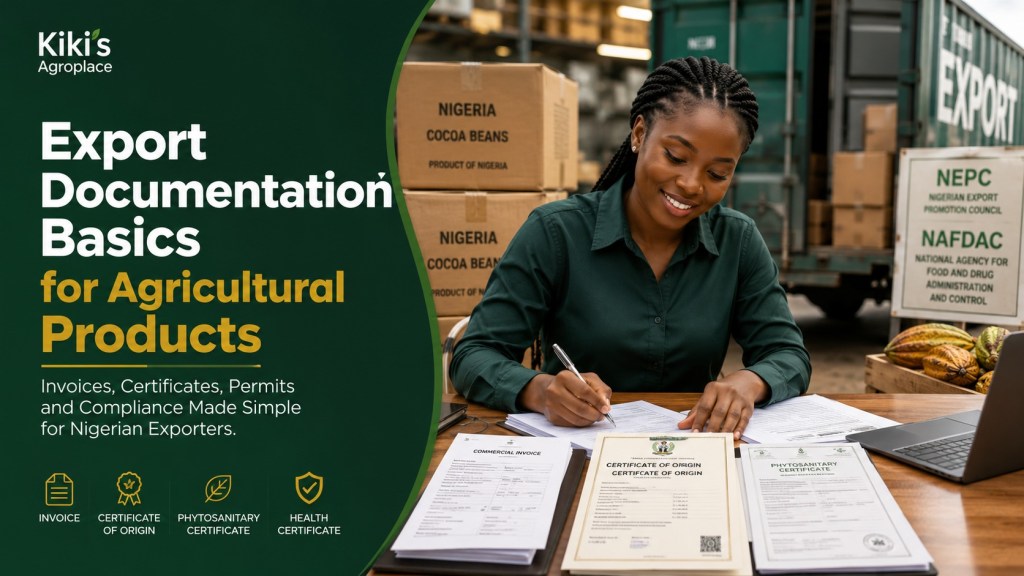
Most rejected agricultural shipments don’t fail because of bad product. They fail because of missing or wrong paperwork. Export documentation isn’t exciting, but it decides whether your goods clear customs or sit stuck at a port. Here’s every document you’re likely to need, what it proves, and who issues it.
The core documents at a glance
| Document | What it proves | Who issues it (Nigeria example) |
| Commercial invoice | What you sold, at what price, on what terms | You, the exporter |
| Packing list | What’s physically inside the shipment | You, the exporter |
| Certificate of Origin | Where your goods came from | NACCIMA (Chamber of Commerce) |
| Bill of Lading / Air Waybill | Proof of shipment and carrier terms | Shipping line or airline |
| Phytosanitary certificate | Plant products are pest and disease-free | NAQS (Nigeria Agricultural Quarantine Service) |
| Health certificate | Processed food is safe to eat | NAFDAC |
| Veterinary certificate | Animal products meet health rules | DVPCS (Veterinary and Pest Control Services) |
Every country has its own version of these agencies. If you’re outside Nigeria, your local export promotion body or agriculture ministry can point you to the right one. The document types stay the same worldwide, only the issuing agency’s name changes.
How to export farm products from Nigeria
Commercial invoice
This is your sales document. It lists the product, price, payment terms, and delivery details. Your buyer uses it to pay you. Customs uses it to calculate duties.
Be specific. “Agricultural produce” gets your shipment flagged. “Dried Hibiscus Flowers, Grade A, 500kg” does not. Vague descriptions are one of the most common reasons shipments get held up.
Packing list
This tells customs exactly what’s inside your shipment: number of boxes, weight per box, dimensions, and how everything is packed. It’s different from your invoice; the invoice covers money, the packing list covers physical details. Customs checks this against your invoice to confirm nothing’s mismatched.
How to package and brand farm products
Certificate of Origin
This proves where your product was grown or made. It matters because of many trade agreements: AfCFTA, ECOWAS, and others give lower tariffs to goods proven to originate in a member country. In Nigeria, NACCIMA (your local Chamber of Commerce) issues this. Bring proof of where your raw materials came from and how the product was processed.
Bill of Lading or Air Waybill
This is your shipping company’s receipt and contract. A Bill of Lading covers sea freight. An Air Waybill covers air freight. Your buyer needs the original (or an approved copy) to collect the goods at the destination port or airport.
Phytosanitary certificate — for plant products
If you’re exporting grains, spices, nuts, cocoa, cashew, sesame, hibiscus, fruits, or vegetables, you need this. It proves your product is free from pests and diseases that could harm farms in the importing country.
Every country has a National Plant Protection Organization, or NPPO, responsible for issuing this. In Nigeria, that’s NAQS. In the US, it’s APHIS. In India, it’s the PPQS. Whatever country you’re in, this certificate comes from your national agricultural quarantine authority, not from a private company.
One timing rule that catches people out: inspections are usually only valid for a limited window before shipping, commonly no more than 30 days. Apply close to your actual shipping date, not months in advance.
Health certificate — for processed and semi-processed food
If you’ve processed your product: dried, milled, roasted, packaged, you likely need a health certificate rather than, or in addition to, a phytosanitary one. It confirms your food is safe for human consumption and meets the importing country’s food safety rules. In Nigeria, NAFDAC issues this.
Veterinary certificate — for animal products
Exporting meat, dairy, or other animal-origin products requires an international veterinary certificate. In Nigeria, this comes from DVPCS (Veterinary and Pest Control Services). Fish and fishery products have their own path in Nigeria; the Federal Ministry of Agriculture’s Department of Fisheries handles that certificate specifically.
If any of your products are perishable, meat, dairy, fish, or fresh produce, the paperwork above is only half the job. See our guide to cold chain logistics for perishable exports for what buyers now expect on top of these certificates.
Extra documents worth knowing about
- Certificate of Analysis / Certificate of Weight and Quality: A lab report confirming your product matches the quality and quantity in your contract. Issued by accredited labs or independent assessors like SGS or Bureau Veritas.
- Fumigation certificate: Common for raw commodities like cocoa, cashew, and sesame. Proves your goods were treated against pests during storage or shipping.
- Insurance certificate: Protects you and your buyer against loss or damage in transit. Not always required, but it builds trust with first-time buyers.
- Quality certification (SON/SONCAP in Nigeria): Confirms manufactured or packaged goods meet national and international standards.
- HACCP or ISO 22000: Food safety certifications. Not always mandatory, but EU and US buyers often ask for them, and having one makes you more competitive.
The paperwork trail, step by step (Nigeria example)
- Register your business with the Corporate Affairs Commission (CAC).
- Register as an exporter with NEPC and get your Exporter’s Certificate. It’s valid for 18 months; mark your renewal date.
- Open a domiciliary account at a bank, linked to your NEPC number.
- Classify your product with the correct HS code. A customs broker can help if you’re unsure.
- Complete an NXP Form at your bank for every export transaction. This lets the Central Bank track your foreign exchange.
- Get the quality or health certificates your specific product needs; SON, NAFDAC, or NAQS, depending on what you’re shipping.
- Book your freight forwarder and confirm they know both Nigerian port procedures and your destination country’s customs rules.
If you’re exporting from another African country, the document types are the same, only the agency names and exact steps differ. Check with your national export promotion body for the equivalent process.
How to trade agricultural products across African borders.
Mistakes that get shipments rejected
- Vague product descriptions on the invoice, instead of specific product, grade, and quantity.
- Assuming every country accepts the same certificates. The EU, US, and other markets each have their own extra requirements.
- Not asking your buyer directly what documents they need, in writing, before you ship.
- Shipping without your NEPC registration, or letting it lapse past 18 months.
- Ignoring labeling rules; product name, weight, origin, and expiry date all need to be on the package.
FAQ
Do I need both a phytosanitary certificate and a health certificate?
It depends on your product. Raw, unprocessed plant products usually need a phytosanitary certificate. Processed food usually needs a health certificate. Some semi-processed products need both; check with your local agricultural quarantine agency.
How long does a Certificate of Origin last?
Under AfCFTA rules, it’s valid for 12 months from the date it’s issued. Other trade agreements may set different periods, so check the specific agreement you’re trading under.
Can I use a photocopy of my phytosanitary certificate?
No. Most countries require the original document. Customs officials may keep a copy for their records, but a photocopy alone won’t clear your shipment.
What happens if my buyer asks for a document I don’t have?
Contact the relevant agency immediately; most certificates can be processed within days if your product already meets the standard. This is why confirming buyer requirements before shipping saves you from last-minute scrambling.
Do small exporters need all of these documents, or just large companies?
Size doesn’t exempt you. A small exporter shipping one container needs the same core documents as a large company shipping ten. The certificates are tied to the product and destination, not your company size.
Where can I check what my specific buyer’s country requires?
Ask your buyer directly and get it in writing. You can also check the importing country’s agriculture or customs authority website, since requirements do differ by destination even for the same product.
Finding buyers and distributors abroad for agricultural exports
Key takeaways
- Documentation, not product quality, is the top reason shipments get rejected or delayed.
- Every country has its own agency for each certificate type; the document types themselves stay consistent worldwide.
- Phytosanitary certificates cover plant products; health certificates cover processed food; veterinary certificates cover animal products.
- Confirm your buyer’s specific requirements in writing before you ship; don’t assume one country’s rules match another’s.
- Keep your export registration current. In Nigeria, that means renewing your NEPC certificate every 18 months.
Not sure which documents your product needs? Get in touch for a free export readiness chat.


Leave a Reply