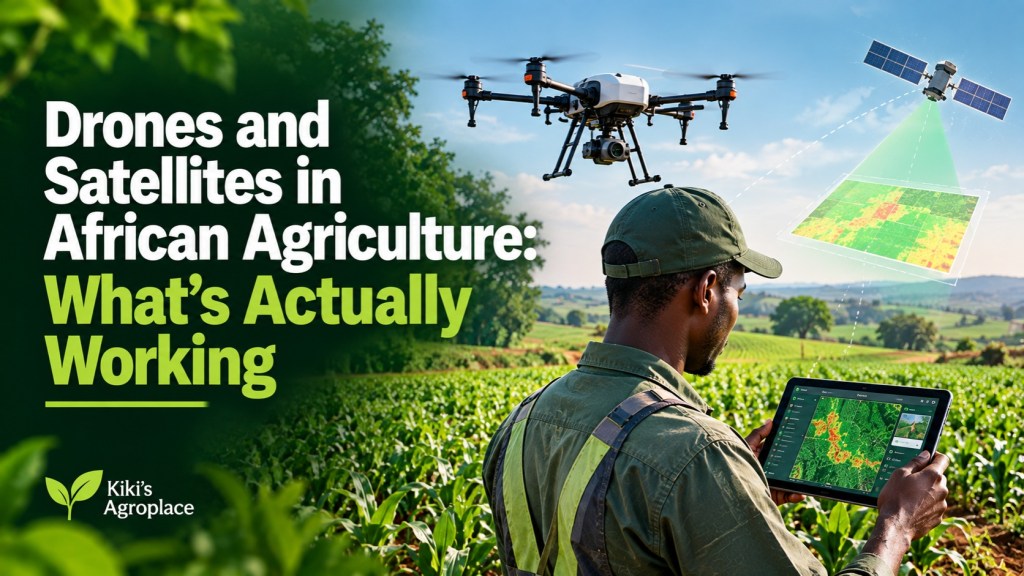
Drones and satellites get more attention than any other part of precision agriculture (using data and technology to farm more exactly). They photograph well, they sound impressive, and donor press releases love them. That attention creates a problem: it’s hard to tell which projects are actually working on farms, and which ones were a pilot (a small trial version of a project, run before deciding whether to expand it) that got a nice write-up and then quietly stopped.
Two examples worth looking at closely: satellite and drone orchard monitoring in South Africa, and drone crop-spraying in Rwanda. Both are genuine, scaled businesses, not pilots. Looking at exactly why they worked shows what it actually takes for this kind of technology to survive past the demo stage.
South Africa: satellite and drone monitoring for orchards
Aerobotics, based in Cape Town, uses satellite imagery and drone flights combined with machine learning (computer software that learns to spot patterns from large amounts of data) to check the health of individual trees across an orchard. The system flags trees under stress from pests, disease, or poor irrigation, days or weeks before a human scout would notice with the naked eye.
This works in South Africa for a specific reason: citrus and macadamia orchards are high-value, long-term crops grown on established commercial farms. A single tree lost to disease represents years of investment, so the cost of ongoing monitoring is easy to justify against the cost of losing that tree. Aerobotics built its business around this exact economic case, and it has grown from a handful of South African farms into operations across 11 countries.
This same case doesn’t automatically transfer to a smallholder growing maize on one hectare. A maize crop is replanted every season, worth far less per plant, and the cost of satellite monitoring per hectare doesn’t make the same financial sense. This is why tree-crop monitoring scaled in South Africa’s commercial farming sector specifically, rather than across the continent generally; the economics, not the technology, decided where it worked.
Rwanda: how one country’s rules created a drone industry
Rwanda has become one of the most drone-friendly countries in the world for a simple reason: it built performance-based drone regulation (rules that set a required safety standard, rather than a long list of fixed technical requirements) early, while airspace was still uncrowded. That gave companies room to test and launch services other countries were still debating on paper.
Two different companies operate in this space, and it’s worth being precise about which does what:
- Zipline runs Rwanda’s national drone delivery network; but mainly for medical supplies (blood, vaccines, medicine) and, more recently, livestock inputs like artificial insemination materials for pig farmers. It is not a crop-spraying service, even though it’s often mentioned in the same breath as agricultural drones.
- Ampere Vision Rwanda, a local start-up, does the crop-spraying work: AI-powered pest detection paired with targeted pesticide spraying, aimed at smallholder and mid-sized farms. A farmer doesn’t own the drone or the flight; they pay for the service, similar to hiring a contractor.
Together, these two companies show what a supportive regulatory environment actually enables: not one company doing everything, but a small industry of specialised services, each solving one problem well.
Why this hasn’t happened everywhere
Rwanda’s approach is the exception, not the rule. Most African countries still have unclear or restrictive rules for commercial drone flights, which makes it hard for a company to plan a business around drone spraying with any confidence. Regulatory uncertainty is often the real barrier here; not the cost of the drone itself, and not a lack of farmer interest.
Cost is still a real factor too. A drone spraying service, satellite subscription, or aerial monitoring platform typically charges per hectare, per flight, or per season. For a smallholder working one or two hectares, that cost only makes sense if the crop value or the risk being managed is high enough to justify it, which is exactly why these services have taken hold in specific, high-value contexts rather than across every type of farm.
Spotting a pilot that won’t scale
Not every drone or satellite agriculture story is a success story in progress. A number of donor-funded pilots have generated strong press coverage; photogenic drone launches, optimistic projected numbers, and then quietly disappeared once the grant funding ran out, without ever reaching a farmer base large enough to run without outside support.
A few questions help tell the difference between a real, scaling service and a pilot that’s likely to stall:
- Is a farmer actually paying for this, or is a donor grant covering the entire cost?
- Has the company grown its farmer or hectare count year over year, with public numbers to show it?
- Does the service exist in more than one country or region, or has it stayed in a single pilot site for years?
Aerobotics and Ampere Vision Rwanda both pass this test — real customers, real growth, public numbers. That’s worth noticing, because it’s the exception in this space, not the norm. Our piece on data ownership and hype goes deeper into this same pattern across the wider precision agriculture cluster, with two named examples of projects that didn’t survive it.
Key takeaways
- Aerobotics scaled in South Africa because tree-crop orchards justify the cost of ongoing satellite and drone monitoring, the economics fit, not just the technology.
- Zipline delivers medical supplies and livestock inputs in Rwanda. Ampere Vision Rwanda does the actual crop-spraying. They are not the same service.
- Rwanda’s drone-friendly regulation is the exception across Africa, not the norm; regulatory uncertainty is a bigger barrier elsewhere than cost or technology.
- Real paying customers and multi-year growth separate a working service from a pilot that quietly died once its funding ended.
Frequently asked questions
Does Zipline spray crops with pesticides?
No. Zipline in Rwanda delivers medical supplies and livestock inputs, not pesticides. Crop-spraying in Rwanda is done by a different company, Ampere Vision Rwanda.
Is drone and satellite monitoring only useful for large commercial farms?
Mostly, so far. It has scaled fastest for high-value crops like citrus and macadamia, where the cost per hectare is easy to justify. It’s less common on smaller, lower-value staple crop farms today, though drone-spraying-as-a-service models are starting to change that.
Why did Rwanda’s drone industry grow faster than other African countries?
Rwanda introduced performance-based drone regulation early, giving companies clear rules to build around instead of long approval delays. Most other African countries are still working out their drone rules for commercial use.
Kiki’s Agroplace: Bridging the knowledge gap in agriculture.


Leave a Reply