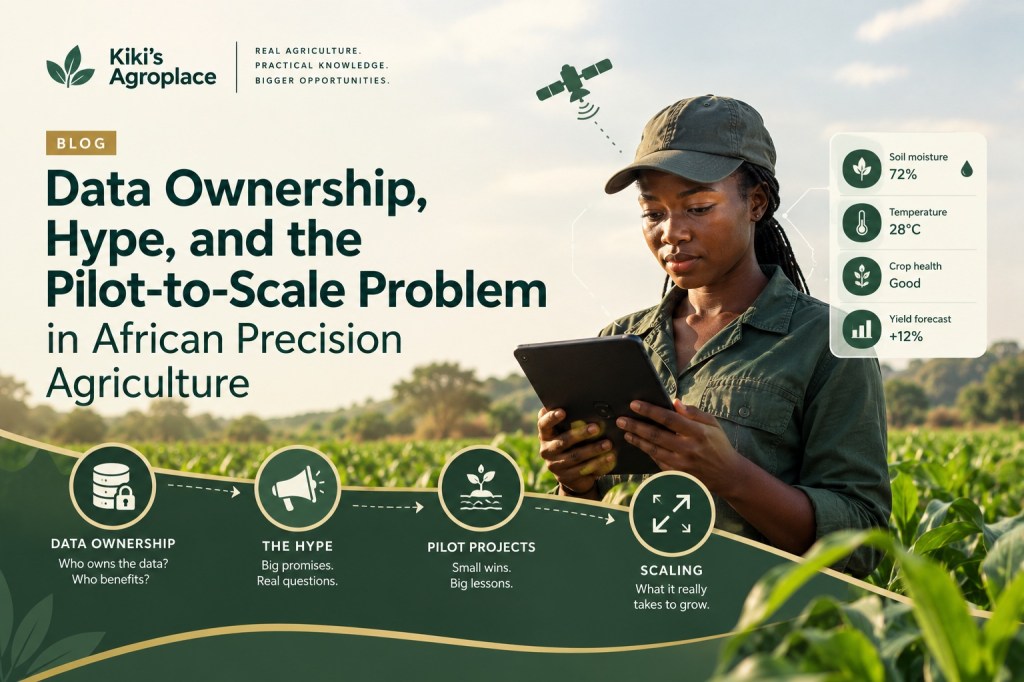
Precision agriculture (using data and technology to farm more accurately) in Africa doesn’t have a technology problem. Most of the tools covered in this series work. What it has is a scaling problem: a large share of promising projects launch, generate good press, and then quietly stop before they reach enough farmers to matter. This post covers two questions worth asking before recommending any precision agriculture tool: who actually owns the data it collects, and is it a real business or a pilot running on borrowed time?
Who owns the data
Every tool in this cluster: SMS forecasts, satellite insurance, soil testing, equipment bookings, collects data about a farmer’s land, decisions, and income. That data has value beyond helping the individual farmer. It can be used to build better products, sold to input companies as market intelligence, or used to price credit and insurance for other farmers.
In practice, most African farmers generate this data without holding any formal ownership over it. Research on agricultural digitalisation in Africa describes a common pattern: farmers act as the source of the data, but the companies collecting, processing, and storing it end up holding practical control over it; deciding who can access it and how it gets used, often through terms buried in an app or service agreement a farmer never reads closely.
This isn’t necessarily bad faith on the part of these companies; most need the data to make their own product work. But it’s worth a farmer, or anyone advising one, asking three plain questions before signing up for a data-driven service: What happens to my data if I stop using this tool? Is it sold or shared with anyone beyond what I signed up for? Can I ask for it to be deleted? A service that can’t answer these clearly is worth a second look.
A handful of African countries now have real data protection law behind these questions, not just company policy. Kenya’s Data Protection Act, in force since 2019, gives farmers formal rights to know what data is held about them, correct it, and ask for it to be deleted; closely modelled on Europe’s GDPR (General Data Protection Regulation, a strict EU privacy law). Nigeria’s equivalent, the Nigeria Data Protection Regulation (NDPR), has applied since the same year. Kenya is also currently drafting a policy to open government-held agricultural data; soil, weather, market prices to private tech developers under clearer rules, which could reshape who gets access to farm data over the next few years. Where one of these laws applies, a farmer has more to stand on than a company’s goodwill.
The pilot-to-scale problem, in actual numbers
This gap between promise and delivery is well documented, not just a general impression. A 2022 review of digital agriculture tools across Africa, published through the CGIAR research network, found that progress had been mostly limited to small pilot projects that struggle to grow past that stage; the underlying idea usually works, but something about the business model, the funding, or the local conditions stops it from ever reaching real scale.
Two named, well-documented Kenyan cases show exactly this pattern. The Kenya Seed Company’s Maize Seed SMS service, launched in 2008, let farmers text their location and receive advice on which maize variety suited their area. It needed roughly 24,000 enquiries a year to break even; by 2013 it was getting fewer than 2,000. A later survey in Kakamega county found 84% of farmers had no idea the service even existed, because promotion had never reached past the company’s head office. The technology worked fine. Nobody had checked whether farmers actually wanted it, or told them it was there.
M-Kilimo, a Kenyan farmer helpline funded by the Rockefeller Foundation and run by call centre operator KenCall, tells a different version of the same story. It launched in 2009 with 15 university-qualified agricultural experts answering farmer calls, and reached over 20,000 users within a year, a genuinely strong start. But it was built entirely on donor funding, with no plan to charge farmers or bill for the service afterward. Within four years, it had shut down. A wider collection of case studies compiled by CTA, covering Côte d’Ivoire, DR Congo, Ghana, Uganda, Zambia, and Kenya, found this same funding-first, revenue-last pattern repeated across nearly every project examined.
A more recent GSMA accelerator programme, working with agricultural technology companies across Africa and Asia, reached the opposite conclusion by studying what actually worked: the companies that scaled treated getting farmers to pay directly; even small amounts, as a core part of the product from day one, rather than something to figure out after the grant funding ran out.
The size of what’s actually at stake
This isn’t a small problem. A 2026 report from Boston Consulting Group and PxD estimated that digital agriculture tools could add up to $500 billion a year in agricultural income across low- and middle-income countries; but only if proven tools actually move past the pilot stage and reach farmers at scale. The technology to get there mostly already exists. What’s missing, in most cases, is the business model and delivery structure to carry it from a demo to a working service.
How to tell a real tool from a funded pilot
A few questions, drawn from the pattern above, help separate a service worth recommending from one likely to disappear:
- Do farmers pay for it directly, even a small amount? A service with real paying customers has a reason to keep running once a grant ends. A fully donor-funded free service often doesn’t.
- Has it grown its farmer numbers over more than one year, with figures it’s willing to share? One good launch year proves less than three years of steady growth.
- Is it available in more than one country or region? A tool stuck in a single pilot site for years, despite early praise, is a warning sign.
- Can the company explain its data policy in plain language? Vague or absent answers on data ownership are often a sign of a company that hasn’t thought past the pilot stage either.
None of this means new or donor-supported projects should be dismissed outright; some of today’s biggest working tools started exactly that way. It means treating early press coverage as a starting point for questions, not as proof a tool works.
Fraud is a real risk here too, not just hype
As phone-based farming tools spread, so do scams built to look like them. Fraudsters send fake SMS messages claiming to be from a real input-credit scheme, asking a farmer to pay a small “registration fee” by mobile money to unlock a loan or fertilizer package that doesn’t exist. Fake versions of popular apps have appeared on app stores, built to collect a farmer’s personal details or mobile money PIN rather than deliver any real service. Because so many legitimate tools genuinely do work this way; a text message, a small mobile payment, a promised benefit later; the scams are hard to tell apart from the real thing by format alone.
A few habits reduce the risk. A real financing or insurance scheme never asks for an upfront “fee” by mobile money before releasing a loan or payout; that request pattern itself is the clearest warning sign. Download apps only from an official app store listing, not a link sent by SMS or WhatsApp. And check an unfamiliar service against the company’s own official website or a known partner, like a bank, telecom, or agricultural cooperative, rather than trusting the message alone.
Key takeaways
- Farmers generate most of the data behind precision agriculture tools, but companies usually hold practical control over it; ask about data policy before signing up.
- Kenya and Nigeria both have data protection laws in force since 2019, giving farmers formal rights over their data where these laws apply.
- Most African digital agriculture projects remain stuck at pilot stage; the common cause is a funding model, not the underlying technology.
- Digital agriculture could add up to $500 billion a year in income across low- and middle-income countries, but only if proven tools scale past the pilot stage.
- Paying customers, multi-year growth, multi-country reach, and a clear data policy are the strongest signs a tool is real, not a temporary pilot.
- Fraudsters increasingly copy the exact format legitimate tools use; a request for an upfront fee before a loan or payout is the clearest warning sign of a scam.
Frequently asked questions
Who legally owns the data a precision agriculture app collects?
It depends on the company’s terms of service, and these vary widely. In practice, the company collecting and storing the data usually holds practical control over it, even when the farmer is the original source. Always check a service’s data policy before signing up.
Why do so many agricultural technology pilots fail in Africa?
Research points to funding structure as the main cause, more often than the technology itself. Projects built around donor grants, without a plan for farmers to pay directly, often stop once that grant funding ends.
Does free mean a tool is more accessible to smallholder farmers?
Not necessarily. A free, fully donor-funded tool can disappear once funding ends, while a low-cost paid tool with real revenue has a stronger reason to keep running. Free access is worth less if the service doesn’t survive long enough to matter.
How can I tell a fake agricultural app or SMS scheme from a real one?
The clearest warning sign is a request for money upfront before a loan, insurance payout, or benefit is released; legitimate schemes don’t work that way. Stick to official app store listings rather than links sent by SMS, and confirm an unfamiliar service through the company’s own website or a trusted local partner before sharing any personal details.
Kiki’s Agroplace: Bridging the knowledge gap in agriculture.


Leave a Reply