Table of Contents
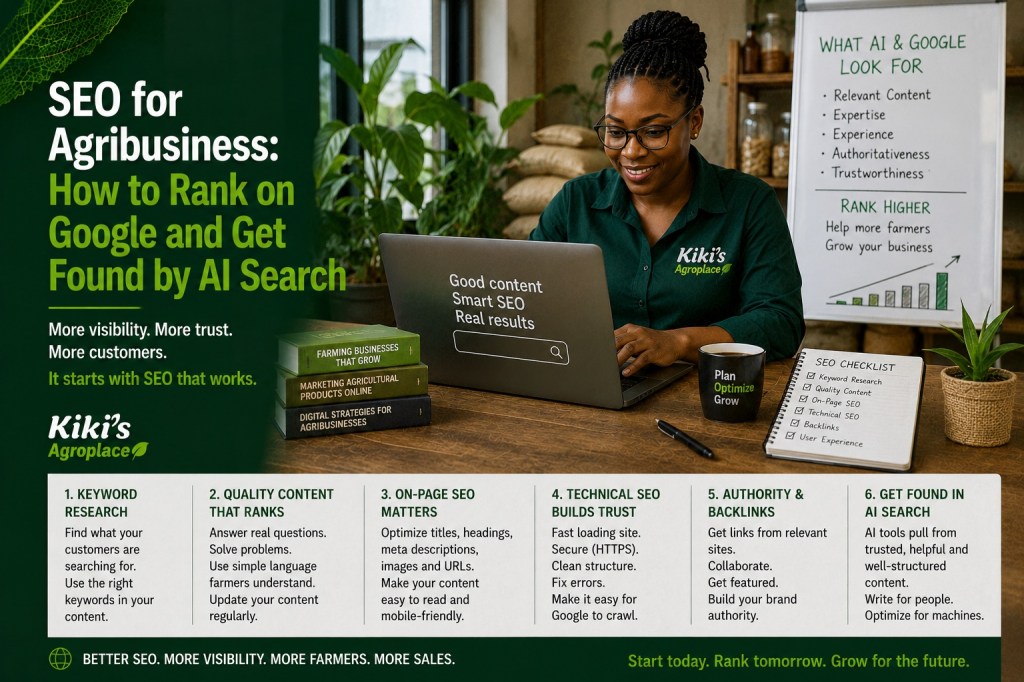
- Why SEO still matters, even though search has changed
- Keyword research that finds buyers, not just traffic
- On-page SEO — the checklist every post needs
- Technical SEO basics that keep Google happy
- Backlinks — why they still decide who wins
- How to get cited by AI search (ChatGPT, Perplexity, Gemini, AI Overviews)
- Common SEO mistakes agribusiness owners make
- Key takeaways
- FAQ
Introduction
SEO for agribusiness in 2026 is not what it was even two years ago. Google search itself has changed shape, and most guides have not caught up.
Search behaviour data from Similarweb and SparkToro shows that more than two-thirds of Google searches now end without a click to any website, up sharply since Google started showing AI Overviews directly on the results page. When an AI Overview appears, click-through rates drop by roughly 60% compared to a normal search.
That sounds like bad news for SEO. It is not. It means SEO now has two jobs instead of one: rank high enough that a buyer clicks through to your site, and get your business named inside the AI-generated answer even when they do not click at all. This guide covers both, in simple steps, without assuming you have a marketing budget.
This guide focuses on keyword research, on-page SEO, backlinks, and AI search visibility. For setting up your free Google Business Profile and getting your farm onto Google Maps, read our guide on how to market your agribusiness on Google for free.
1. Why SEO Still Matters, Even Though Search Has Changed
A 2026 zero-click study by SparkToro and Similarweb found that only around 3 in 10 US Google searches now end in a click to the open web, with AI Overviews now appearing on more than 20% of all searches. Pew Research found that when an AI Overview appears, users click through only about 8% of the time, compared to 15% on a normal search.
Two things follow from this:
- Ranking position matters even more than before. With fewer total clicks available, the businesses that do get clicked are almost always the ones ranking in the top few results, or the ones named directly inside an AI Overview.
- Being the source an AI system cites is now part of SEO. When ChatGPT, Google AI Overviews, Perplexity, or Gemini answer a question about, say, catfish farming costs in Nigeria, they pull that answer from websites. If your site is one of them, buyers see your business name even if they never click a link.
SEO has not become less important. It has become more concentrated. A handful of well-built pages can now capture a disproportionate share of both clicks and AI citations. The rest of this guide shows you how to build those pages.
2. Keyword Research That Finds Buyers, Not Just Traffic
A keyword is the phrase someone types when they are looking for what you sell. Good keyword research is not about chasing the highest search volume. It is about finding the phrases your actual buyers use, right before they are ready to buy.
Sort every keyword into one of three types:
| Keyword type | What it looks like | What it is worth to you |
|---|---|---|
| Buyer-intent | “buy fresh catfish Lagos”, “oyster mushroom supplier Abuja” | Highest value — this person is ready to order |
| Comparison | “best catfish farm near me”, “catfish vs tilapia for restaurants” | High value — this person is deciding who to buy from |
| Informational | “how to cook oyster mushrooms”, “catfish farming profit Nigeria” | Lower immediate value, but builds the traffic and trust that buyer-intent pages depend on |
A strong content plan mixes all three: a handful of buyer-intent and comparison pages that convert directly, supported by a larger base of informational posts that bring in traffic and prove you know your subject.
Three free ways to find keywords your buyers use:
- Google autocomplete. Start typing your product into Google and read the suggestions. These are real searches, not guesses.
- “People also ask” boxes. Search any topic in your niche and scroll to this section. Every question listed is something people are typing into Google.
- Ask your last ten customers one question: “What did you type into Google before you found us, or before you messaged us?” This is the single most reliable keyword research method for a small agribusiness, and it costs nothing.
Once you have a list, pick one clear keyword per page. Trying to rank one page for many unrelated keywords weakens it for all of them.
3. On-Page SEO — The Checklist Every Post Needs
On-page SEO means the changes you make directly on your website and blog posts to help Google understand what each page is about. Run through this checklist on every page you publish:
- Title tag. Put your main keyword near the start of the page title. Keep it under 60 characters so it does not get cut off in search results.
- Meta description. Write a 1 to 2 sentence summary that includes your keyword and gives someone a reason to click. This does not affect ranking directly, but it strongly affects whether people click your result over a competitor’s.
- One clear H1, then H2s and H3s. Your page title is your H1. Break the body into H2 sections and H3 subsections. This is also what AI systems use to understand and quote your content in structured pieces.
- Keyword in the first 100 words. Say what the page is about early. Do not make Google or a reader guess.
- Descriptive URLs. A URL like /catfish-feed-schedule-nigeria tells Google and readers what the page is about. A URL like /post-4821 tells them nothing.
- Alt text on every image. Describe the image plainly, including a keyword where it fits naturally; “farmer harvesting oyster mushrooms in grow bag, Lagos farm” rather than a blank field or a generic label.
- Internal links. Link to at least two other relevant posts on your site from every new post, and go back and add links from older posts to newer ones. This is one of the clearest signals to Google that your site covers a topic in depth.
- A short FAQ section at the end. Google often pulls FAQ answers directly into search results as featured snippets, and AI systems favour clearly structured question-and-answer content when building their own answers.
4. Technical SEO Basics That Keep Google Happy
Technical SEO is the behind-the-scenes work that makes sure Google can actually find, load, and understand your site. You do not need to be technical to get the basics right.
- Site speed. A slow-loading site loses both rankings and visitors. Compress your images before uploading them, and avoid overloading pages with heavy plugins or embeds.
- Mobile-friendly design. With well over 100 million Nigerians accessing the internet mostly through their phones, a site that does not work properly on mobile is invisible to most of your audience before it even gets to rank.
- One page, one purpose. Avoid publishing several pages that all target the same keyword. They compete with each other instead of building combined authority.
- Google Search Console set up and checked weekly. This free tool tells you which pages are indexed, which search terms bring people to your site, and any errors Google has found. If you have not set this up yet, our guide on marketing your agribusiness on Google for free walks through it step by step.
5. Backlinks — Why They Still Decide Who Wins
A backlink is a link from another website pointing to yours. Backlinks are one of the oldest ranking signals in SEO, and despite years of predictions that they would stop mattering, they still do.
Backlinko’s analysis of 11.8 million Google search results found that the number one search result carries close to four times more backlinks on average than the pages ranked two through ten. Separate research from Ahrefs has found that pages with at least one backlink perform dramatically better in organic search than pages with none and that roughly 90 to 95% of pages online have no backlinks at all, which is a large part of why most content never ranks for anything competitive.
Backlinks now matter for AI search too. Sites with stronger backlink profiles are cited more often inside AI Overviews and chatbot answers, because these systems lean on the same trust signals search engines have used for years.
How a small agribusiness earns backlinks without a marketing budget:
- Publish original data. A short survey of your own customers, a cost breakdown of your operation, or yield numbers from your farm is the kind of specific, original content that agriculture blogs, journalists, and NGOs link to. Generic advice never gets linked; specific numbers do.
- Get listed by agriculture associations, cooperatives, and NGOs. Many of these organisations maintain member directories or resource pages online. Ask to be listed, and make sure the listing links to your website.
- Offer expert quotes to journalists and bloggers. If you run a mushroom farm and a journalist is writing about food security, a short, specific quote from you is genuinely useful to them; ask for a link back in return.
- Partner content with suppliers or buyers. If you supply a restaurant, hotel, or processor, ask if they will mention or link to you on their website as a trusted supplier. This works both ways; offer to do the same for them.
Link building is slow. A handful of genuine, relevant backlinks earned over months will outperform dozens of low-quality ones bought or exchanged in bulk.
6. How to Get Cited by AI Search (ChatGPT, Perplexity, Gemini, AI Overviews)
AI search tools do not crawl the web the same way Google’s classic search does, but the overlap is large. The same qualities that help a page rank on Google also make it more likely to be cited by an AI system. A few things matter more here specifically:
- Answer the question directly and early. AI systems tend to pull the clearest, most direct answer to a specific question. Bury your answer under three paragraphs of introduction and it is less likely to get picked up.
- Use clear structure. Headers, numbered steps, tables, and FAQ sections are easier for AI systems to extract and quote accurately than long unstructured paragraphs.
- Include specific numbers and sources. AI systems are built to prefer content that cites real data over vague claims. A sentence with a figure and a named source is more likely to be quoted than a sentence that says “many farmers report success.”
- Build backlinks and mentions. As covered above, AI systems weigh authority signals similar to those used in classic search. A site that is linked to and mentioned elsewhere is more likely to be treated as a trustworthy source.
- Keep information current. AI systems tend to favour recently updated content on topics where facts change, such as prices, regulations, or market conditions. Revisit and update your older posts rather than leaving them untouched for years.
This is a new part of SEO, and it is still evolving. But the direction is clear: specific, well-sourced, clearly structured content wins in both classic search and AI search, because both systems are ultimately trying to answer the same question; which source actually deserves to be trusted here?
7. Common SEO Mistakes Agribusiness Owners Make
- Writing for search engines instead of people. Stuffing a keyword unnaturally into every sentence reads badly and Google’s systems are built to penalise it. Write for the person, use the keyword where it fits.
- Publishing once and stopping. A single blog post rarely ranks well on its own. Google and AI systems both favour sites that consistently publish and cover a topic in depth over time.
- Ignoring page speed and mobile design. A beautifully written post that takes eight seconds to load on a phone loses most of its potential readers before they ever see the content.
- No internal linking. Every post you publish should connect to your other posts. A site with no internal links looks, to Google, like a set of disconnected pages rather than a site with real authority on a topic.
- Chasing keyword volume over buyer intent. A keyword with 10,000 monthly searches but no buying intent is often worth less than one with 100 searches from people ready to order.
- Never checking Google Search Console. Most of the data you need to improve your SEO is already sitting in this free tool. Check it at least monthly.
8. Key Takeaways
- More than two-thirds of Google searches now end without a click, but this makes strong SEO more valuable, not less; it concentrates clicks and AI citations on fewer, stronger pages.
- Sort your keywords by buyer intent first. A handful of buyer-intent pages, backed by a wider base of informational content, is the strongest structure for a small agribusiness site.
- On-page SEO — title tags, headers, internal links, alt text, and FAQs — is free and fully within your control. Do it on every post.
- Backlinks still carry ranking weight. Earn them through original data, association listings, expert quotes, and supplier partnerships rather than bulk link exchanges.
- AI search visibility depends on the same fundamentals as classic SEO, plus clear structure, specific sourced numbers, and content that stays current.
9. FAQ
How long does SEO take to work for an agribusiness website?
Most sites start seeing meaningful movement after 3 to 6 months of consistent publishing and on-page optimisation. Backlink-driven authority builds more slowly, often 6 to 12 months. SEO is a compounding effort; the pages you publish today keep working for you years later, unlike a one-time ad.
Do I need to pay for SEO tools to get started?
No. Google Search Console, Google autocomplete, and the “People also ask” box are all free and cover the essentials for a small agribusiness. Paid tools like Ahrefs or Semrush become useful once you are managing a larger content library or competing in a crowded niche.
Is SEO still worth it if AI Overviews are reducing clicks?
Yes. Fewer total clicks means the ranking pages capture a larger share of the clicks that remain, and AI systems still need real websites to pull answers and citations from. Not investing in SEO means losing both the shrinking pool of clicks and the growing pool of AI citations.
What is the single highest-impact SEO action for a small agribusiness with no budget?
Publish one well-researched, specific post per week that directly answers a real question your buyers are asking, with a clear structure, a keyword in the title, and internal links to your other posts. Consistency on this one habit outperforms most paid SEO tactics for a small site.
Do backlinks matter for a local agribusiness that only sells nearby?
Yes, and research shows local search queries show an even stronger link between backlinks and ranking than general informational searches. A listing from a local agriculture association or a mention from a nearby buyer or supplier carries real weight for local search visibility.
Published by Kiki’s Agroplace — Digital Marketing for African Agribusinesses.


Leave a Reply