If you want to raise pigs successfully, one of the first decisions you need to make is this: where and how will you house them?
The type of housing you choose affects everything; how healthy your pigs are, how much they grow, how easy the farm is to manage, and how much money you spend. Understanding the different types of housing for pigs before you build anything can save you a lot of money and problems down the road.
This guide explains each housing system in plain, simple language so you can choose what works best for your farm. New to pig farming? Start with our complete beginner guide to starting a pig farm.
What Is Pig Housing? (Simple Explanation)
Pig housing is the space where your pigs live, eat, sleep, and grow. It is not just a place to keep pigs out of the rain. A good pig house protects your animals, keeps them healthy, and makes your daily work easier.
Think of it like this: the way a family lives in a comfortable, clean home versus a dirty, cramped room, pigs respond the same way. Where they live affects how they feel and how well they grow.
Pig housing = the space your pigs live in. Good housing = healthier pigs, less disease, better growth.
Why Good Pig Housing Is Important
Bad housing is one of the biggest reasons pig farmers lose money. Here is what good housing does for your farm:
- Protects pigs from heat, rain, and cold – pigs that are too hot or too wet get sick faster
- Reduces disease – a clean, well-managed space means fewer bacteria and fewer infections
- Improves growth – comfortable pigs eat better and grow faster
- Makes management easier – a well-designed pen is easier to clean, monitor, and work in
- Controls smell and waste – good housing has a plan for where waste goes, which reduces odour and keeps neighbours happy
Poor housing does the opposite. Overcrowded, poorly ventilated pens are one of the fastest ways to spread disease across your whole herd.
What Are the Main Types of Housing for Pigs?
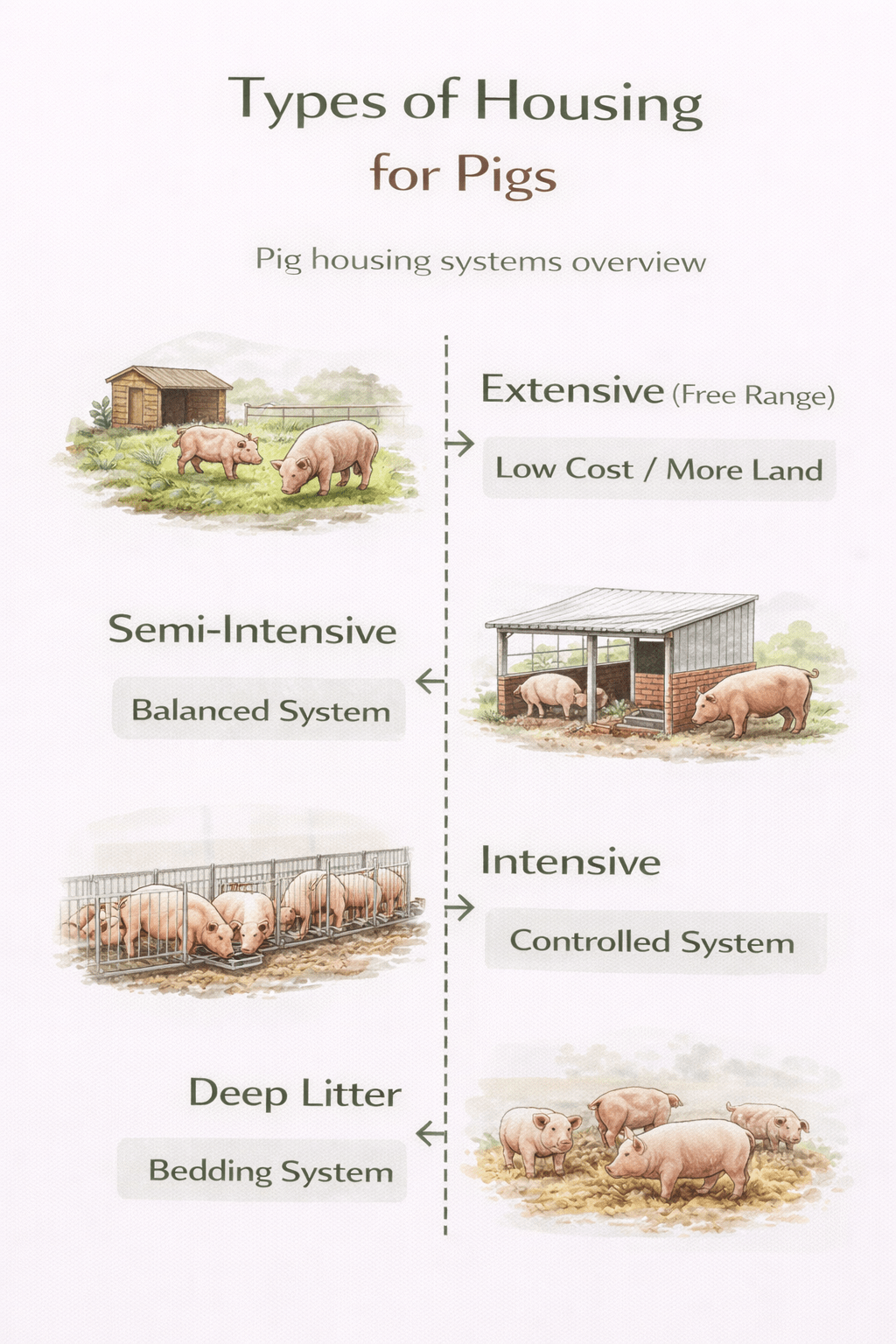
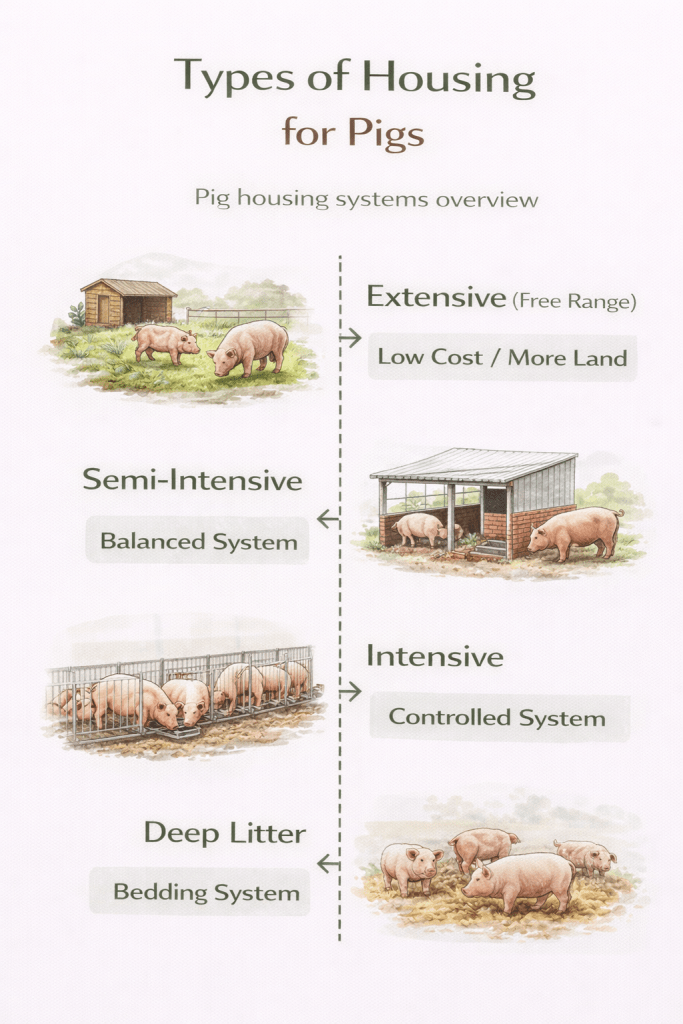
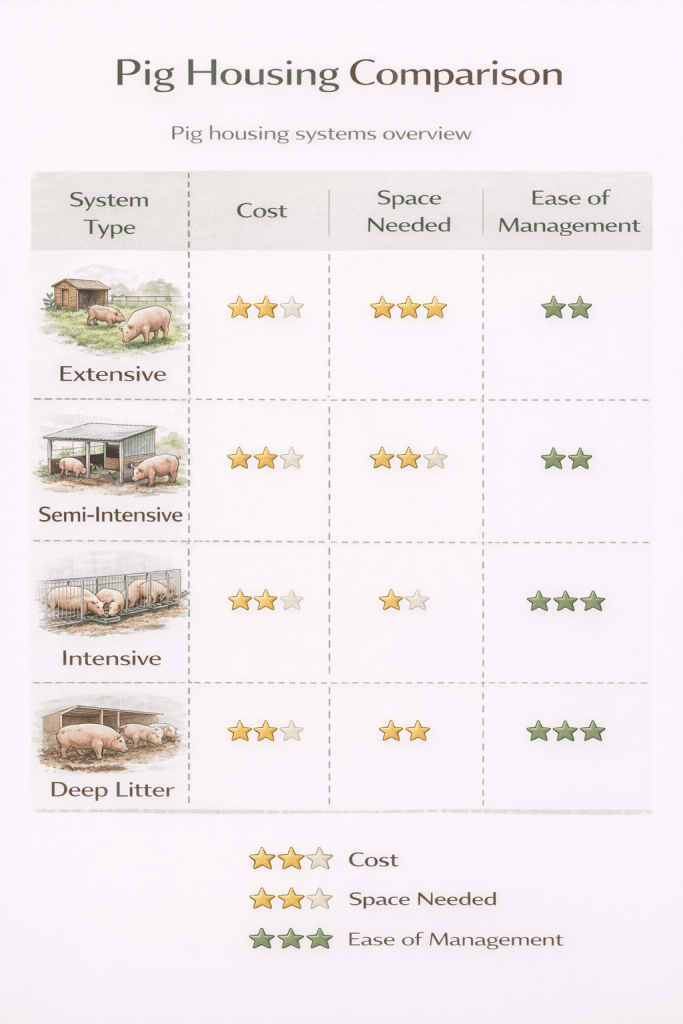
The four main types of housing for pigs are the extensive system, semi-intensive system, intensive system, and deep litter system. Each one works differently and suits different farm sizes and budgets. The best choice depends on your land, money, and how many pigs you plan to raise.
There is no single best system. The right one depends on your land, budget, and number of pigs.
Main Types of Housing for Pigs
1. Extensive System (Free Range)
In the extensive system, pigs are allowed to move freely across a large open area. They roam, root in the soil, and behave more naturally. There is usually a simple shelter – like a shed or hut – where they sleep or take cover from rain.
How it works:
- Pigs live and feed across a large open land area
- They find some of their own food by rooting in the ground
- You supplement with additional feed
- A basic shelter provides shade and rain cover
Good for:
- Farmers with a lot of land and a small number of pigs
- Very tight budgets – low cost to set up
- Farmers who want a low-maintenance system
Watch out for:
- Pigs can damage the land over time if the area is too small
- Harder to monitor individual animals for sickness
- Pigs are exposed to external diseases and predators
- Not suitable for high-density production
Free range = pigs roam freely on land. Low cost, but needs more space and harder to manage.
2. Semi-Intensive System
The semi-intensive system is a mix of the two extremes. Pigs have an indoor housing area; usually a pen or shelter but they also have access to an outdoor area where they can move around.
How it works:
- Pigs sleep and are fed inside a housing structure
- During the day, they can access a fenced outdoor run
- Waste management is easier than full free range
- You control feeding more closely than in extensive farming
Good for:
- Small to medium farms
- Farmers who want more control than free range but cannot afford full intensive housing
- Moderate budgets
Watch out for:
- Still needs decent land for the outdoor area
- Fencing costs add up
- Requires consistent feeding and monitoring
Semi-intensive = pigs have a pen to sleep in and an outdoor area to move around during the day. A middle-ground option.
3. Intensive System
In the intensive system, pigs are kept inside a pen or building at all times. Everything, from feeding to water to waste removal is managed within the housing structure. This is the most controlled type of pig housing.
How it works:
- Pigs stay inside a pen – they do not go outside
- Feeding and water are supplied inside the pen
- Waste is cleaned out regularly or managed through drainage systems
- You can monitor each pig closely
Good for:
- Serious, commercial-scale pig farming
- Farmers with limited land but enough capital (money to invest)
- Farms that need high productivity and close management
Watch out for:
- Higher setup cost – you need proper structures, drainage, and ventilation
- Poor design leads to overcrowding, bad air quality, and disease
- Requires consistent cleaning and waste management
- Pigs need enough space per animal – overcrowding is a common and costly mistake
Intensive = pigs stay inside a pen all the time. More control, higher cost, needs good design.
4. Deep Litter System
The deep litter system is a type of indoor pig housing where the pen floor is covered with a thick layer of bedding material – usually sawdust, rice husks, or wood shavings. Instead of cleaning out the waste every day, the bedding absorbs the waste and slowly breaks it down naturally.
This is one of the most practical housing options for small to medium pig farms in Africa.
How it works:
- The pen floor is covered with 30–70 cm of dry bedding material (sawdust, rice husks, or wood shavings)
- Pigs live on top of this bedding layer
- Waste falls into the bedding and is broken down by natural microorganisms – tiny living things in the bedding that eat and decompose waste
- You top up the bedding regularly and turn it over periodically
- After several months, the used bedding becomes compost – a natural fertilizer for your crops
Good for:
- Small and medium pig farms
- Farmers who want to reduce smell without chemicals
- Farms that want to produce their own compost
- Works well combined with IMO – Indigenous Microorganisms to speed up waste breakdown
Watch out for:
- Bedding must not get too wet – moisture management is critical
- Overcrowding ruins the system – pigs produce more waste than the bedding can absorb
- Rotting bedding is a real risk in pig pens, caused by high levels of water intake and discharge from animals, especially when pigs consistently pass solid waste in the same spot – leading to unpleasant odours and harmful gases
- You need to source bedding material regularly
Deep litter = thick layer of sawdust or husks on the floor. Waste breaks down naturally inside the bedding. Less cleaning, less smell, produces compost.
How to Improve Pig Housing Using Indigenous Microorganisms (IMO) – learn how to use natural microorganisms to make your deep litter system work even better.
Which Pig Housing System Should You Choose?
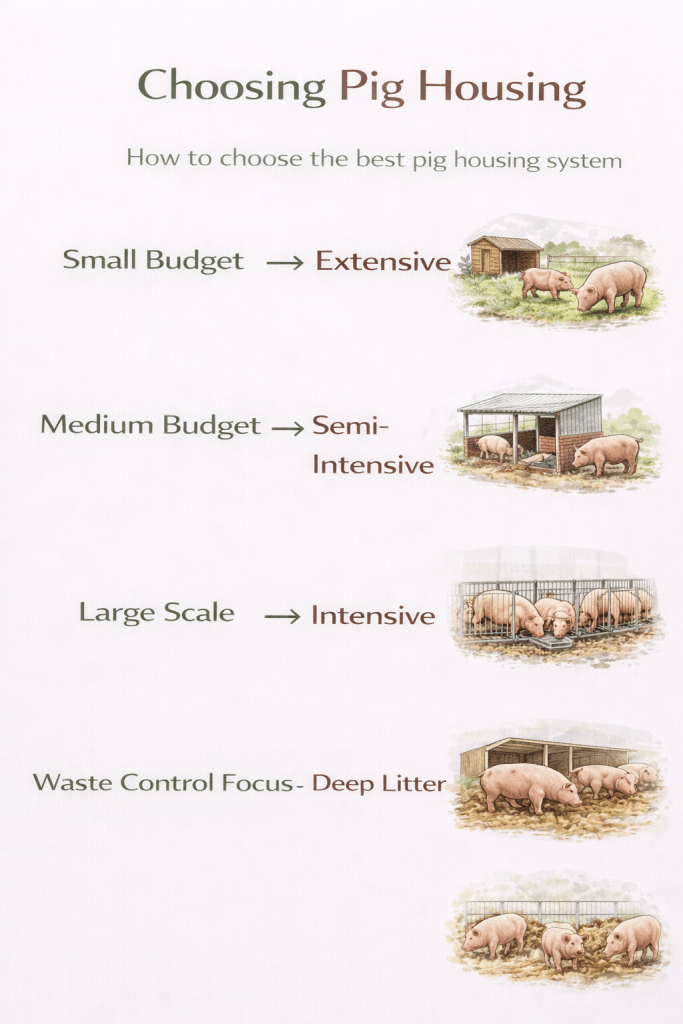
Here is a simple breakdown based on your situation:
If you have a small budget and a lot of land:
- Start with the extensive (free range) system
- Low cost to set up
- Good for a small number of pigs while you learn
If you have a moderate budget and some land:
- The semi-intensive system gives you more control
- Better for growing your herd gradually
- Easier to manage than full free range
If you are serious about pig farming as a business:
- The intensive system gives you the most control over production
- Higher setup cost, but higher output potential
- Requires good pen design, ventilation, and waste management
If you want low maintenance and natural waste management:
- The deep litter system is practical and cost-effective
- Works best for small to medium farms
- Pairs well with IMO for smell control and composting
Which pig housing system is best? There is no single best system. The right system depends on your budget, land size, and how many pigs you plan to raise. Beginners with small budgets do well with the extensive or semi-intensive system. Farmers ready to scale up benefit more from intensive or deep litter housing.
Features of Good Pig Housing
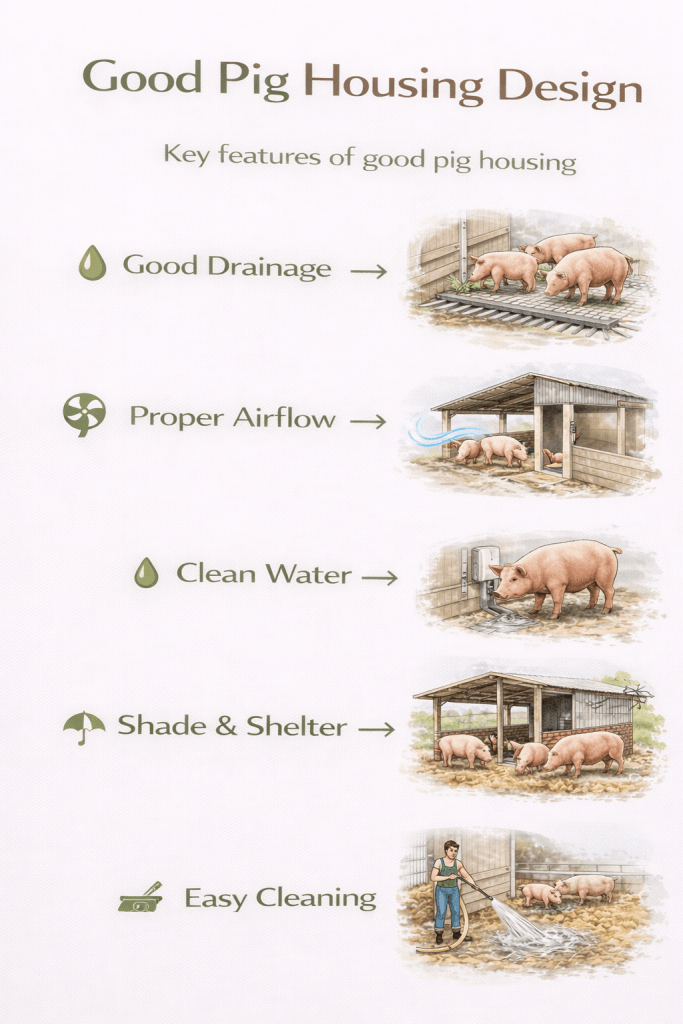
No matter which system you choose, your pig housing should have these features:
- Good drainage water and liquid waste must have somewhere to go; a flooded pen causes disease and smell problems fast
- Good airflow (ventilation) stale, hot air makes pigs uncomfortable and spreads respiratory (breathing-related) diseases; pens need windows, gaps, or open sides to allow fresh air in
- Clean water access pigs need fresh water every day; water points should be easy to clean and refill
- Protection from sun and rain a roof is not optional; pigs overheat quickly and get sick from cold, wet conditions
- Enough space per pig overcrowding is one of the most common mistakes in pig housing; each pig needs room to move, eat, and rest without competing
Common Mistakes in Pig Housing
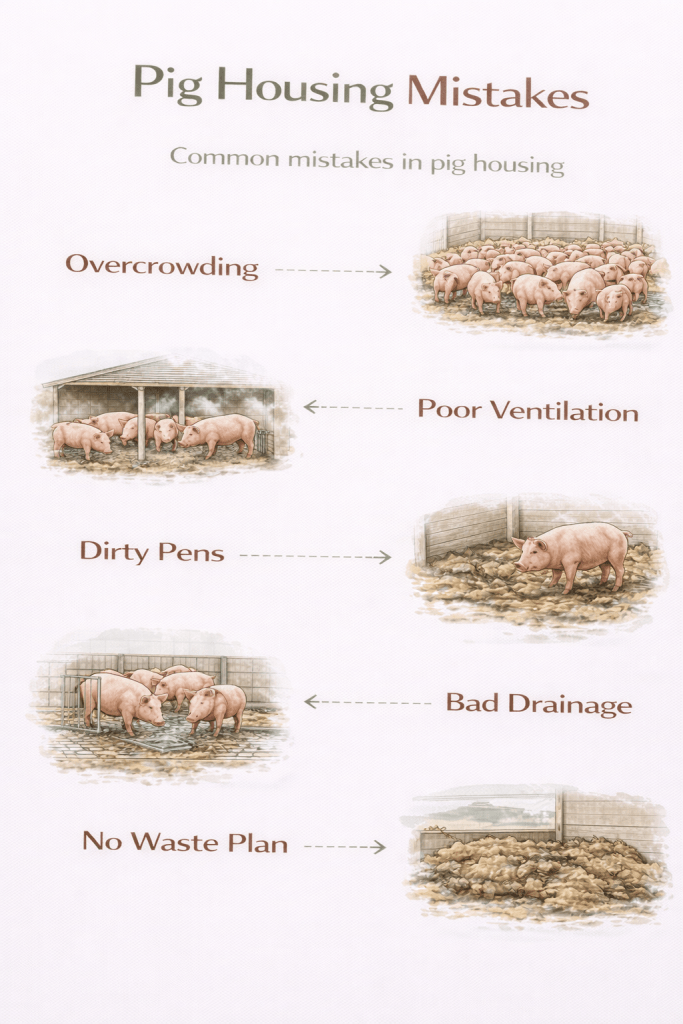
These mistakes cost pig farmers money every year:
- Overcrowding putting too many pigs in a small space causes stress, fighting, slow growth, and disease spread
- Poor ventilation closed, airless pens trap heat and harmful gases like ammonia (the gas that causes that sharp pig smell); this weakens pigs over time
- Dirty pens waste that is not managed properly breeds bacteria and flies
- Bad drainage pens that flood or stay wet are a breeding ground for disease
- No waste management plan if you do not plan where waste goes, it builds up and causes problems for your animals, your neighbours, and your soil
- Building before planning many farmers build a pen without thinking about how many pigs they will have, how they will feed them, or how they will clean the space
Simple Checklist Before Building Pig Housing
Go through this list before you spend a single naira on materials:
- [ ] How much land do I have available for housing?
- [ ] How many pigs am I starting with, and how many do I plan to have in 12 months?
- [ ] What is my budget for building materials?
- [ ] Do I have a clean, reliable water source close to the pen?
- [ ] What is my plan for managing waste? (drainage, composting, deep litter?)
- [ ] Is the location well-ventilated and protected from flooding?
- [ ] Will there be enough space per pig as my herd grows?
- [ ] Have I considered smell and how it might affect nearby homes or farms?
Frequently Asked Questions About Pig Housing
What is the cheapest type of pig housing?
The extensive (free range) system has the lowest setup cost. You need basic shelter materials and fencing. However, it works only if you have enough land and a small number of pigs.
Can I convert my deep litter pen to an intensive system later?
Yes. Many farmers start with a deep litter or semi-intensive system and upgrade as they grow. Plan your initial structure so expansion is possible.
How much space does one pig need?
A growing pig needs roughly 1 to 1.5 square metres of floor space. Sows (adult female pigs) with piglets need more – at least 4 to 6 square metres. These are minimum figures; more space is always better.
What flooring is best for a pig pen?
Concrete is the most common and practical choice for intensive pens – it is easy to clean and long-lasting. For deep litter systems, a concrete base under the bedding helps with drainage and hygiene.
Does pig housing affect how fast pigs grow?
Yes, directly. Research has shown that piglets raised in deep litter pig pens have average daily body weight gain, feed conversion, and survival rates equal to or better than those raised in conventional concrete floor pig houses. Comfortable pigs eat better and grow faster.
How do I control smell in a pig pen?
Good ventilation, proper drainage, and a waste management system are the foundation. If you use a deep litter system, combining it with indigenous microorganisms (IMO) is one of the most effective natural methods for reducing pig farm smell. Read more: How to Improve Pig Housing Using Indigenous Microorganisms (IMO).
Key Takeaways
- There are four main types of pig housing: extensive (free range), semi-intensive, intensive, and deep litter
- The right system depends on your land, budget, and number of pigs
- Good housing protects pigs, reduces disease, and makes farm management easier
- Deep litter is a practical, low-cost option for small to medium farms in Africa – it reduces smell and produces compost
- The most common and costly mistakes are overcrowding, poor ventilation, and no waste management plan
- Plan your housing before you build – changes are expensive once the structure is up
Final Word
The type of housing you choose for your pigs is one of the most important decisions you will make as a pig farmer. Get it right and your farm runs more smoothly, your pigs grow better, and your costs stay lower. Get it wrong and you spend more time fixing problems than farming.
If you are just starting, keep it simple. Start with a system that fits your budget and land. Learn how it works. Then grow from there.
A well-housed pig is a productive pig.
Want to go deeper? See our complete guide to starting a pig farm, and read also is pig farming profitable? Cost, profit, and beginner guide.


Leave a Reply