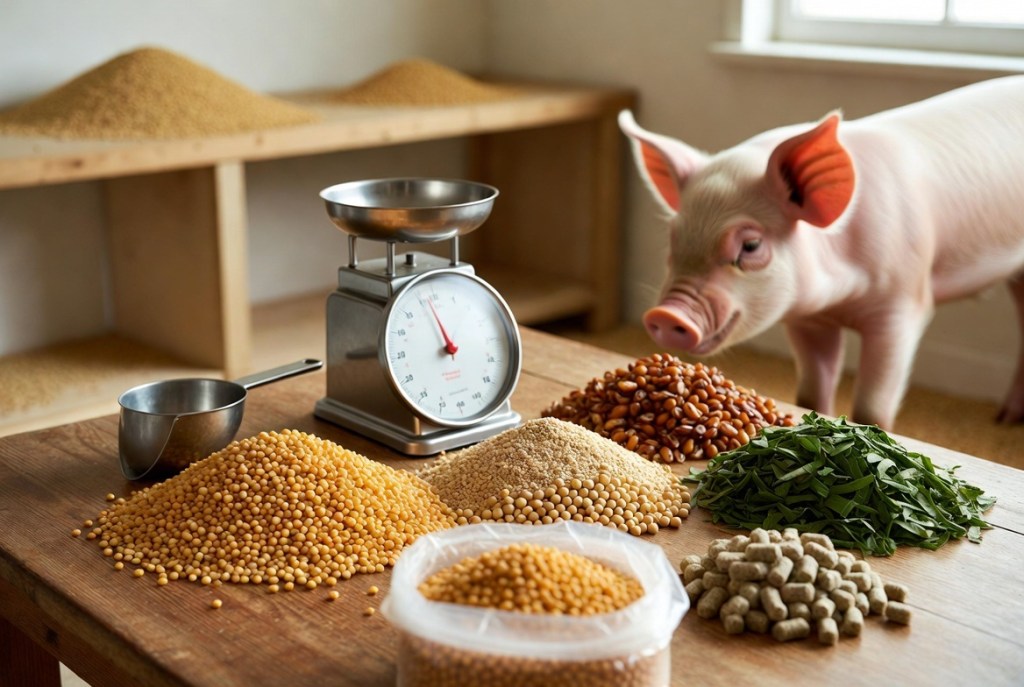
Feed accounts for 60 to 70% of your total pig farming cost. Get pig feed formulation right, and you control the single biggest lever for both growth rate and profit. Get it wrong, and no amount of good housing or breeding will save your margins. Here’s how to feed pigs properly at each growth stage using ingredients you can actually source in Nigeria.
Feeding by growth stage
A pig’s protein needs drop as it matures. Feeding a finisher-stage diet to a weaner stunts growth, and feeding a weaner-stage diet to a finisher wastes money on protein the pig no longer needs at that intensity.
| Stage | Crude protein target | Focus |
|---|---|---|
| Weaner | Around 18–20% | Highly digestible, nutrient-dense feed to support rapid early growth and gut development |
| Grower | Around 17% | Balanced energy and protein for steady muscle and bone development |
| Finisher | Lower than grower stage | More energy, less protein, since growth needs shift toward finishing weight rather than lean tissue development |
Feed twice a day, morning and evening, regardless of stage. With a well-formulated diet, pigs typically convert around 3kg of feed into 1kg of weight gain, a ratio worth tracking to know whether your formulation is actually working.
Key ingredients available in Nigeria
| Ingredient | Contribution | Notes |
|---|---|---|
| Maize | Main energy source, around 10% crude protein | Must be properly dried before use |
| Soybean meal | Major plant protein source, around 45% crude protein | One of the two main protein backbones in most local formulations |
| Groundnut cake | Plant protein source, around 45% crude protein | Guard carefully against mold; spoiled groundnut cake carries aflatoxin risk |
| Fish meal | Animal protein, rich in amino acids, calcium, and phosphorus | More commonly and affordably available near coastal or riverine areas |
| Palm kernel cake (PKC) | Protein and fiber, around 18% crude protein | Cheap and widely used as a major formulation component in Nigeria |
| Wheat offal / rice bran | Complementary energy source, higher fiber, lower energy than maize | Useful filler and fiber source rather than a primary energy ingredient |
| Crushed shells / bone meal | Calcium source | Supports bone development, especially important at growing stages |
| Vitamin-mineral premix | Essential vitamins and minerals | Not optional; skipping this shows up as slower growth and weaker immunity |
A practical grower ration, on a 100kg batch basis
This is a starting reference for a locally-sourced grower formulation, targeting around 17% crude protein. Adjust based on what’s available and priced well in your area.
- Maize: 60kg
- Soybean meal: 20kg
- Rice bran: 8kg
- Palm kernel cake: 5kg
- Crushed shells: 3kg
- Lysine: 0.25kg
- Vitamin-mineral premix: 0.8kg
- Toxin binder: 0.2kg
- Salt: 0.5kg
The toxin binder deserves attention: it protects against mycotoxins that can contaminate maize and other grains, especially important given Nigeria’s humid storage conditions.
Adjusting for your region and season
- Near water bodies: Fish meal tends to be more affordable and available, making it a stronger protein choice in coastal or riverine areas.
- Hot season: Reduce oils and fats in the formulation; higher fat intake in intense heat can cause digestive issues for pigs.
- Humid conditions: Prioritize proper feed storage. Mold growth in stored maize or groundnut cake is a real risk in high humidity, and moldy feed carries aflatoxin danger, not just wasted money.
- Limited soybean or fish meal access: Groundnut cake can substitute as your main protein source, provided it’s stored properly and mold-free.
Mistakes that cost pig farmers the most
- Feeding the wrong protein level for the growth stage. Overfeeding protein to older pigs wastes money; underfeeding it to young pigs stunts growth permanently.
- Skipping the vitamin-mineral premix to save cost. This is one of the smallest line items in your formulation and one of the most consequential to cut.
- Storing feed poorly in humid conditions. Mold isn’t just spoilage, it introduces aflatoxin risk that can harm your pigs and, ultimately, anyone eating the pork.
- Ignoring feed conversion tracking. If you’re not tracking roughly how much feed produces how much weight gain, you have no way of knowing whether your formulation is actually working.
- Copying a formulation without adjusting for local ingredient availability and pricing. The right formulation is the one that balances nutrition with what’s actually affordable and available where you farm.
For the full picture on getting started with pig farming, including housing, breeds, and market planning, see our beginner’s guide to pig farming.
Key takeaways
- Feed is 60 to 70% of your total pig farming cost, making formulation your biggest lever for profit.
- Protein needs drop as pigs mature: roughly 18–20% for weaners, 17% for growers, and less for finishers.
- Maize, soybean meal, groundnut cake, fish meal, and palm kernel cake form the backbone of most Nigerian pig feed formulations.
- Adjust for your region: more fish meal near water bodies, less fat in hot weather, and careful storage in humid conditions to prevent mold and aflatoxin risk.
- Track your feed conversion ratio, roughly 3kg of feed per 1kg of weight gain is a reasonable benchmark, to know whether your formulation is actually working.
FAQ
What is the ideal protein percentage for pig feed?
It depends on the growth stage. Weaners need around 18 to 20% crude protein, growers around 17%, and finishers need less protein and more energy as they approach market weight.
What are the best local ingredients for pig feed in Nigeria?
Maize for energy, soybean meal and groundnut cake for plant protein, fish meal for animal protein, and palm kernel cake as an affordable protein and fiber source are the main building blocks used across Nigerian pig farms.
How often should I feed my pigs?
Twice a day, morning and evening, is the standard feeding schedule regardless of growth stage.
Why is a vitamin-mineral premix necessary in pig feed?
Premix supplies essential vitamins and minerals, including calcium and zinc, that support bone development and immunity. Skipping it to cut cost shows up later as slower growth and weaker disease resistance, making it a false saving.
How much feed does it take to produce 1kg of pork?
With a well-formulated diet, pigs typically convert around 3kg of feed into 1kg of weight gain. Tracking this ratio on your own farm is a practical way to check whether your feed formulation is working as intended.


Leave a Reply