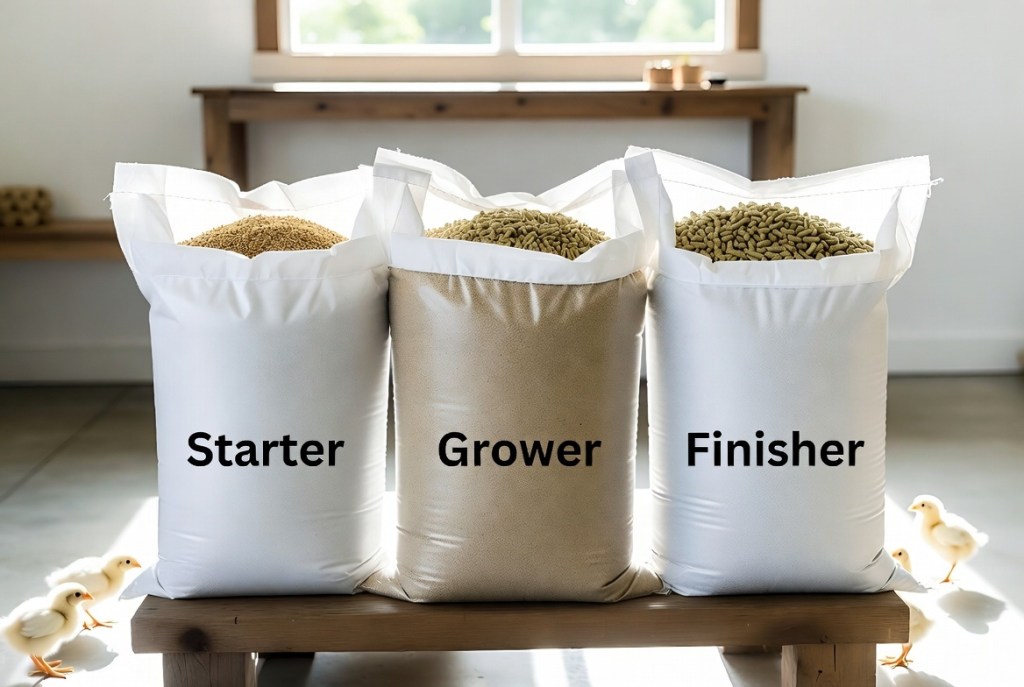
Feed makes up roughly 70% of your total broiler production cost. Get broiler feed formulation right at each growth stage, and you control the single biggest lever for both growth rate and profit margin. Broilers need considerably more protein than layers or general chick mash, so feeding the wrong formula, or just reusing layer feed, costs you weeks of growth and a chunk of your feed budget.
Broiler Vs Layers: which one is more profitable?
Feeding by growth stage
Broiler protein needs start high and decrease as birds mature, while energy needs increase to support fat deposition and rapid weight gain.
| Stage | Protein target | Energy target | Form |
|---|---|---|---|
| Starter (0-3 weeks) | 22-24% | Around 3,000 kcal/kg | Crumble or mash for easy consumption by young chicks |
| Grower (3-5 weeks) | 20-22% | Around 3,100 kcal/kg | Pellet or mash for better feed intake |
| Finisher (5 weeks to market) | 18-20% | Highest energy density of the three stages | Pellet, focused on fat deposition and final weight gain |
Chick mash formulated for layers isn’t a good substitute for broiler starter. It typically carries only 18-20% protein against the 22-24% broilers actually need at that stage, and using it will slow early growth even if you correct the diet later.
A practical starter and grower formulation
Starter (percentages, scale to your batch size):
- Maize: 50% (primary energy source)
- Soybean meal: 25% (main protein source)
- Fishmeal: 10% (concentrated protein for rapid growth)
- Vegetable oil: 3-5% (extra energy and fatty acids)
- Limestone: 1.5% (calcium for bone development)
- Dicalcium phosphate: 1%
- Salt: 0.5%
- Vitamin-mineral premix: 1-2%
Grower:
- Maize: 55%
- Soybean meal: 20%
- Fishmeal or meat and bone meal: 5%
- Vegetable oil: 3%
- Limestone: 1%
- Dicalcium phosphate: 1%
- Salt: 0.5%
- Vitamin-mineral premix: 1%
Grind maize and soybean meal to a fine, even consistency and mix thoroughly, making sure the premix is distributed evenly through the whole batch, not concentrated in one section.
How to calculate Metabolisable energy and crude protein in livestock feed.
Finisher stage and local cost-saving substitutes
Finisher feed drops protein slightly (18-20%) while pushing energy density higher to support final weight gain. This is also where local ingredient substitutes genuinely help your margins:
- Cassava meal can replace up to 20% of the maize in finisher feed, a useful cost lever given how widely available cassava is across Nigeria.
- Palm kernel cake works as a fiber source in finisher feed, but keep it to 5-8% of the mix; more than that can hurt digestibility.
The most cost-effective broiler feeds generally lean on local grains like maize and wheat offal for energy, paired with budget-friendly protein sources like fishmeal and soybean meal, rather than imported specialty ingredients.
Why tracking feed conversion ratio matters
Feed conversion ratio (FCR) measures how much feed it takes to produce a kilogram of bird weight, and it’s the clearest sign of whether your formulation is actually working. Typical benchmarks run roughly 1 to 1.1 at 0.5kg body weight, 1.25 to 1.4 at 1kg, and 1.4 to 1.55 at 2kg. Even a 0.1 improvement in FCR can lift profitability by 8 to 12% per production cycle, which makes tracking it every batch worth the extra five minutes with a scale and a notebook.
For breed selection to pair with your feeding plan, see our guide on best poultry breeds for Nigerian farmers.
Mistakes that cost broiler farmers the most
- Using layer chick mash for broiler chicks. The protein level is too low for what broilers actually need at that stage, and it shows up as slower early growth.
- Not tracking FCR. Without measuring how much feed produces how much weight gain, you have no way to know if your formulation is working or quietly costing you money.
- Ignoring local substitutes. Cassava meal and palm kernel cake can meaningfully cut costs in finisher feed without hurting performance, when used within the right proportions.
- Uneven premix mixing. Poorly distributed premix means some birds get too little of the vitamins and minerals they need while others get too much.
Key takeaways
- Feed is roughly 70% of your total broiler production cost, making formulation your biggest lever for profit.
- Protein needs drop as birds mature: 22-24% at starter, 20-22% at grower, 18-20% at finisher, while energy needs rise.
- Layer chick mash is not a substitute for broiler starter; its protein level is too low for what broilers need.
- Cassava meal (up to 20% of finisher feed) and palm kernel cake (5-8%) are genuine local cost-saving substitutes.
- Track your feed conversion ratio every batch; a 0.1 improvement can lift profit by 8-12% per cycle.
FAQ
What protein level do broiler chicks need?
Broiler starter feed should carry 22-24% protein, considerably higher than the 18-20% found in typical layer chick mash. Using layer feed for broiler chicks will slow their growth.
Can I use cassava in broiler feed?
Yes. Cassava meal can replace up to 20% of the maize in finisher feed, making it a useful, widely available cost-saving substitute in Nigeria.
What is a good feed conversion ratio for broilers?
Typical benchmarks are roughly 1 to 1.1 at 0.5kg body weight, 1.25 to 1.4 at 1kg, and 1.4 to 1.55 at 2kg. Even a small improvement of 0.1 in your FCR can raise profitability by 8-12% per production cycle.
How much palm kernel cake can I use in broiler feed?
Keep palm kernel cake to 5-8% of finisher feed. It works well as a fiber source within that range, but higher inclusion can hurt digestibility.
Why does broiler feed change across growth stages?
Young broilers need high protein to build muscle and tissue quickly. As they mature, their energy needs rise to support fat deposition and final weight gain, while their protein requirement gradually decreases.
Kiki’s Agroplace: Bridging the knowledge gap in agriculture.


Leave a Reply